Dorothea E. von Mücke – författare
Visar alla böcker från författaren Dorothea E. von Mücke. Handla med fri frakt och snabb leverans.
4 produkter
4 produkter
Del 13 - Harvard University Press Reference Library
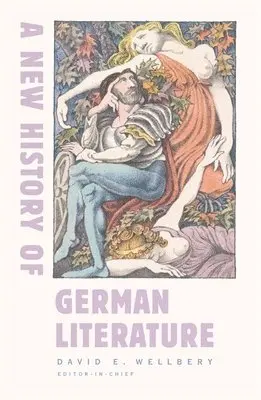
New History of German Literature
Inbunden, Engelska, 2005
517 kr
Skickas inom 7-10 vardagar
The revolutionary spirit that animates the culture of the Germans has been alive for at least twelve centuries, far longer than the dramatically fragmented and reshaped political entity known as Germany. German culture has been central to Europe, and it has contributed the transforming spirit of Lutheran religion, the technology of printing as a medium of democracy, the soulfulness of Romantic philosophy, the structure of higher education, and the tradition of liberal socialism to the essential character of modern American life.In this book leading scholars and critics capture the spirit of this culture in some 200 original essays on events in German literary history. Rather than offering a single continuous narrative, the entries focus on a particular literary work, an event in the life of an author, a historical moment, a piece of music, a technological invention, even a theatrical or cinematic premiere. Together they give the reader a surprisingly unified sense of what it is that has allowed Meister Eckhart, Hildegard of Bingen, Luther, Kant, Goethe, Beethoven, Benjamin, Wittgenstein, Jelinek, and Sebald to provoke and enchant their readers. From the earliest magical charms and mythical sagas to the brilliance and desolation of 20th-century fiction, poetry, and film, this illuminating reference book invites readers to experience the full range of German literary culture and to investigate for themselves its disparate and unifying themes.Contributors include: Amy M. Hollywood on medieval women mystics, Jan-Dirk Müller on Gutenberg, Marion Aptroot on the Yiddish Renaissance, Emery Snyder on the Baroque novel, J. B. Schneewind on Natural Law, Maria Tatar on the Grimm brothers, Arthur Danto on Hegel, Reinhold Brinkmann on Schubert, Anthony Grafton on Burckhardt, Stanley Corngold on Freud, Andreas Huyssen on Rilke, Greil Marcus on Dada, Eric Rentschler on Nazi cinema, Elisabeth Young-Bruehl on Hannah Arendt, Gordon A. Craig on Günter Grass, Edward Dimendberg on Holocaust memorials.
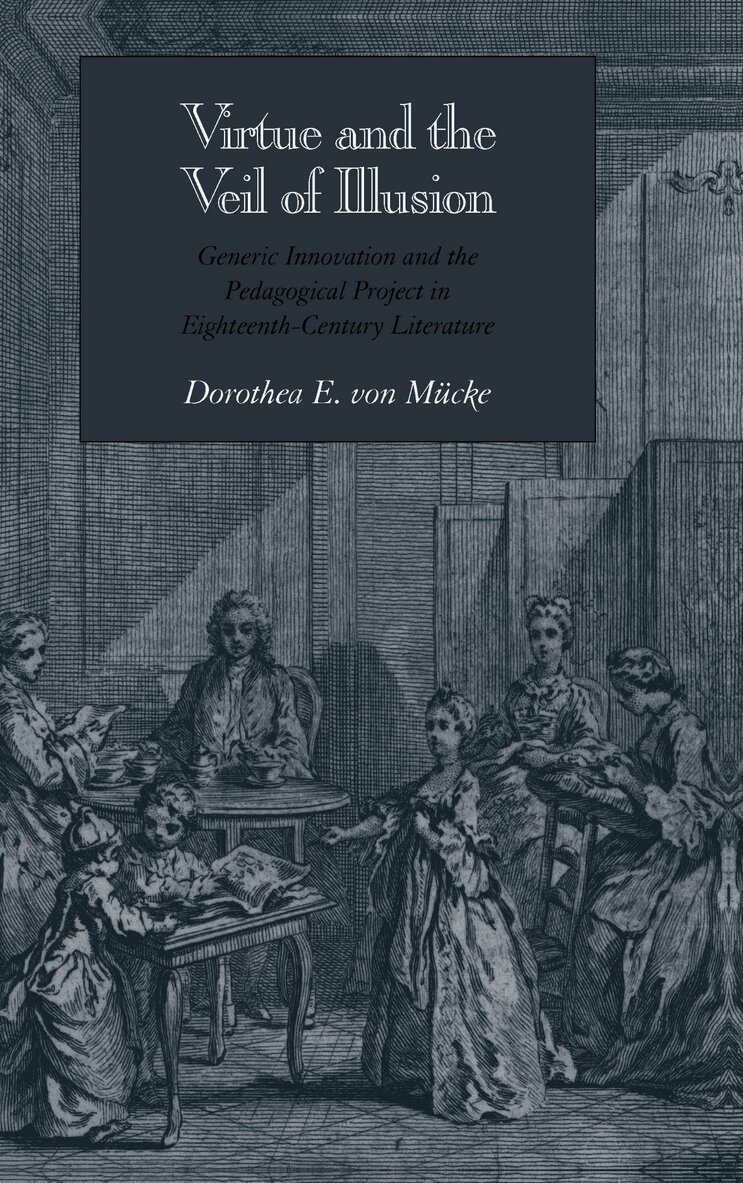
Virtue and the Veil of Illusion
Generic Innovation and the Pedagogical Project in Eighteenth-Century Literature
Inbunden, Engelska, 1991
918 kr
Skickas inom 7-10 vardagar
A Stanford University Press classic.
1 706 kr
Skickas inom 7-10 vardagar
The emergence of the fantastic tale in the late eighteenth and early nineteenth centuries reflects a growing fascination with the supernatural, the marvelous, and the occult as the site for literary innovation. Taking Jacques Cazotte's prototypical The Devil in Love as a starting point, this book examines the genre's early development in the fantastic tales of the German romantics Ludwig Tieck, Achim von Arnim, and E. T. A. Hoffmann; the subsequent French rediscovery of the genre in works by Théophile Gautier and Prosper Mérimée; and Edgar Allan Poe's contributions to the new literary form.The literary innovation of the fantastic tale contributed to the production of a mode of subjectivity intrinsic to the history of sexuality. It arose at a moment in the history of communication when similarity and perfect openness were no longer considered the unquestioned basis of friendship or love, when the other's potentially dark secrets became seductive and fascinating.
417 kr
Skickas inom 7-10 vardagar
The emergence of the fantastic tale in the late eighteenth and early nineteenth centuries reflects a growing fascination with the supernatural, the marvelous, and the occult as the site for literary innovation. Taking Jacques Cazotte's prototypical The Devil in Love as a starting point, this book examines the genre's early development in the fantastic tales of the German romantics Ludwig Tieck, Achim von Arnim, and E. T. A. Hoffmann; the subsequent French rediscovery of the genre in works by Théophile Gautier and Prosper Mérimée; and Edgar Allan Poe's contributions to the new literary form.The literary innovation of the fantastic tale contributed to the production of a mode of subjectivity intrinsic to the history of sexuality. It arose at a moment in the history of communication when similarity and perfect openness were no longer considered the unquestioned basis of friendship or love, when the other's potentially dark secrets became seductive and fascinating.