Anton Kaes - Böcker
Visar alla böcker från författaren Anton Kaes. Handla med fri frakt och snabb leverans.
9 produkter
9 produkter
443 kr
Skickas inom 7-10 vardagar
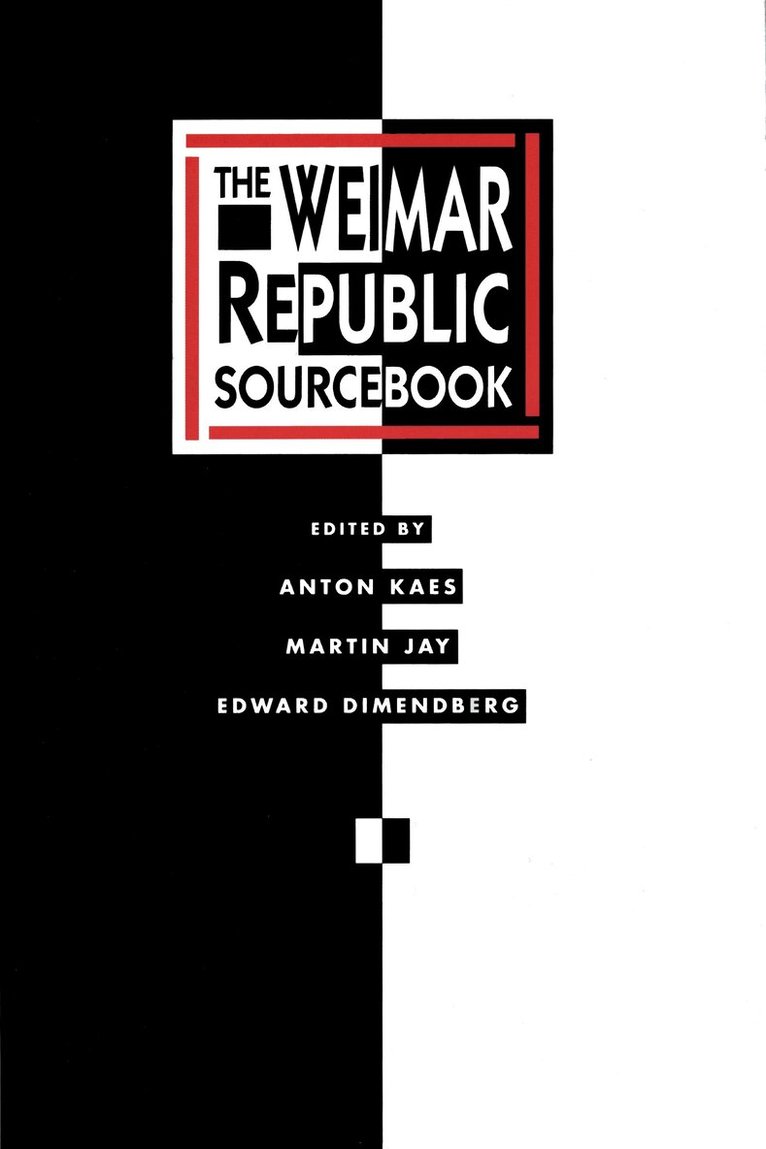
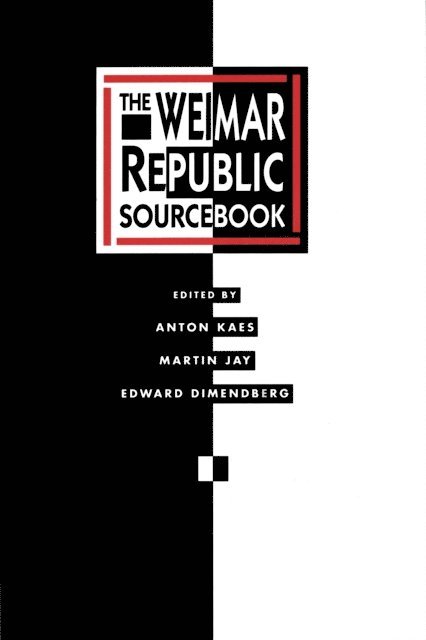
A laboratory for competing visions of modernity, the Weimar Republic (1918-1933) continues to haunt the imagination of the twentieth century. Its political and cultural lessons retain uncanny relevance for all who seek to understand the tensions and possibilities of our age. "The Weimar Republic Sourcebook" represents the most comprehensive documentation of Weimar culture, history, and politics assembled in any language. It invites a wide community of readers to discover the richness and complexity of the turbulent years in Germany before Hitler's rise to power. Drawing from such primary sources as magazines, newspapers, manifestos, and official documents (many unknown even to specialists and most never before available in English), this book challenges the traditional boundaries between politics, culture, and social life. Its thirty chapters explore Germany's complex relationship to democracy, ideologies of 'reactionary modernism', the rise of the 'New Woman', Bauhaus architecture, the impact of mass media, the literary life, the tradition of cabaret and urban entertainment, and the situation of Jews, intellectuals, and workers before and during the emergence of fascism.While devoting much attention to the Republic's varied artistic and intellectual achievements (the Frankfurt School, political theater, twelve-tone music, cultural criticism, photomontage, and urban planning), the book is unique for its inclusion of many lesser-known materials on popular culture, consumerism, body culture, drugs, criminality, and sexuality; it also contains a timetable of major political events, an extensive bibliography, and capsule biographies. This will be a major resource and reference work for students and scholars in history; art; architecture; literature; social and political thought; and, cultural, film, German, and women's studies.
Del 49 - Weimar & Now: German Cultural Criticism
Promise of Cinema
German Film Theory, 1907–1933
Inbunden, Engelska, 2016
1 281 kr
Skickas inom 7-10 vardagar
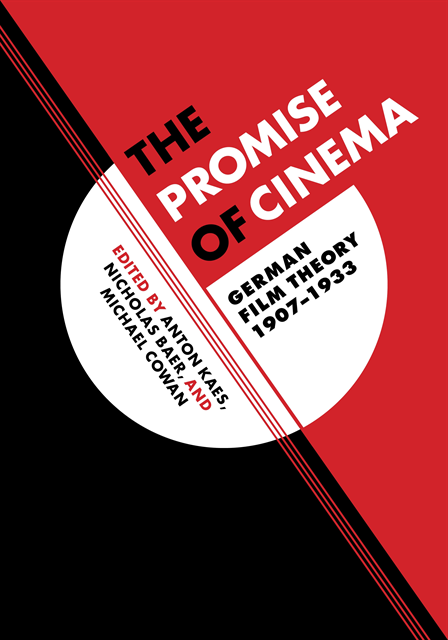
Rich in implications for our present era of media change, the Promise of Cinema offers a compelling new vision of film theory. The volume conceives of "theory" not as a fixed body of canonical texts, but as a dynamic set of reflections on the very idea of cinema and the possibilities once associated with it. Unearthing more than 275 early-twentieth-century German texts, this ground-breaking documentation leads readers into a world that was striving to assimilate modernity's most powerful new medium. We encounter lesser-known essays by Bela Balazs, Walter Benjamin, and Siegfried Kracauer alongside interventions from the realms of aesthetics, education, industry, politics, science, and technology. The book also features programmatic writings from the Weimar avant-garde and from directors such as Fritz Lang and F.W. Murnau. Nearly all documents appear in English for the first time; each is meticulously introduced and annotated. The most comprehensive collection of German writings on film published to date, the Promise of Cinema is an essential resource for students and scholars of film and media, critical theory, and European culture and history.
Del 49 - Weimar & Now: German Cultural Criticism
Promise of Cinema
German Film Theory, 1907–1933
Häftad, Engelska, 2016
729 kr
Skickas inom 7-10 vardagar
Rich in implications for our present era of media change, the Promise of Cinema offers a compelling new vision of film theory. The volume conceives of "theory" not as a fixed body of canonical texts, but as a dynamic set of reflections on the very idea of cinema and the possibilities once associated with it. Unearthing more than 275 early-twentieth-century German texts, this ground-breaking documentation leads readers into a world that was striving to assimilate modernity's most powerful new medium. We encounter lesser-known essays by Bela Balazs, Walter Benjamin, and Siegfried Kracauer alongside interventions from the realms of aesthetics, education, industry, politics, science, and technology. The book also features programmatic writings from the Weimar avant-garde and from directors such as Fritz Lang and F.W. Murnau. Nearly all documents appear in English for the first time; each is meticulously introduced and annotated. The most comprehensive collection of German writings on film published to date, The Promise of Cinema is an essential resource for students and scholars of film and media, critical theory, and European culture and history.
Del 40 - Weimar & Now: German Cultural Criticism
Germany in Transit
Nation and Migration, 1955-2005
Häftad, Engelska, 2007
669 kr
Skickas inom 3-6 vardagar
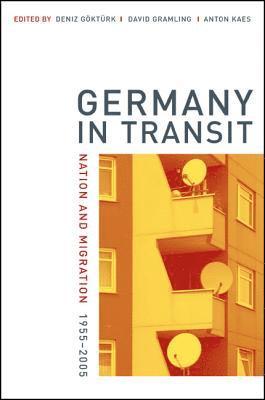
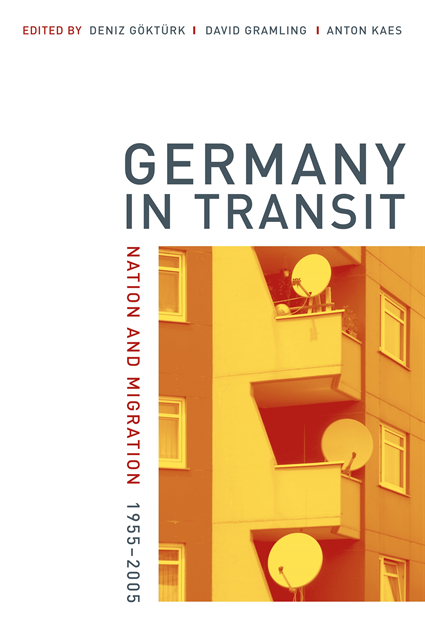
How does migration change a nation? "Germany in Transit" is the first sourcebook to illuminate the country's transition into a multiethnic society - from the arrival of the first guest workers in the mid-1950s to the most recent reforms in immigration and citizenship law. The book charts the highly contentious debates about migrant labor, human rights, multiculturalism, and globalization that have unfolded in Germany over the past fifty years - debates that resonate far beyond national borders. This cultural history in documents offers a rich archive for the comparative study of modern Germany against the backdrop of European integration, transnational migration, and the fall of the Berlin Wall. Divided into eleven thematic chapters, "Germany in Transit" includes 200 original texts in English translation, as well as a historical introduction, chronology, glossary, bibliography, and filmography.
Del 13 - Harvard University Press Reference Library
New History of German Literature
Inbunden, Engelska, 2005
523 kr
Skickas inom 7-10 vardagar
The revolutionary spirit that animates the culture of the Germans has been alive for at least twelve centuries, far longer than the dramatically fragmented and reshaped political entity known as Germany. German culture has been central to Europe, and it has contributed the transforming spirit of Lutheran religion, the technology of printing as a medium of democracy, the soulfulness of Romantic philosophy, the structure of higher education, and the tradition of liberal socialism to the essential character of modern American life.In this book leading scholars and critics capture the spirit of this culture in some 200 original essays on events in German literary history. Rather than offering a single continuous narrative, the entries focus on a particular literary work, an event in the life of an author, a historical moment, a piece of music, a technological invention, even a theatrical or cinematic premiere. Together they give the reader a surprisingly unified sense of what it is that has allowed Meister Eckhart, Hildegard of Bingen, Luther, Kant, Goethe, Beethoven, Benjamin, Wittgenstein, Jelinek, and Sebald to provoke and enchant their readers. From the earliest magical charms and mythical sagas to the brilliance and desolation of 20th-century fiction, poetry, and film, this illuminating reference book invites readers to experience the full range of German literary culture and to investigate for themselves its disparate and unifying themes.Contributors include: Amy M. Hollywood on medieval women mystics, Jan-Dirk Müller on Gutenberg, Marion Aptroot on the Yiddish Renaissance, Emery Snyder on the Baroque novel, J. B. Schneewind on Natural Law, Maria Tatar on the Grimm brothers, Arthur Danto on Hegel, Reinhold Brinkmann on Schubert, Anthony Grafton on Burckhardt, Stanley Corngold on Freud, Andreas Huyssen on Rilke, Greil Marcus on Dada, Eric Rentschler on Nazi cinema, Elisabeth Young-Bruehl on Hannah Arendt, Gordon A. Craig on Günter Grass, Edward Dimendberg on Holocaust memorials.
410 kr
Skickas inom 10-15 vardagar
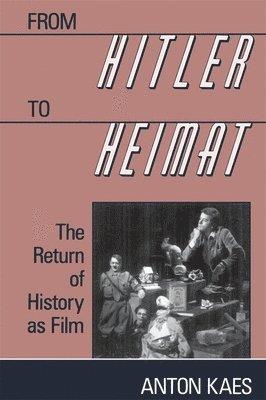
West German filmmakers have tried to repeatedly over the past half-century to come to terms with Germany’s stigmatized history. How can Hitler and the Holocaust, how can the complicity and shame of the average German be narrated and visualized? How can Auschwitz be reconstructed? Anton Kaes argues that a major shift in German attitudes occurred in the mid-1970s—a shift best illustrated in films of the New German Cinema, which have focused less on guilt and atonement than on personal memory and yearning for national identity.To support his claim, Kaes devotes a chapter to each of five complex and celebrated films of the modern German era: Hans Jürgen Syberberg's Hitler, a Film from Germany, a provocative restaging of German history in postmodern tableaux; The Marriage of Maria Braun, the personal and political reflection on postwar Germany with which Rainer Werner Fassbinder first caught the attention of American and European audiences; Helma Sanders-Brahms's feminist and autobiographical film Germany, Pale Mother, relating the unexplored role of German women during and after the war; Alexander Kluge's The Patriot, a self-reflexive collage of verbal and visual quotations from the entire course of the German past; and, finally, Edgar Reitz's Heimat, a 16-hour epic rendering of German history from 1918 to the present from the perspective of everyday life in the provinces.Despite radical differences in style and form, these films are all concerned with memory, representation, and the dialogue between past and present Kaes draws from a variety of disciplines, interweaving textual interpretation, cultural history, and current theory to create a dynamic approach to highly complex and multi-voiced films. His book will engage readers interested in postwar German history, politics, and culture; in film and media studies; and in the interplay of history, memory, and film.
296 kr
Skickas inom 7-10 vardagar
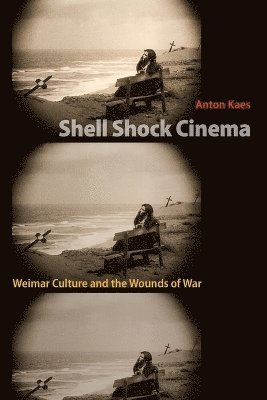
Shell Shock Cinema explores how the classical German cinema of the Weimar Republic was haunted by the horrors of World War I and the the devastating effects of the nation's defeat. In this exciting new book, Anton Kaes argues that masterworks such as The Cabinet of Dr. Caligari, Nosferatu, The Nibelungen, and Metropolis, even though they do not depict battle scenes or soldiers in combat, engaged the war and registered its tragic aftermath. These films reveal a wounded nation in post-traumatic shock, reeling from a devastating defeat that it never officially acknowledged, let alone accepted. Kaes uses the term "shell shock"--coined during World War I to describe soldiers suffering from nervous breakdowns--as a metaphor for the psychological wounds that found expression in Weimar cinema. Directors like Robert Wiene, F. W. Murnau, and Fritz Lang portrayed paranoia, panic, and fear of invasion in films peopled with serial killers, mad scientists, and troubled young men.Combining original close textual analysis with extensive archival research, Kaes shows how this post-traumatic cinema of shell shock transformed extreme psychological states into visual expression; how it pushed the limits of cinematic representation with its fragmented story lines, distorted perspectives, and stark lighting; and how it helped create a modernist film language that anticipated film noir and remains incredibly influential today. A compelling contribution to the cultural history of trauma, Shell Shock Cinema exposes how German film gave expression to the loss and acute grief that lay behind Weimar's sleek facade.
181 kr
Skickas
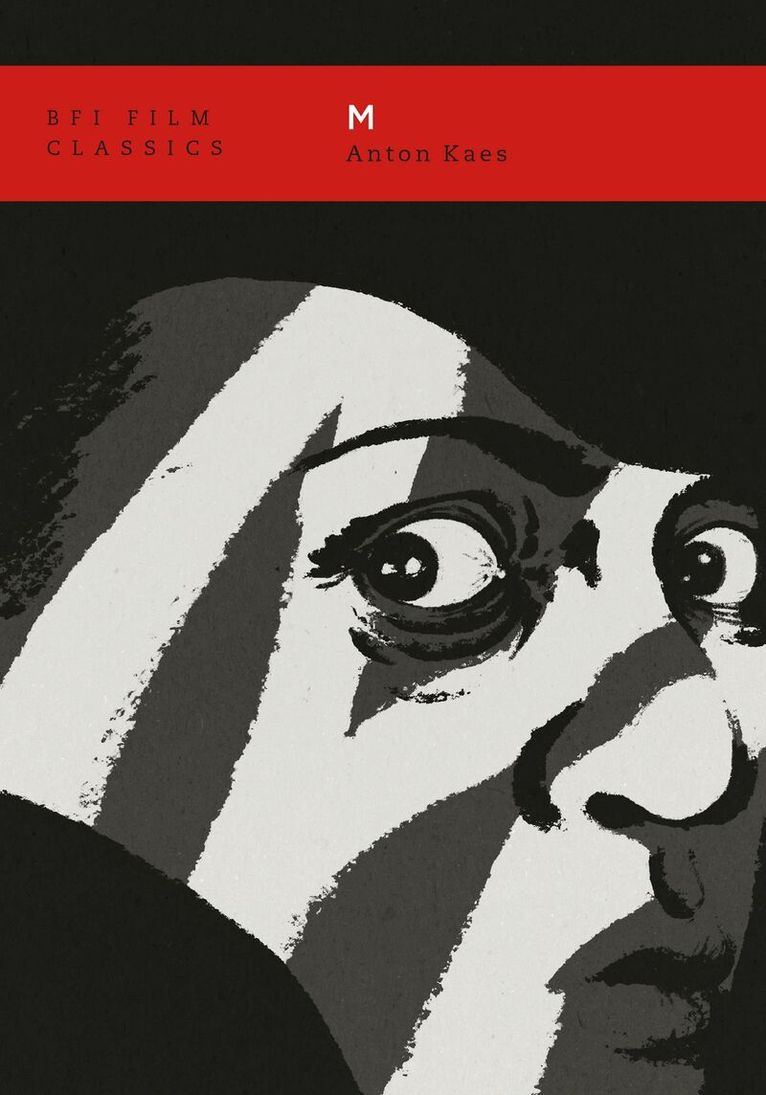
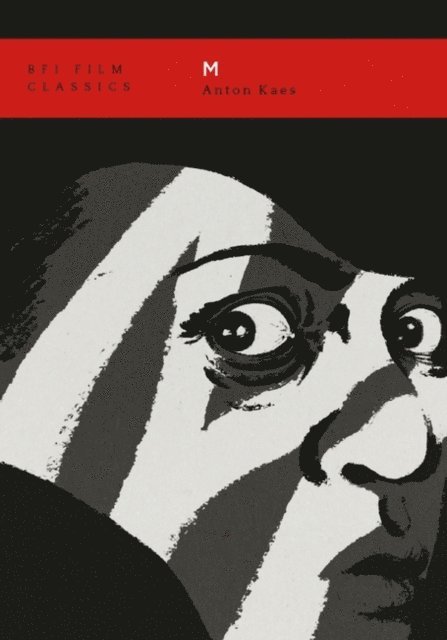
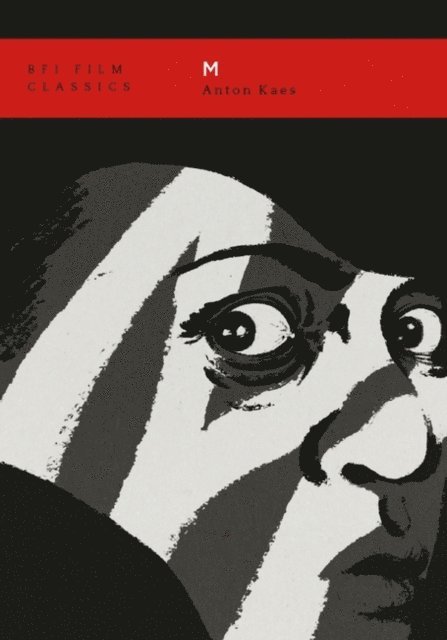
Fritz Lang's 'M' (1931) is an undisputed classic of world cinema. Lang considered it his most lasting work. Peter Lorre's extraordinary performance as the childlike misfit Hans Beckert was one of the most striking of film debuts, and it made him an international star. Lang's vision of a city gripped with fear, haunted by surveillance and total mobillization, is still remarkably powerful today. And 'M' resonates too in the serial-killer genre which is so prominent in contemporary cinema. 'M' speaks to us as a timeless classic, but also as a Weimar film that has too often been isolated from its political and cultural context. In this groundbreaking book, Anton Kaes reconnects 'M''s much-studied formal brilliance to its significance as an event in 1931 Germany, recapturing the film's extraordinary social and symbolic energy. Interweaving close reading with cultural history, Kaes reconstitutes 'M' as a crucial modernist artwork. In addition he analyzes Joseph Losey's 1951 film noir remake and, in an appendix, publishes for the first time 'M''s missing scene.
903 kr
Skickas inom 10-15 vardagar
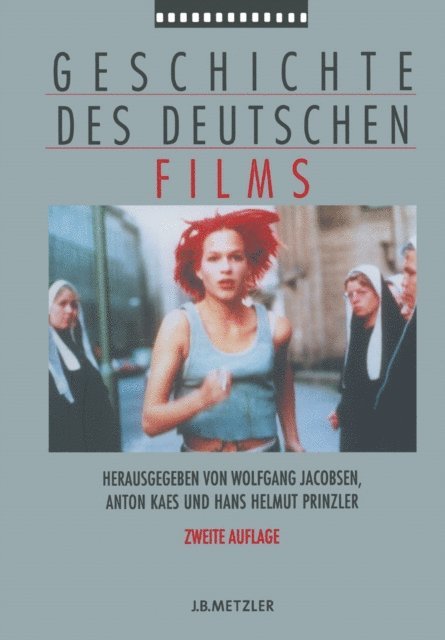
Internationales Standardwerk der Filmgeschichtsschreibung. Von ausgewählten Filmen und ihren Regisseuren bis zum "Autorenfilm" berichtet der Band über alle wichtigen filmgeschichtlichen Epochen. Vorgestellt werden auch die charakteristischen Genres, Ideen, Motive, die politische Dimension des Films und die Rolle des Publikums. Eine Chronik erschließt die Daten zum deutschen Film, eine Bibliografie nennt weiterführende Literatur. Mit zahlreichen Abbildungen von über einhundert Jahren deutscher Filmgeschichte.