Douglas H. K. Lee – författare
Visar alla böcker från författaren Douglas H. K. Lee. Handla med fri frakt och snabb leverans.
3 produkter
3 produkter
E-bok
PDF, Engelska, 2013779 kr
Läs direkt efter köp
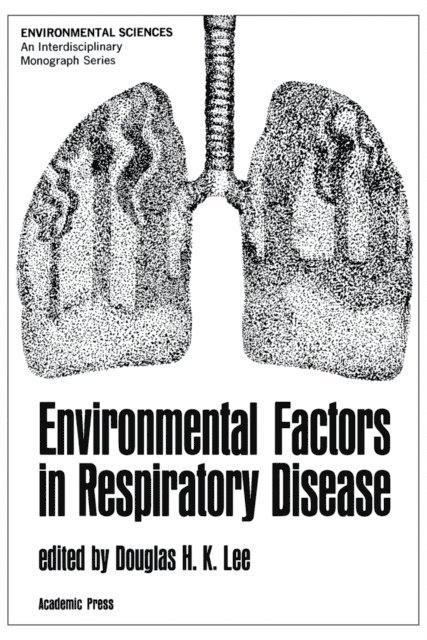
Environmental Factors in Respiratory Disease provides an overview of the state of knowledge on the role of environmental factors in respiratory disease. The book opens with a discussion of some trends and developments which bear on concerns with respiratory disease and the environment. This is followed by separate chapters on pulmonary anatomy and physiology as it relates to the problem of environmental factors in respiratory disease; various tracheobronchial responses to insult; the response of alveoli of the lung to damaging agents; and effects of chronic respiratory disease on lung and heart functions. Subsequent chapters deal with environmental pollutants, their routes of transport, and impact on lung function; specific reactions of the lung that can be attributed to a particular material or agent; host defense mechanisms in the lung; and interactions of infectious diseases and air pollutants. This text will be helpful to those who need to know the state of current knowledge on the health significance of environmental factors in respiratory disease but who do not have the time to pursue the detailed literature or to seek a compilation directed to their special needs.
E-bok
PDF, Engelska, 2013779 kr
Läs direkt efter köp
Physiology, Environment, and Man is based on a symposium conducted by the National Academy of Sciences-National Research Council, August 1966. While one might expect a textbook to present its field in organized and comprehensive fashion, a symposium necessarily follows more of an illustrative pattern, according to the personal interests or even idiosyncrasies of the participants. It is interesting to note that, in spite of these limitations, the presentations did in fact cover the range of physiological concerns with environmental effects, from the genetic to the temporal, and from the molecular to the holistic. The book opens with a discussion of the National Academy of Sciences-National Research Council''s broad-based critical study of the physiological underpinning of current concepts of biological responses to toxic chemicals and physical stresses. Subsequent chapters deal with topics such as the metabolic fate of common environmental agents; growth and trophic factors in carcinogenesis; environmental factors in aging and mortality; adaptation to heat and cold; and the definition of an optimum environment.
E-bok
PDF, Engelska, 2013756 kr
Läs direkt efter köp
Biometeorological Methods provides a unified look at methodologies in biometeorology. Examples of biometeorological studies have been chosen not because the results are necessarily significant but because the method is instructive. The book begins with a brief survey of biometeorology to orient the reader approaching the subject for the first time. The remaining chapters seek to place in perspective the various experimental, empirical, analytical, and physical methods that are being used or could be used in biometeorology. Key topics discussed include space and time considerations in the sampling of the atmosphere; the design of biometeorological experiments; the use of tables, graphs, and charts in the search for biometeorological relationships; statistical and physical methods; and the synoptic approach. Also covered are studies on seasonal relationships, past climates, and climatic classification and indices. The present volume should be of value to anyone seeking assistance in the design of experiments and analysis of environmental data.