Douglas H. Norrie - Böcker
Visar alla böcker från författaren Douglas H. Norrie. Handla med fri frakt och snabb leverans.
2 produkter
2 produkter
2 357 kr
Skickas inom 7-10 vardagar
Agent Technology, or Agent-Based Approaches, is a new paradigm for developing software applications. It has been hailed as 'the next significant breakthrough in software development', and 'the new revolution in software' after object technology or object-oriented programming.In this context, an agent is a computer system which is capable of acting autonomously in its environment in order to meet its design objectives. So in the area of concurrent design and manufacturing, a manufacturing resource, namely a machine or an operator, may cooperate and negotiate with other agents for task assignment; and an existing engineering software can be integrated with a distributed integrated engineering design and manufacturing system. Hence in agent-based systems, there is no centralized system control structure, and no pre-defined agenda for the system execution, as exist in traditional systems.This book systematically describes the principles, key issues, and applications of agent technology in relation to concurrent engineering design and manufacturing. It introduces the methodology, standards, frameworks, tools, and languages of agent-based approaches and presents a general procedure for building agent-based concurrent engineering design and manufacturing systems.Both professional and university researchers and postgraduates should find this an invaluable presentation of the corresponding theories and methods, with some practical examples for developing multi-agent systems in the domain.
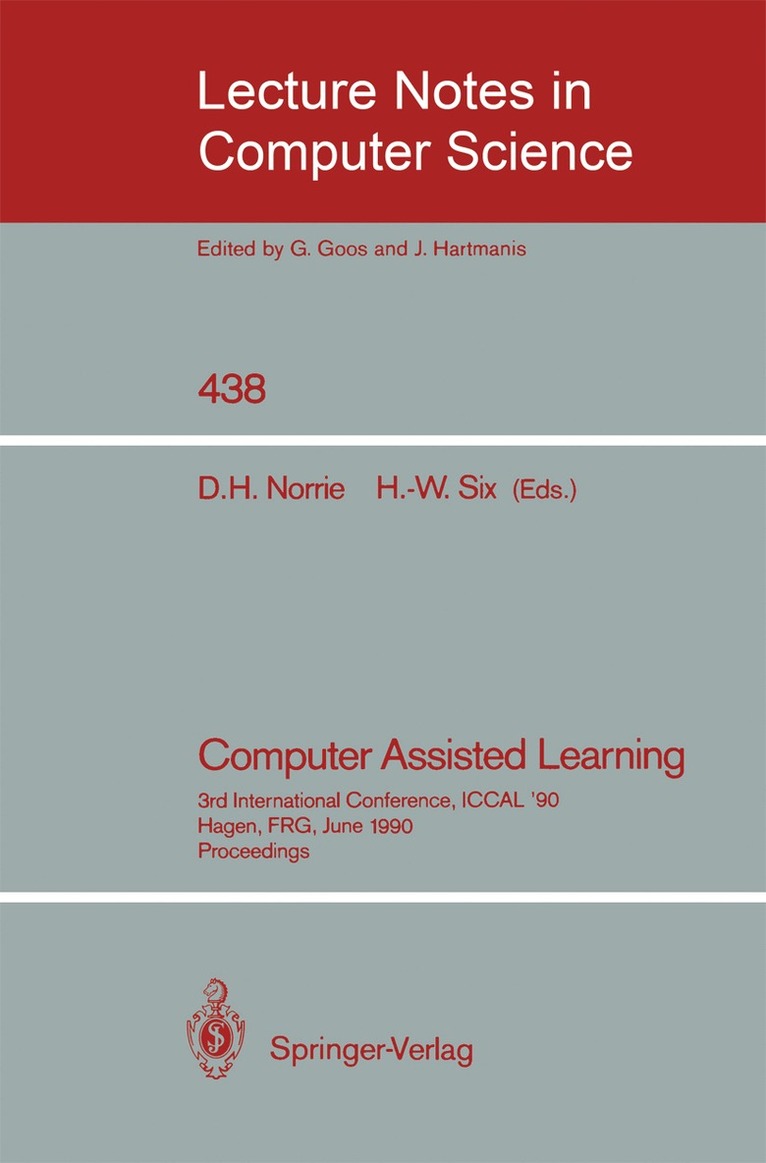
Computer Assisted Learning
3rd International Conference, ICCAL '90, Hagen, FRG, June 11-13, 1990, Proceedings
Häftad, Engelska, 1990
521 kr
Skickas inom 10-15 vardagar
This volume contains the invited lectures and selected papers from the 3rd International Conference on Computer Assisted Learning. The contributions cover a wide range of theoretical and practical topics, including knowledge acquisition, intelligent computer assisted instruction, microworlds, media-based CAL, hypermedia environments and instruction, student modelling, evaluation of learning environments, simulation tools, application systems for logic, discourse, visual programming, physiology, structural frames, real time measurement, automotive maintenance, flight training, and implementation of CAL in education in various countries.