Douglas W. Allen – författare
Visar alla böcker från författaren Douglas W. Allen. Handla med fri frakt och snabb leverans.
10 produkter
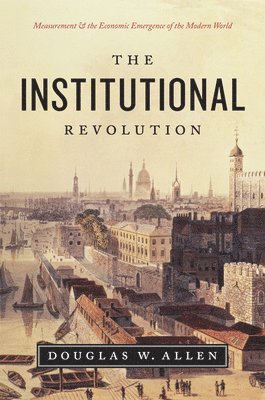
Institutional Revolution
Measurement and the Economic Emergence of the Modern World
Inbunden, 2011
334 kr
Lägg i varukorg
Few events in the history of humanity rival the Industrial Revolution. Following its onset in eighteenth-century Britain, sweeping changes in agriculture, manufacturing, transportation, and technology began to gain unstoppable momentum throughout Europe, North America, and eventually much of the …
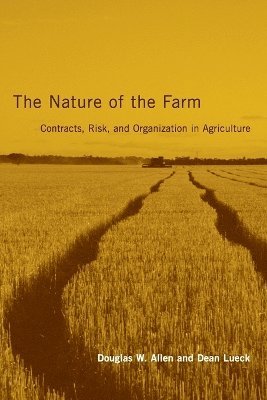
Nature of the Farm
Contracts, Risk, and Organization in Agriculture
Av Douglas W. Allen, Dean Lueck
Häftad, 2004
557 kr
Lägg i varukorg
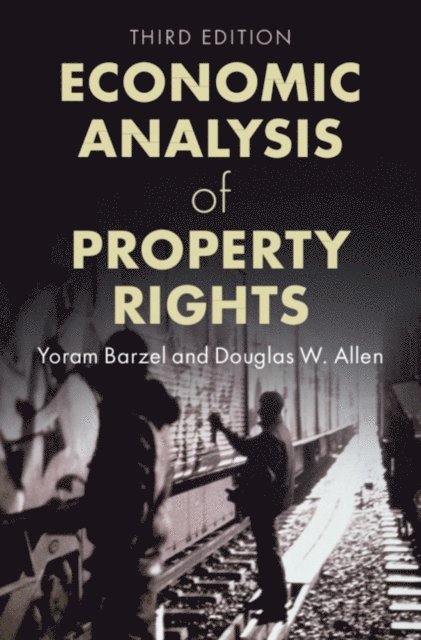
Economic Analysis of Property Rights
Av Yoram Barzel, Douglas W. Allen
Häftad, 2023
446 kr
Lägg i varukorg
The standard neoclassical model of economics is incapable of explaining why one form of organization arises over another. It is a model where transaction costs are implicitly assumed to not exist; however, transaction costs are here defined as the costs of strengthening a given distribution of …
Economic Analysis of Property Rights
Av Yoram Barzel, Douglas W. Allen
Inbunden, 2023
1168 kr
Lägg i varukorg
The standard neoclassical model of economics is incapable of explaining why one form of organization arises over another. It is a model where transaction costs are implicitly assumed to not exist; however, transaction costs are here defined as the costs of strengthening a given distribution of …
Economic Analysis of Property Rights
Av Douglas W. Allen, Yoram Barzel
E-bok, 2023
360 kr
Lägg i varukorg
Economic Analysis of Property Rights
Av Douglas W. Allen, Yoram Barzel
E-bok, 2023
360 kr
Lägg i varukorg
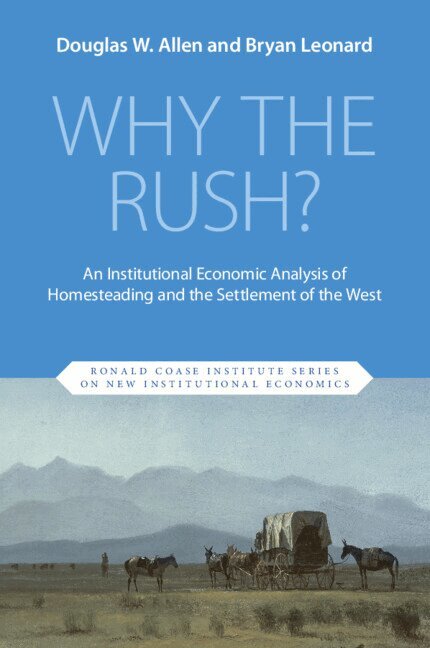
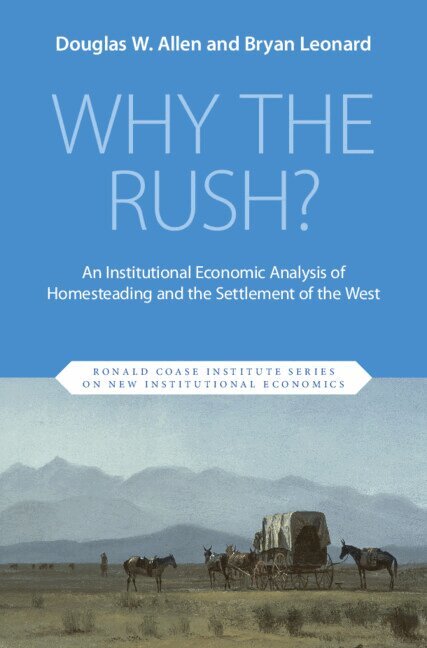
Why the Rush?
An Institutional Economic Analysis of Homesteading and the Settlement of the West
Av Douglas W. Allen, Bryan Leonard
Häftad, 2026
511 kr
Lägg i varukorg
Establishing economic property rights is a ubiquitous human activity that is key to the creation of wealth. Why the Rush? combines economic and historical analysis to argue that the institution of homesteading, as established in the US through the Homestead Act of 1862, was a method to establish …
Why the Rush?
An Institutional Economic Analysis of Homesteading and the Settlement of the West
Av Bryan Leonard, Douglas W. Allen
E-bok, 2026
537 kr
Lägg i varukorg
Why the Rush?
An Institutional Economic Analysis of Homesteading and the Settlement of the West
Av Bryan Leonard, Douglas W. Allen
E-bok, 2026
520 kr
Lägg i varukorg
Why the Rush?
An Institutional Economic Analysis of Homesteading and the Settlement of the West
Av Douglas W. Allen, Bryan Leonard
Inbunden, 2026
1693 kr
Lägg i varukorg
Establishing economic property rights is a ubiquitous human activity that is key to the creation of wealth. Why the Rush? combines economic and historical analysis to argue that the institution of homesteading, as established in the US through the Homestead Act of 1862, was a method to establish …