
D.R. McCullough – författare
Visar alla böcker från författaren . Handla med fri frakt och snabb leverans.
2 produkter
2 produkter
Inbunden, Engelska, 1992
5 361 kr
Skickas inom 10-15 vardagar
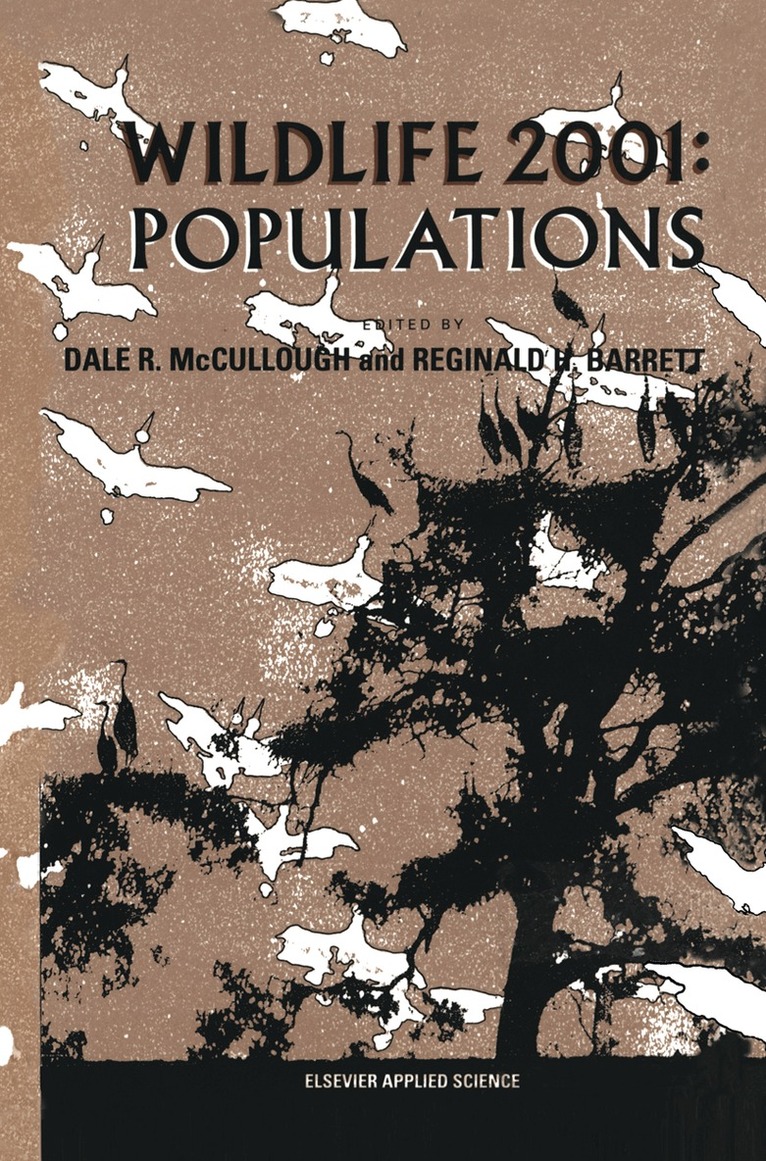
This volume contains papers presented at the Wildlife 2001: Populations Conference held on 29-31 July 1991 in Oakland, California. The conference aimed to bring together specialists from around the world whose interest is the science, conservation and management of vertebrate populations and to set the agenda for future research and management on the threshold of the 21st century. Three general sessions covered methods, modelling and conservation of threatened species. Twelve special sessions addressed a wide array of taxonomic groups of vertebrates, plus one session directed towards the problem of wildlife species in overabundant numbers. This book should be of interest to scientists in the field of research and management of conservation, environmental science and ecology.
E-bok
PDF, Engelska, 20127 092 kr
Läs direkt efter köp
In 1984, a conference called Wildlife 2000: Modeling habitat relationships of terrestrial vertebrates, was held at Stanford Sierra Camp at Fallen Leaf Lake in the Sierra Nevada Mountains of California. The conference was well-received, and the published volume (Verner, J. , M. L. Morrison, and C. J. Ralph, editors. 1986. Wildlife 2000: modeling habitat relationships of terrestrial vertebrates, University of Wisconsin Press, Madison, Wisconsin, USA) proved to be a landmark publication that received a book award by The Wildlife Society. Wildlife 2001: populations was a followup conference with emphasis on the other major biological field of wildlife conservation and management, populations. It was held on July 29-31, 1991, at the Oakland Airport Hilton Hotel in Oakland, California, in accordance with our intent that this conference have a much stronger international representation than did Wildlife 2000. The goal of the conference was to bring together an international group of specialists to address the state of the art in wildlife population dynamics, and set the agenda for future research and management on the threshold of the 21st century. The mix of specialists included workers in theoretical, as well as practical, aspects of wildlife conservation and management. Three general sessions covered methods, modelling, and conservation of threatened species.