Duane F. Alwin – författare
285 kr
Skickas inom 10-15 vardagar
Margins of Error
A Study of Reliability in Survey Measurement
1 635 kr
Skickas inom 5-8 vardagar
1 914 kr
Läs direkt efter köp
Margins of Error: A Study of Reliability in Survey Measurement demonstrates how and hwy identifying the presence and extent of measurement errors in survey data is essential for improving the overall collection and analysis of the data. The author outlines the consequences of ignoring survey measurement errors and also discusses ways to detect and estimate the impact of these errors. This book also provides recommendations of improving the quality of survey data.
Logically organized and clearly written, this book:
Deconstructs the data gathering process into six main elements of the response process: question adequacy, comprehension, accessibility, retrieval, motivation, and communication Provides an exhaustive review of valuable reliability estimation techniques that can be applied to survey data Identifies the types of questions and interviewer practices that are essential to the collection of reliable data Addresses hypotheses regarding which survey questions, sources of information, and questionnaire formats produce the most reliable dataIn conjunction with research data gathered on nearly 500 survey measures and the application of an empirical approach grounded in classical measurement theory, this book discusses the sources of measurement error and provides the tools necessary for improving survey data collection methods.
Margins of Error enables statisticians and researchers in the fields of public opinion and survey research to design studies that can detect, estimate, and reduce measurement errors that may have previously gone undetected. This book also serves as a supplemental textbook for both undergraduate and graduate survey methodology courses.
2 913 kr
Skickas inom 3-6 vardagar
"Provides a unique perspective. I am particularly impressed with the sections on innovative design and methods to investigate cognitive aging and the integrative perspectives. None of the existing texts covers this material to the same level." —Donna J. La Voie, Saint Louis University "The emphasis on integrating the literature with theoretical and methodological innovations could have a far-reaching impact on the field." —Deb McGinnis, Oakland University The Handbook of Cognitive Aging: Interdisciplinary Perspectives clarifies the differences in patterns and processes of cognitive aging. Along with a comprehensive review of current research, editors Scott M. Hofer and Duane F. Alwin provide a solid foundation for building a multidisciplinary agenda that will stimulate further rigorous research into these complex factors. Key Features
Gathers the widest possible range of perspectives by including cognitive aging experts in various disciplines while maintaining a degree of unity across chapters Examines the limitations of the extant literature, particularly in research design and measurement, and offers new suggestions to guide future research Highlights the broad scope of the field with topics ranging from demography to development to neuroscience, offering the most complete coverage available on cognitive aging2 113 kr
Skickas inom 3-6 vardagar
235 kr
Skickas inom 5-8 vardagar
350 kr
Skickas inom 5-8 vardagar
251 kr
Skickas inom 5-8 vardagar
402 kr
Skickas inom 5-8 vardagar
754 kr
Skickas inom 5-8 vardagar
890 kr
Skickas inom 5-8 vardagar
55 kr
Läs direkt efter köp
1 883 kr
Skickas inom 10-15 vardagar
1 883 kr
Skickas inom 10-15 vardagar
2 453 kr
Läs direkt efter köp
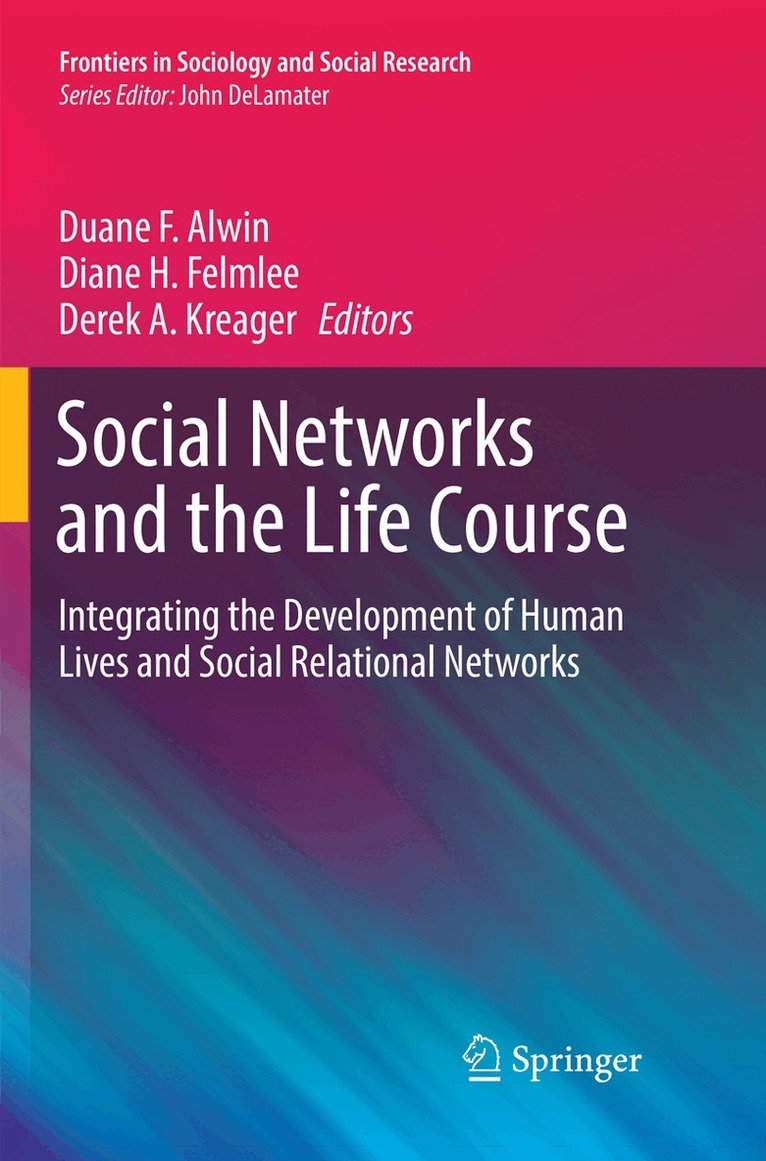
This volume engages the interface between the development of human lives and social relational networks. It focuses on the integration of two subfields of sociology/social science--the life course and social networks. Research practitioners studying social networks typically focus on social structure or social organization, ignoring the complex lives of the people in those networks. At the same time, life course researchers tend to focus on individual lives without necessarily studying the contexts of social relationships in which lives are embedded and “linked” to one another through social networks. These patterns are changing and this book creates an audience of researchers who will better integrate the two subfields. It covers the role of social networks across the life span, from childhood and adolescence, to midlife, through old age.