Duane Swank - Böcker
Visar alla böcker från författaren Duane Swank. Handla med fri frakt och snabb leverans.
4 produkter
4 produkter
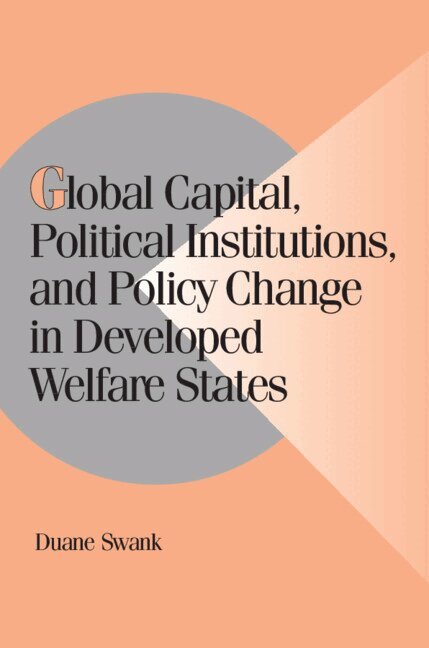
Global Capital, Political Institutions, and Policy Change in Developed Welfare States
Häftad, Engelska, 2002
410 kr
Skickas inom 7-10 vardagar
This book argues that the post-1970 rise in international capital mobility has not contributed to the retrenchment of developed welfare states. Nor has globalization reduced the revenue-raising capacities of governments and undercut the political institutions that support the welfare state. Rather, institutional features of the polity and the welfare state determine the extent to which the economic and political pressures associated with globalization produce welfare state retrenchment. In systems characterized by electoral institutions, social corporatist interest representation and policy-making, centralized political authority, and social insurance-based program structures, pro-welfare state interests are favored. In nations characterized by majoritarian electoral institutions, pluralist interest representation and policy-making, decentralization of policy-making authority, and liberal program structure, the economic and political pressures attendant on globalization are translated into rollbacks of social protection. Globalization has had least impact on large welfare states of Northern Europe and most effect on small welfare states of Anglo nations.
Global Capital, Political Institutions, and Policy Change in Developed Welfare States
Inbunden, Engelska, 2002
665 kr
Skickas inom 7-10 vardagar
This book argues that the post-1970 rise in international capital mobility has not contributed to the retrenchment of developed welfare states. Nor has globalization reduced the revenue-raising capacities of governments and undercut the political institutions that support the welfare state. Rather, institutional features of the polity and the welfare state determine the extent to which the economic and political pressures associated with globalization produce welfare state retrenchment. In systems characterized by electoral institutions, social corporatist interest representation and policy-making, centralized political authority, and social insurance-based program structures, pro-welfare state interests are favored. In nations characterized by majoritarian electoral institutions, pluralist interest representation and policy-making, decentralization of policy-making authority, and liberal program structure, the economic and political pressures attendant on globalization are translated into rollbacks of social protection. Globalization has had least impact on large welfare states of Northern Europe and most effect on small welfare states of Anglo nations.
The Political Construction of Business Interests
Coordination, Growth, and Equality
Inbunden, Engelska, 2012
1 034 kr
Skickas inom 7-10 vardagar
Many societies use labor market coordination to maximize economic growth and equality, yet employers' willing cooperation with government and labor is something of a mystery. The Political Construction of Business Interests recounts employers' struggles to define their collective social identities at turning points in capitalist development. Employers are most likely to support social investments in countries with strong peak business associations, that help members form collective preferences and realize policy goals in labor market negotiations. Politicians, with incentives shaped by governmental structures, took the initiative in association-building and those that created the strongest associations were motivated to evade labor radicalism and to preempt parliamentary democratization. Sweeping in its historical and cross-national reach, the book builds on original archival data, interviews and cross-national quantitative analyses. The research has important implications for the construction of business as a social class and powerful ramifications for equality, welfare state restructuring and social solidarity.
The Political Construction of Business Interests
Coordination, Growth, and Equality
Häftad, Engelska, 2012
370 kr
Skickas inom 7-10 vardagar
Many societies use labor market coordination to maximize economic growth and equality, yet employers' willing cooperation with government and labor is something of a mystery. The Political Construction of Business Interests recounts employers' struggles to define their collective social identities at turning points in capitalist development. Employers are most likely to support social investments in countries with strong peak business associations, that help members form collective preferences and realize policy goals in labor market negotiations. Politicians, with incentives shaped by governmental structures, took the initiative in association-building and those that created the strongest associations were motivated to evade labor radicalism and to preempt parliamentary democratization. Sweeping in its historical and cross-national reach, the book builds on original archival data, interviews and cross-national quantitative analyses. The research has important implications for the construction of business as a social class and powerful ramifications for equality, welfare state restructuring and social solidarity.