E. Bayro-Corrochano – författare
Visar alla böcker från författaren E. Bayro-Corrochano. Handla med fri frakt och snabb leverans.
2 produkter
2 produkter
Inbunden, Engelska, 2001
1 086 kr
Skickas inom 10-15 vardagar
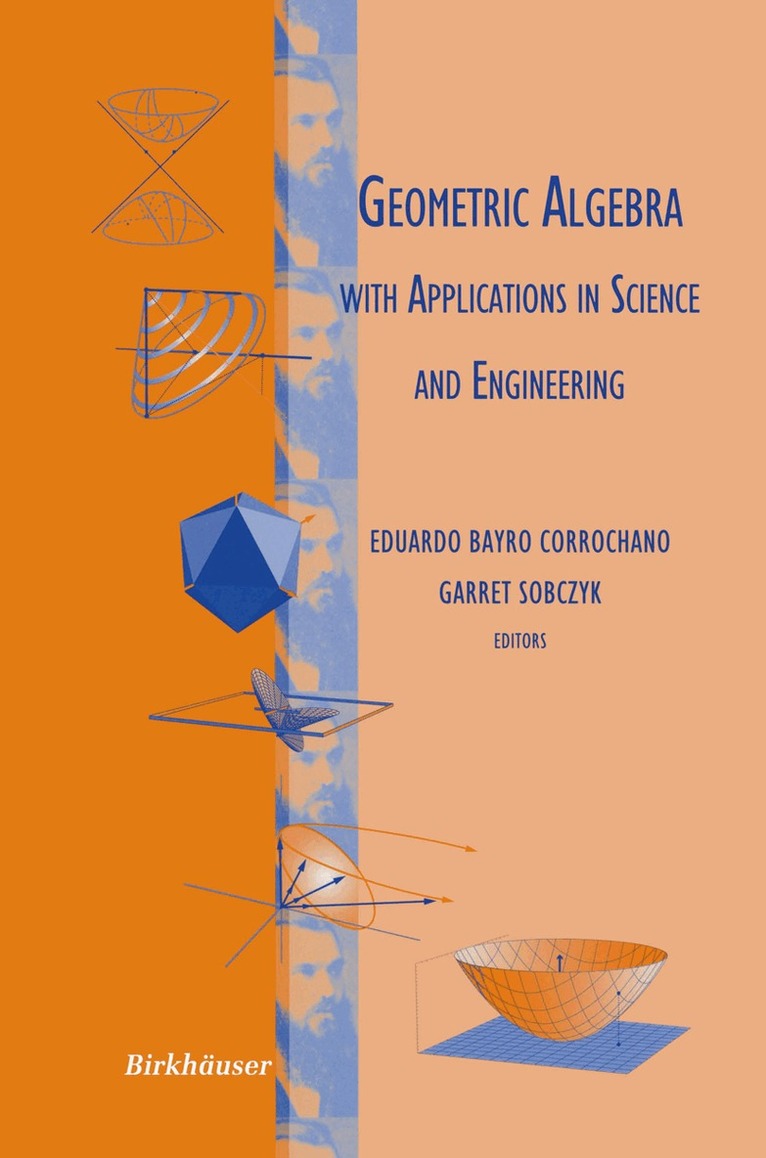
The goal of this book is to present a unified mathematical treatment of diverse problems in mathematics, physics, computer science, and engineer ing using geometric algebra. Geometric algebra was invented by William Kingdon Clifford in 1878 as a unification and generalization of the works of Grassmann and Hamilton, which came more than a quarter of a century before. Whereas the algebras of Clifford and Grassmann are well known in advanced mathematics and physics, they have never made an impact in elementary textbooks where the vector algebra of Gibbs-Heaviside still predominates. The approach to Clifford algebra adopted in most of the ar ticles here was pioneered in the 1960s by David Hestenes. Later, together with Garret Sobczyk, he developed it into a unified language for math ematics and physics. Sobczyk first learned about the power of geometric algebra in classes in electrodynamics and relativity taught by Hestenes at Arizona State University from 1966 to 1967. He still vividly remembers a feeling of disbelief that the fundamental geometric product of vectors could have been left out of his undergraduate mathematics education. Geometric algebra provides a rich, general mathematical framework for the develop ment of multilinear algebra, projective and affine geometry, calculus on a manifold, the representation of Lie groups and Lie algebras, the use of the horosphere and many other areas. This book is addressed to a broad audience of applied mathematicians, physicists, computer scientists, and engineers.
Inbunden, Engelska, 2005
2 178 kr
Skickas inom 10-15 vardagar
Many computer scientists, engineers, applied mathematicians, and physicists use geometry theory and geometric computing methods in the design of perception-action systems, intelligent autonomous systems, and man-machine interfaces. This handbook brings together the most recent advances in the application of geometric computing for building such systems, with contributions from leading experts in the important fields of neuroscience, neural networks, image processing, pattern recognition, computer vision, uncertainty in geometric computations, conformal computational geometry, computer graphics and visualization, medical imagery, geometry and robotics, and reaching and motion planning. For the first time, the various methods are presented in a comprehensive, unified manner.This handbook is highly recommended for postgraduate students and researchers working on applications such as automated learning; geometric and fuzzy reasoning; human-like artificial vision; tele-operation; space maneuvering; haptics; rescue robots; man-machine interfaces; tele-immersion; computer- and robotics-aided neurosurgery or orthopedics; the assembly and design of humanoids; and systems for metalevel reasoning.