E Churchill - Böcker
Visar alla böcker från författaren E Churchill. Handla med fri frakt och snabb leverans.
6 produkter
6 produkter
266 kr
Skickas inom 5-8 vardagar
266 kr
Skickas inom 5-8 vardagar
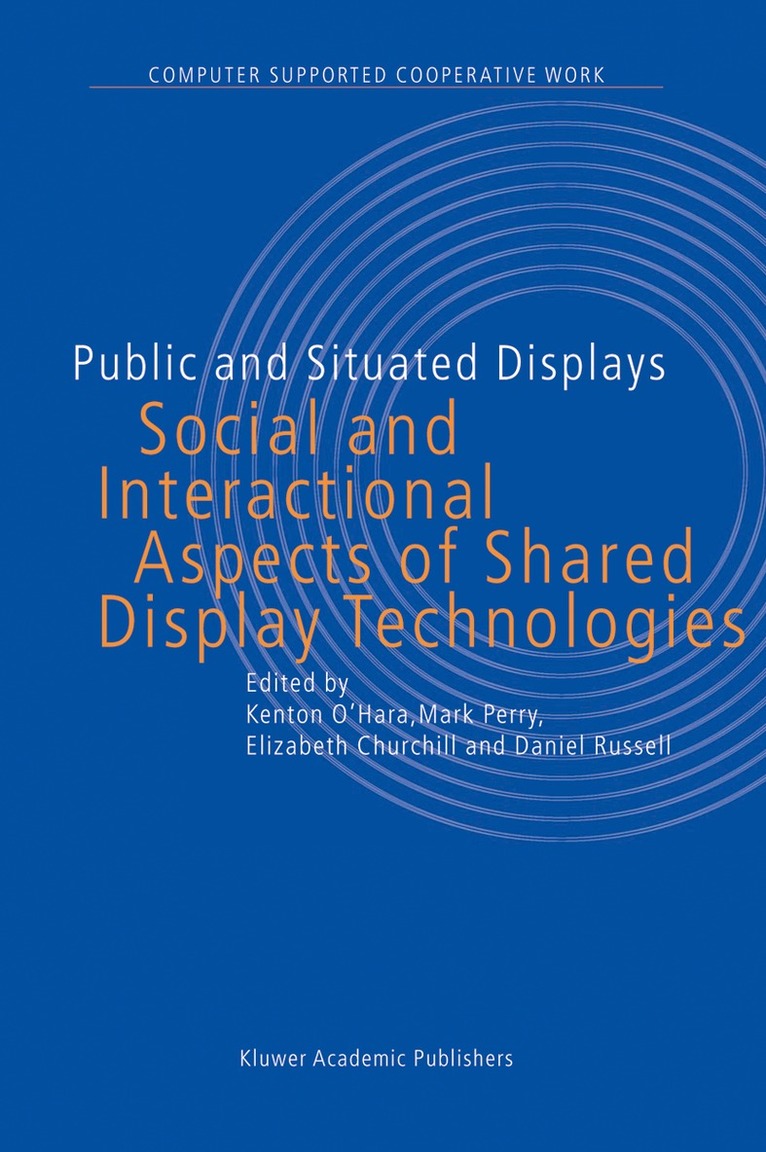
Public and Situated Displays
Social and Interactional Aspects of Shared Display Technologies
Inbunden, Engelska, 2003
1 548 kr
Skickas inom 10-15 vardagar
Public and situated display technologies can have an important impact on individual and social behaviour and present us with particular interesting new design considerations and challenges. While there is a growing body of research exploring these design considerations and social impact this work remains somewhat disparate, making it difficult to assimilate in a coherent manner. This book brings together the perspectives of key researchers in the area of public and situated display technology. The chapters detail research representing the social, technical and interactional aspects of public and situated display technologies. The underlying concern common to these chapters is how these displays can be best designed for collaboration, coordination, community building and mobility. Presenting them together allows the reader to examine everyday display activities within the context of emerging technological possibilities.This book is intended as a foundational text for researchers and practitioners in the areas of CSCW, Ubiquitous Computing and HCI as well as a useful reference for advanced undergraduate and postgraduate students on HCI, psychology, information systems and computer science courses.
1 640 kr
Skickas inom 10-15 vardagar
Improvements in computer networking have heralded great expectations for computer-mediated distributed work. However, experience has revealed that, as information flow improves, a central problem for distributed workers is the administration, management and control of that information. Research into Computer Supported Cooperative Work (CSCW) investigates design methods and technologies for the support of collaboration, communication and coordination of distributed group work, both within and among organizations. In tandem with this focus on the support of distributed communication and collaboration, there have been exciting developments in the fields of Intelligent Agents and Distributed Artificial Intelligence (DAI), notably in the concepts, theories and deployment of intelligent agents as a means of distributing computer-based problem solving expertise. The paradigm of multi-agent systems forms a proposed basis for the design of CSCW architectures, the support of CSCW operations and for addressing some of the problems of cooperative working.The application of a multi-agent approach to CSCW makes information exchange among the participants easier by delivering support to the participants, assisting workflows and procedures, and providing convenient user interfaces to CSCW systems. Furthermore, the ideas inherent in such an approach are also applicable to other domains, such as support for interactive learning. Organizations that seek to exploit the advantages offered through CSCW will benefit from the integration of agents in the management and use of their corporate knowledge, especially with the advancement of wired or wireless networking, pervasive computing, and other information technologies. Agent Supported Cooperative Work describes the state of the art in this exciting new area, covering both theoretical foundations and practical applications of ASCW.
1 640 kr
Skickas inom 10-15 vardagar
Improvements in computer networking have heralded great expectations for computer-mediated distributed work. However, experience has revealed that, as information flow improves, a central problem for distributed workers is the administration, management and control of that information. Research into Computer Supported Cooperative Work (CSCW) investigates design methods and technologies for the support of collaboration, communication and coordination of distributed group work, both within and among organizations. In tandem with this focus on the support of distributed communication and collaboration, there have been exciting developments in the fields of Intelligent Agents and Distributed Artificial Intelligence (DAI), notably in the concepts, theories and deployment of intelligent agents as a means of distributing computer-based problem solving expertise. The paradigm of multi-agent systems forms a proposed basis for the design of CSCW architectures, the support of CSCW operations and for addressing some of the problems of cooperative working. The application of a multi-agent approach to CSCW makes information exchange among the participants easier by delivering support to the participants, assisting workflows and procedures, and providing convenient user interfaces to CSCW systems. Furthermore, the ideas inherent in such an approach are also applicable to other domains, such as support for interactive learning. Organizations that seek to exploit the advantages offered through CSCW will benefit from the integration of agents in the management and use of their corporate knowledge, especially with the advancement of wired or wireless networking, pervasive computing, and other information technologies. Agent Supported Cooperative Work describes the state of the art in this exciting new area, covering both theoretical foundations and practical applications of ASCW. It is the first book explicitly dedicated to ASCW, bringingtogether contributions from international experts in the field.
Public and Situated Displays
Social and Interactional Aspects of Shared Display Technologies
Häftad, Engelska, 2011
1 593 kr
Skickas inom 10-15 vardagar
Public and situated display technologies can have an important impact on individual and social behaviour and present us with particular interesting new design considerations and challenges. While there is a growing body of research exploring these design considerations and social impact this work remains somewhat disparate, making it difficult to assimilate in a coherent manner. This book brings together the perspectives of key researchers in the area of public and situated display technology. The chapters detail research representing the social, technical and interactional aspects of public and situated display technologies. The underlying concern common to these chapters is how these displays can be best designed for collaboration, coordination, community building and mobility. Presenting them together allows the reader to examine everyday display activities within the context of emerging technological possibilities.