E. Jan W. ter Maten - Böcker
Visar alla böcker från författaren E. Jan W. ter Maten. Handla med fri frakt och snabb leverans.
11 produkter
11 produkter
959 kr
Skickas inom 10-15 vardagar
Designs in nanoelectronics often lead to challenging simulation problems and include strong feedback couplings. Industry demands provisions for variability in order to guarantee quality and yield. It also requires the incorporation of higher abstraction levels to allow for system simulation in order to shorten the design cycles, while at the same time preserving accuracy. The methods developed here promote a methodology for circuit-and-system-level modelling and simulation based on best practice rules, which are used to deal with coupled electromagnetic field-circuit-heat problems, as well as coupled electro-thermal-stress problems that emerge in nanoelectronic designs. This book covers:(1) advanced monolithic/multirate/co-simulation techniques, which are combined with envelope/wavelet approaches to create efficient and robust simulation techniques for strongly coupled systems that exploit the different dynamics of sub-systems within multiphysics problems, and which allow designers to predict reliability and ageing; (2) new generalized techniques in Uncertainty Quantification (UQ) for coupled problems to include a variability capability such that robust design and optimization, worst case analysis, and yield estimation with tiny failure probabilities are possible (including large deviations like 6-sigma); (3) enhanced sparse, parametric Model Order Reduction techniques with a posteriori error estimation for coupled problems and for UQ to reduce the complexity of the sub-systems while ensuring that the operational and coupling parameters can still be varied and that the reduced models offer higher abstraction levels that can be efficiently simulated. All the new algorithms produced were implemented, transferred and tested by the EDA vendor MAGWEL. Validation was conducted on industrial designs provided by end-users from the semiconductor industry, who shared their feedback, contributed to the measurements, and supplied both material data and process data. In closing, a thorough comparison to measurements on real devices was made in order to demonstrate the algorithms’ industrial applicability.
694 kr
Skickas inom 10-15 vardagar
Designs in nanoelectronics often lead to challenging simulation problems and include strong feedback couplings. Industry demands provisions for variability in order to guarantee quality and yield. It also requires the incorporation of higher abstraction levels to allow for system simulation in order to shorten the design cycles, while at the same time preserving accuracy. The methods developed here promote a methodology for circuit-and-system-level modelling and simulation based on best practice rules, which are used to deal with coupled electromagnetic field-circuit-heat problems, as well as coupled electro-thermal-stress problems that emerge in nanoelectronic designs. This book covers:(1) advanced monolithic/multirate/co-simulation techniques, which are combined with envelope/wavelet approaches to create efficient and robust simulation techniques for strongly coupled systems that exploit the different dynamics of sub-systems within multiphysics problems, and which allow designers to predict reliability and ageing; (2) new generalized techniques in Uncertainty Quantification (UQ) for coupled problems to include a variability capability such that robust design and optimization, worst case analysis, and yield estimation with tiny failure probabilities are possible (including large deviations like 6-sigma); (3) enhanced sparse, parametric Model Order Reduction techniques with a posteriori error estimation for coupled problems and for UQ to reduce the complexity of the sub-systems while ensuring that the operational and coupling parameters can still be varied and that the reduced models offer higher abstraction levels that can be efficiently simulated. All the new algorithms produced were implemented, transferred and tested by the EDA vendor MAGWEL. Validation was conducted on industrial designs provided by end-users from the semiconductor industry, who shared their feedback, contributed to the measurements, and supplied both material data and process data. In closing, a thorough comparison to measurements on real devices was made in order to demonstrate the algorithms’ industrial applicability.
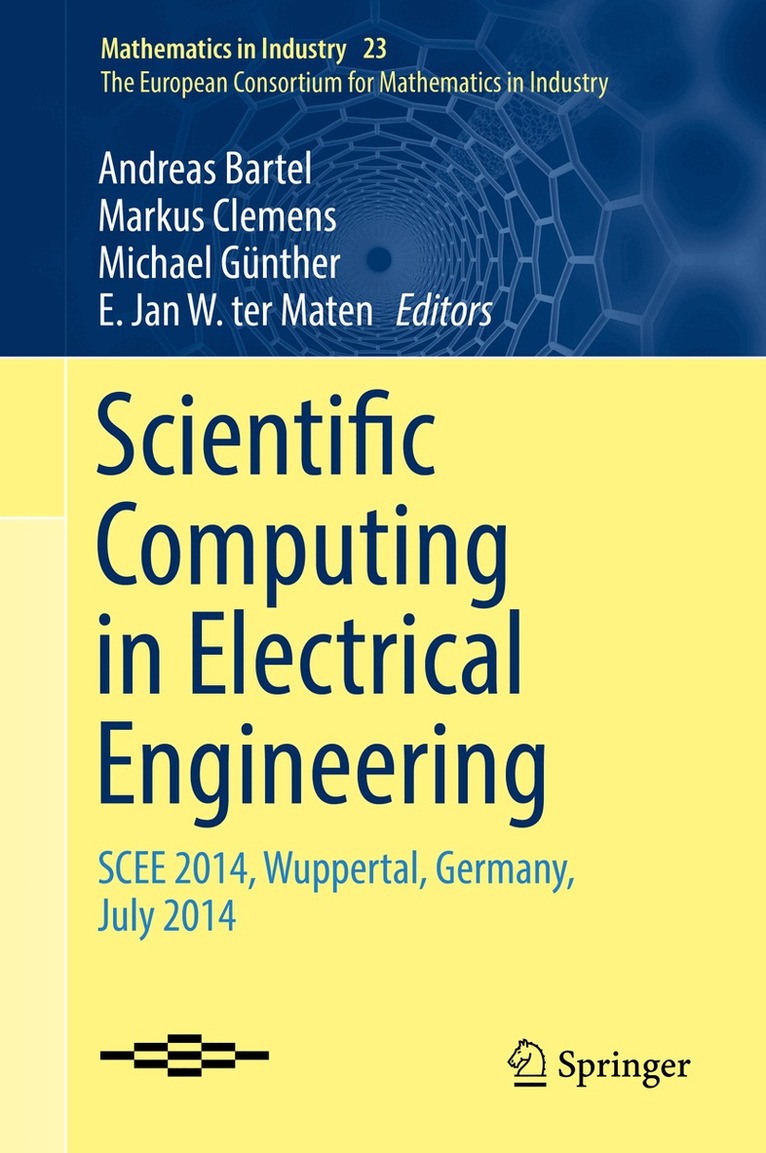
Scientific Computing in Electrical Engineering
SCEE 2014, Wuppertal, Germany, July 2014
Inbunden, Engelska, 2016
1 578 kr
Skickas inom 10-15 vardagar
This book is a collection of selected papers presented at the 10thInternational Conference on Scientific Computing in Electrical Engineering(SCEE), held in Wuppertal, Germany in 2014. The book is divided into fiveparts, reflecting the main directions of SCEE 2014: 1. Device Modeling,Electric Circuits and Simulation, 2. Computational Electromagnetics, 3. CoupledProblems, 4. Model Order Reduction, and 5. UncertaintyQuantification. Each part starts with a general introduction followed bythe actual papers. The aim of the SCEE 2014 conference was to bring together scientistsfrom academia and industry, mathematicians, electrical engineers, computerscientists, and physicists, with the goal of fostering intensive discussions onindustrially relevant mathematical problems, with an emphasis on the modelingand numerical simulation of electronic circuits and devices, electromagneticfields, and coupled problems. The methodological focus was on model orderreduction anduncertainty quantification.
1 682 kr
Skickas inom 10-15 vardagar
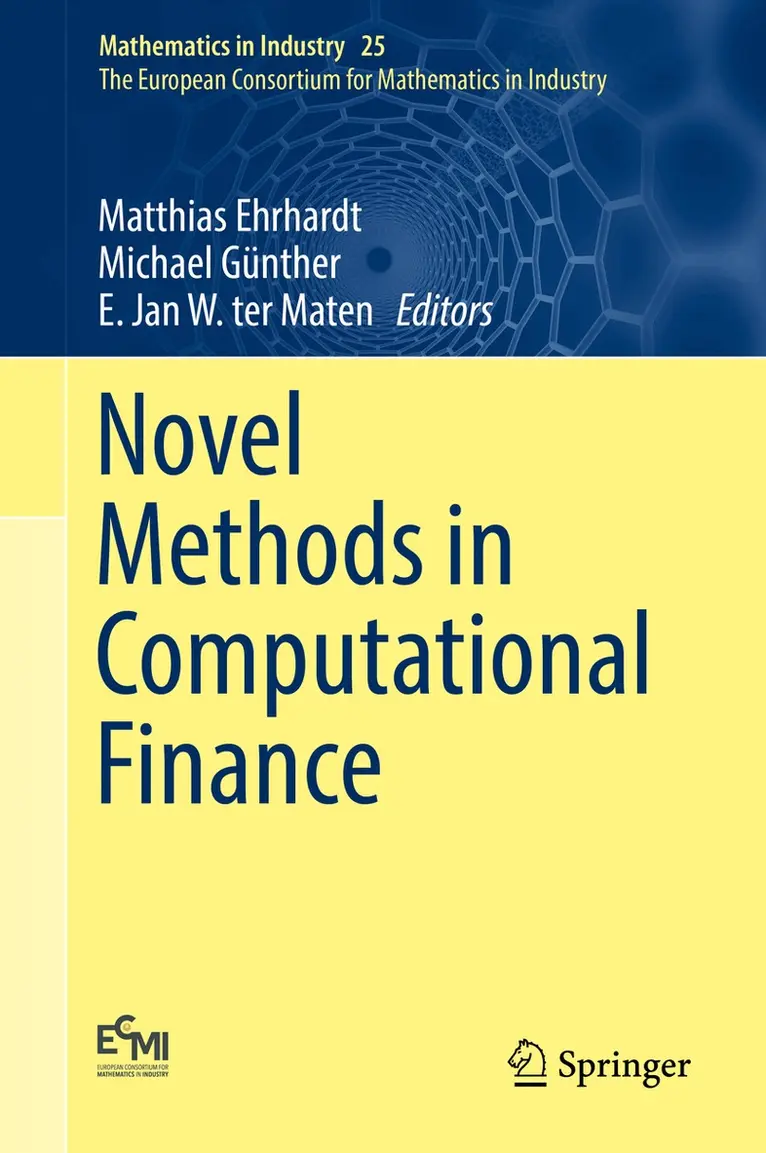
This book discusses the state-of-the-art and open problems in computational finance. It presents a collection of research outcomes and reviews of the work from the STRIKE project, an FP7 Marie Curie Initial Training Network (ITN) project in which academic partners trained early-stage researchers in close cooperation with a broader range of associated partners, including from the private sector.The aim of the project was to arrive at a deeper understanding of complex (mostly nonlinear) financial models and to develop effective and robust numerical schemes for solving linear and nonlinear problems arising from the mathematical theory of pricing financial derivatives and related financial products. This was accomplished by means of financial modelling, mathematical analysis and numerical simulations, optimal control techniques and validation of models.In recent years the computational complexity of mathematical models employed in financial mathematics has witnessed tremendous growth. Advanced numerical techniques are now essential to the majority of present-day applications in the financial industry.Special attention is devoted to a uniform methodology for both testing the latest achievements and simultaneously educating young PhD students. Most of the mathematical codes are linked into a novel computational finance toolbox, which is provided in MATLAB and PYTHON with an open access license. The book offers a valuable guide for researchers in computational finance and related areas, e.g. energy markets, with an interest in industrial mathematics.
Del 23 - Mathematics in Industry
Scientific Computing in Electrical Engineering
SCEE 2014, Wuppertal, Germany, July 2014
Häftad, Engelska, 2018
1 578 kr
Skickas inom 10-15 vardagar
This book is a collection of selected papers presented at the 10thInternational Conference on Scientific Computing in Electrical Engineering(SCEE), held in Wuppertal, Germany in 2014. The book is divided into fiveparts, reflecting the main directions of SCEE 2014: 1. Device Modeling,Electric Circuits and Simulation, 2. Computational Electromagnetics, 3. CoupledProblems, 4. Model Order Reduction, and 5. UncertaintyQuantification. Each part starts with a general introduction followed bythe actual papers. The aim of the SCEE 2014 conference was to bring together scientistsfrom academia and industry, mathematicians, electrical engineers, computerscientists, and physicists, with the goal of fostering intensive discussions onindustrially relevant mathematical problems, with an emphasis on the modelingand numerical simulation of electronic circuits and devices, electromagneticfields, and coupled problems. The methodological focus was on model orderreduction anduncertainty quantification.
1 682 kr
Skickas inom 10-15 vardagar
This book discusses the state-of-the-art and open problems in computational finance. It presents a collection of research outcomes and reviews of the work from the STRIKE project, an FP7 Marie Curie Initial Training Network (ITN) project in which academic partners trained early-stage researchers in close cooperation with a broader range of associated partners, including from the private sector.The aim of the project was to arrive at a deeper understanding of complex (mostly nonlinear) financial models and to develop effective and robust numerical schemes for solving linear and nonlinear problems arising from the mathematical theory of pricing financial derivatives and related financial products. This was accomplished by means of financial modelling, mathematical analysis and numerical simulations, optimal control techniques and validation of models.In recent years the computational complexity of mathematical models employed in financial mathematics has witnessed tremendous growth. Advanced numerical techniques are now essential to the majority of present-day applications in the financial industry.Special attention is devoted to a uniform methodology for both testing the latest achievements and simultaneously educating young PhD students. Most of the mathematical codes are linked into a novel computational finance toolbox, which is provided in MATLAB and PYTHON with an open access license. The book offers a valuable guide for researchers in computational finance and related areas, e.g. energy markets, with an interest in industrial mathematics.
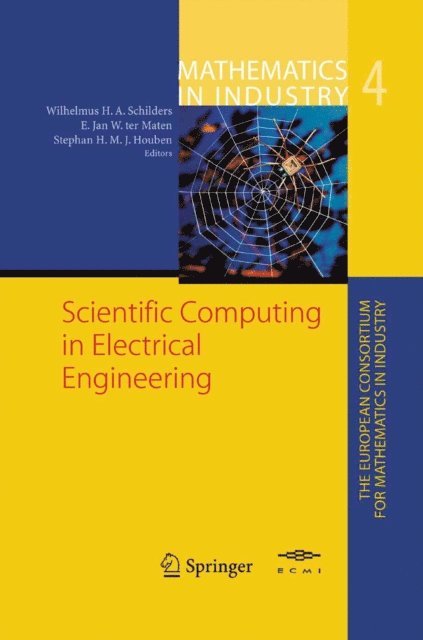
Scientific Computing in Electrical Engineering
Proceedings of the SCEE-2002 Conference held in Eindhoven
Inbunden, Engelska, 2004
1 578 kr
Skickas inom 10-15 vardagar
The fourth international conference on Scientific Computing in Electrical En- gineering (SCEE) was held at the Eindhoven University of Technology, from 23rd to 28th June, 2002. It was sponsored by Philips Research Laborato- ries Eindhoven, the Eindhoven University of Technology, Computer Simula- tion Technology (CST) from Darmstadt, ABB Corporate Research, Thales Netherlands,the European Consortium for Mathematics in Industry (ECMI), the University of Rostock (organiser of SCEE-2000), the European network for Mathematics, Computing and Simulation for Industry (MACSI-net), the Royal Netherlands Academy of Arts and Sciences (KNAW), and the Scien- tific Computing Group of the Eindhoven University of Technology. The Program Committee consisted of: Dr. Alain Bossavit, Electricite de France, Clamart, France. Dr. Uwe Feldmann, Infineon Technologies A.G., Munich, Germany. Prof.Dr. Leszek Demkowicz, University of Texas at Austin, USA. Dr. Michael Gunther, Universitat Karlsruhe, Germany. Prof.Dr. Ulrich Langer, Johannes Kepler Universitat, Linz, Austria. Dr. Jan ter Maten,Philips Research Laboratories Eindhoven, The Nether- lands. Prof.Dr. Ursula van Rienen, Universitat Rostock, Germany.Prof.Dr. Jaijeet Roychowdhury, University of Minnesota, USA. - Prof.Dr. Wil Schilders, Technische Universiteit Eindhoven and Philips Research Laboratories Eindhoven, The Netherlands. - Prof.Dr. Thomas Weiland, Technische Universitat Darmstadt, Germany.
Scientific Computing in Electrical Engineering
Proceedings of the SCEE-2002 Conference held in Eindhoven
Häftad, Engelska, 2014
1 578 kr
Skickas inom 10-15 vardagar
The fourth international conference on Scientific Computing in Electrical En- gineering (SCEE) was held at the Eindhoven University of Technology, from 23rd to 28th June, 2002. It was sponsored by Philips Research Laborato- ries Eindhoven, the Eindhoven University of Technology, Computer Simula- tion Technology (CST) from Darmstadt, ABB Corporate Research, Thales Netherlands,the European Consortium for Mathematics in Industry (ECMI), the University of Rostock (organiser of SCEE-2000), the European network for Mathematics, Computing and Simulation for Industry (MACSI-net), the Royal Netherlands Academy of Arts and Sciences (KNAW), and the Scien- tific Computing Group of the Eindhoven University of Technology. The Program Committee consisted of: Dr. Alain Bossavit, Electricite de France, Clamart, France. Dr. Uwe Feldmann, Infineon Technologies A.G., Munich, Germany. Prof.Dr. Leszek Demkowicz, University of Texas at Austin, USA. Dr. Michael Gunther, Universitat Karlsruhe, Germany. Prof.Dr. Ulrich Langer, Johannes Kepler Universitat, Linz, Austria. Dr. Jan ter Maten,Philips Research Laboratories Eindhoven, The Nether- lands. Prof.Dr. Ursula van Rienen, Universitat Rostock, Germany.Prof.Dr. Jaijeet Roychowdhury, University of Minnesota, USA. - Prof.Dr. Wil Schilders, Technische Universiteit Eindhoven and Philips Research Laboratories Eindhoven, The Netherlands. - Prof.Dr. Thomas Weiland, Technische Universitat Darmstadt, Germany.
1 064 kr
Skickas inom 10-15 vardagar
This book contains the proceedings of the 8th Workshop on Coupled Descriptor Systems held March 2013 in the Castle of Eringerfeld, Geseke in the neighborhood of Paderborn, Germany. It examines the wide range of current research topics in descriptor systems, including mathematical modeling, index analysis, wellposedness of problems, stiffness and different time-scales, cosimulation and splitting methods and convergence analysis. In addition, the book also presents applications from the automotive and circuit industries that show that descriptor systems provide challenging problems from the point of view of both theory and practice. The book contains nine papers and is organized into three parts: control, simulation, and model order reduction. It will serve as an ideal resource for applied mathematicians and engineers, in particular those from mechanics and electromagnetics, who work with coupled differential equations.
Del 74 - Lecture Notes in Electrical Engineering
Model Reduction for Circuit Simulation
Inbunden, Engelska, 2011
1 578 kr
Skickas inom 10-15 vardagar
Simulation based on mathematical models plays a major role in computer aided design of integrated circuits (ICs). Decreasing structure sizes, increasing packing densities and driving frequencies require the use of refined mathematical models, and to take into account secondary, parasitic effects. This leads to very high dimensional problems which nowadays require simulation times too large for the short time-to-market demands in industry. Modern Model Order Reduction (MOR) techniques present a way out of this dilemma in providing surrogate models which keep the main characteristics of the device while requiring a significantly lower simulation time than the full model.With Model Reduction for Circuit Simulation we survey the state of the art in the challenging research field of MOR for ICs, and also address its future research directions. Special emphasis is taken on aspects stemming from miniturisations to the nano scale. Contributions cover complexity reduction using e.g., balanced truncation, Krylov-techniques or POD approaches. For semiconductor applications a focus is on generalising current techniques to differential-algebraic equations, on including design parameters, on preserving stability, and on including nonlinearity by means of piecewise linearisations along solution trajectories (TPWL) and interpolation techniques for nonlinear parts. Furthermore the influence of interconnects and power grids on the physical properties of the device is considered, and also top-down system design approaches in which detailed block descriptions are combined with behavioral models. Further topics consider MOR and the combination of approaches from optimisation and statistics, and the inclusion of PDE models with emphasis on MOR for the resulting partial differential algebraic systems. The methods which currently are being developed have also relevance in other application areas such as mechanical multibody systems, and systems arising in chemistry and to biology.The current number of books in the area of MOR for ICs is very limited, so that this volume helps to fill a gap in providing the state of the art material, and to stimulate further research in this area of MOR. Model Reduction for Circuit Simulation also reflects and documents the vivid interaction between three active research projects in this area, namely the EU-Marie Curie Action ToK project O-MOORE-NICE (members in Belgium, The Netherlands and Germany), the EU-Marie Curie Action RTN-project COMSON (members in The Netherlands, Italy, Germany, and Romania), and the German federal project System reduction in nano-electronics (SyreNe).
Del 74 - Lecture Notes in Electrical Engineering
Model Reduction for Circuit Simulation
Häftad, Engelska, 2012
1 578 kr
Skickas inom 10-15 vardagar
Simulation based on mathematical models plays a major role in computer aided design of integrated circuits (ICs). Decreasing structure sizes, increasing packing densities and driving frequencies require the use of refined mathematical models, and to take into account secondary, parasitic effects. This leads to very high dimensional problems which nowadays require simulation times too large for the short time-to-market demands in industry. Modern Model Order Reduction (MOR) techniques present a way out of this dilemma in providing surrogate models which keep the main characteristics of the device while requiring a significantly lower simulation time than the full model.With Model Reduction for Circuit Simulation we survey the state of the art in the challenging research field of MOR for ICs, and also address its future research directions. Special emphasis is taken on aspects stemming from miniturisations to the nano scale. Contributions cover complexity reduction using e.g., balanced truncation, Krylov-techniques or POD approaches. For semiconductor applications a focus is on generalising current techniques to differential-algebraic equations, on including design parameters, on preserving stability, and on including nonlinearity by means of piecewise linearisations along solution trajectories (TPWL) and interpolation techniques for nonlinear parts. Furthermore the influence of interconnects and power grids on the physical properties of the device is considered, and also top-down system design approaches in which detailed block descriptions are combined with behavioral models. Further topics consider MOR and the combination of approaches from optimisation and statistics, and the inclusion of PDE models with emphasis on MOR for the resulting partial differential algebraic systems. The methods which currently are being developed have also relevance in other application areas such as mechanical multibody systems, and systems arising in chemistry and to biology.The current number of books in the area of MOR for ICs is very limited, so that this volume helps to fill a gap in providing the state of the art material, and to stimulate further research in this area of MOR. Model Reduction for Circuit Simulation also reflects and documents the vivid interaction between three active research projects in this area, namely the EU-Marie Curie Action ToK project O-MOORE-NICE (members in Belgium, The Netherlands and Germany), the EU-Marie Curie Action RTN-project COMSON (members in The Netherlands, Italy, Germany, and Romania), and the German federal project System reduction in nano-electronics (SyreNe).