E. Sackmann – författare
Visar alla böcker från författaren E. Sackmann. Handla med fri frakt och snabb leverans.
3 produkter
3 produkter
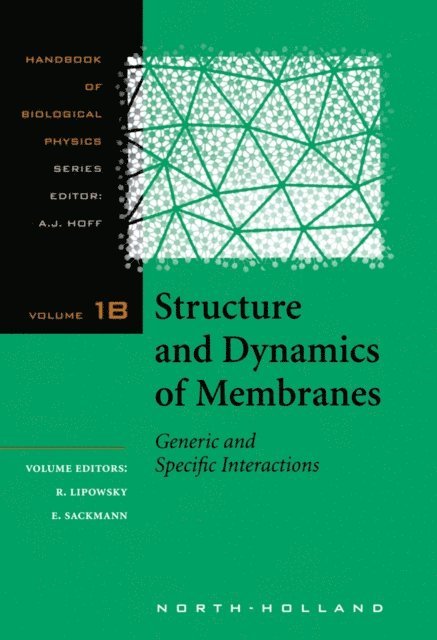
Structure and Dynamics of Membranes
I. From Cells to Vesicles / II. Generic and Specific Interactions
E-bok
PDF, Engelska, 19954 174 kr
Läs direkt efter köp
The first volume of the Handbook deals with the amazing world of biomembranes and lipid bilayers. Part A describes all aspects related to the morphology of these membranes, beginning with the complex architecture of biomembranes, continues with a description of the bizarre morphology of lipid bilayers and concludes with technological applications of these membranes. The first two chapters deal with biomembranes, providing an introduction to the membranes of eucaryotes and a description of the evolution of membranes. The following chapters are concerned with different aspects of lipids including the physical properties of model membranes composed of lipid-protein mixtures, lateralphase separation of lipids and proteins and measurement of lipid-protein bilayer diffusion. Other chapters deal with the flexibility of fluid bilayers, the closure of bilayers into vesicles which attain a large variety of different shapes, and applications of lipid vesicles and liposomes. Part B covers membrane adhesion, membrane fusion and the interaction of biomembranes withpolymer networks such as the cytoskeleton. The first two chapters of this part discuss the generic interactions of membranes from the conceptual point of view. The following two chapters summarize the experimental work on two different bilayer systems. The next chapter deals with the process ofcontact formation, focal bounding and macroscopic contacts between cells. The cytoskeleton within eucaryotic cells consists of a network of relatively stiff filaments of which three different types of filaments have been identified. As explained in the next chapter much has been recently learned aboutthe interaction of these filaments with the cell membrane. The final two chapters deal with membrane fusion.
E-bok
PDF, Engelska, 2012712 kr
Läs direkt efter köp
Over the past ten years liquid crystals have attracted much interest and considerable progress has been made with respect to our knowledge in this field. The recent development was initiated mainly by the work of J. L. Fergason and G. H. Heilmeier, who pointed out the importance of liquid crystals for thermographic and electro optic applications. The first part of this book is a brief introduction to the physics of liquid crystals. The structures and properties of the three basic types of liquid crystals are discussed. A special paragraph is devoted to electric-field effects, which are important in display applications. The chapter on Scientific Applications gives an insight into the potential applications of liquid crystals in fundamental research, with special emphasis on explaining the principles involved. Two groups of potential applications are discussed in detail: 1. the use of liquid crystals as anisotropic solvent for the determination of molecular properties by means of spectroscopy, and 2. their use in analytical chemistry, particularly in gas chromatography. The reverse process involves the use of the dissolved molecules as microscopic probes in the investigation of the dynamical molecular structure of anisotropic fluid systems (e.g. biological membranes). This extremely important technique is also described.
Häftad, Engelska, 2012
550 kr
Skickas inom 10-15 vardagar
Over the past ten years liquid crystals have attracted much interest and considerable progress has been made with respect to our knowledge in this field. The recent development was initiated mainly by the work of J. L. Fergason and G. H. Heilmeier, who pointed out the importance of liquid crystals for thermographic and electro optic applications. The first part of this book is a brief introduction to the physics of liquid crystals. The structures and properties of the three basic types of liquid crystals are discussed. A special paragraph is devoted to electric-field effects, which are important in display applications. The chapter on Scientific Applications gives an insight into the potential applications of liquid crystals in fundamental research, with special emphasis on explaining the principles involved. Two groups of potential applications are discussed in detail: 1. the use of liquid crystals as anisotropic solvent for the determination of molecular properties by means of spectroscopy, and 2. their use in analytical chemistry, particularly in gas chromatography. The reverse process involves the use of the dissolved molecules as microscopic probes in the investigation of the dynamical molecular structure of anisotropic fluid systems (e.g. biological membranes). This extremely important technique is also described.