E. Thomas Strom - Böcker
Visar alla böcker från författaren E. Thomas Strom. Handla med fri frakt och snabb leverans.
5 produkter
5 produkter
Del 1080 - ACS Symposium Series
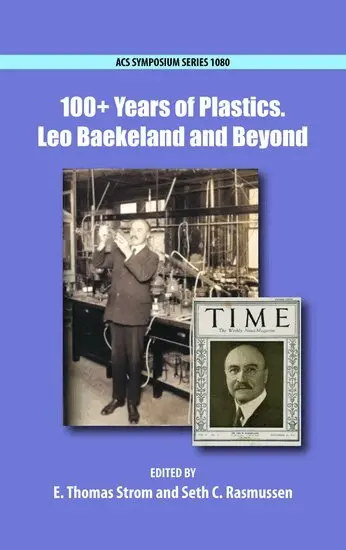
100+ Years of Plastics
Leo Baekeland and Beyond
Inbunden, Engelska, 2012
2 585 kr
Skickas inom 5-8 vardagar
This volume consists of written chapters taken from the presentations at the symposium "100+ Years of Plastics: Leo Baekeland and Beyond", held March 22, 2010, at the 239th ACS National Meeting in San Francisco. The symposium celebrates the 100th anniversary of the formation of General Bakelite Corp., which was preceded by Leo Baekland's synthesis of Bakelite in 1907 and the unveiling of the Bakelite process in 1909. It is quite reasonable to use the synthesis ofBakelite as the starting point of the Age of Plastics. Indeed, Time magazine in its June 14, 1999, issue on the 100 most influential people of the 20th century chose Leo Baekeland and his Bakelite synthesis as the sole representative of chemistry. Leo Baekeland and Bakelite are the topics of the first four chapters of this volume. The first two chapters come from the perspective of Baekeland family members. Carl Kaufmann is related to the Baekeland family through marriage and is the author of the only full-length biography of Baekeland, published as a master's thesis from the University of Delaware. As a family member Kaufmann had access to all of Baekeland's papers. This first chapter (Leo H. Baekeland) is not only a biographicalsketch, but an exploration of Baekeland's effect on the chemical industry. Hugh Karraker is Baekeland's great-grandson, and his chapter (A Portrait of Leo H. Baekeland) provides a family picture of the great inventor. Gary Patterson's chapter (Materia Polymerica: Bakelite) goes into the history of Bakelitechemistry, while Burkhard Wagner's contribution (Leo Baekeland's Legacy-100 Years of Plastics) covers the history of Bakelite manufacture through time and space, finishing with a description of another Baekeland legacy, the Baekeland Award given through the North Jersey Section of the ACS. In later chapters, Les Sperling (History of Interpenetrating Polymer Networks Starting with Bakelite-Based Compositions) covers the improvements in interpenetrating networks. James Economy and Z. Parkar (Historical Perspectives on Phenolic Resins and High-Temperature Aromatic Polyesters of p-Hydroxybenzoic Acid and Their Copolyesters) follow the paths of resoles, novolaks, and related chemicals.
2 585 kr
Skickas inom 5-8 vardagar
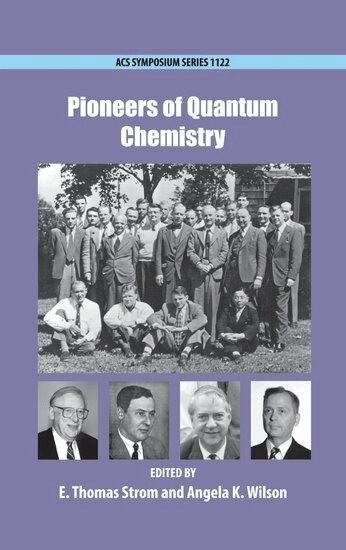
The field of quantum chemistry has grown so immensely that the importance of some of the earliest work and the earliest pioneers of quantum chemistry is unfamiliar to many of today's youngest scientists in the field. Thus, this book is an attempt to preserve some of the very valuable, early history of quantum chemistry, providing the reader with not only a perspective of the science, but a perspective of the early pioneers themselves, some of whom were quiteinteresting characters. The symposium on which this book is based came about because one of the co-editors (ETS) came to a conviction that the contributions such as those by George Wheland to quantum chemistry and Otto Schmidt to free electron theory should be better appreciated and known. He organized asymposium in which quantum chemistry pioneers, both those celebrated by everyone and those seemingly overlooked by posterity, would be recognized. While this volume is certainly not a history of quantum chemistry, it does cover many highlights over a period of about sixty years. This volume consists of chapters based upon ten of the presentations at the symposium "Pioneers of Quantum Chemistry" held March 28, 2011, at the 241st ACS National Meeting in Anaheim, CA.
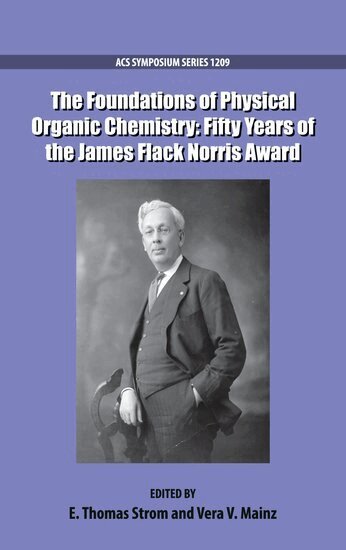
Foundations of Physical Organic Chemistry
Fifty Years of the James Flack Norris Award
Inbunden, Engelska, 2016
2 585 kr
Skickas inom 5-8 vardagar
This book examines the history and fundamentals of the physical organic chemistry discipline. With the recent flowering of the organic synthesis field, physical organic chemistry has seemed to be shrinking or perhaps is just being absorbed into the toolkit of the synthetic chemist. The only Nobel Prize that can be reasonably attributed to a physical organic chemist is the 1994 award to George Olah, although Jeffrey I. Seeman has recently made a strong case that R. B.Woodward was actually a physical organic chemist in disguise (I).2014 saw the awarding of the 50th James Flack Norris Award in Physical Organic Chemistry. James Flack Norris was an early physical organic chemist, before the discipline received its name. This book provides insight into the fundamentals of the field, and each chapter is devoted to a major discovery or to noted physical organic chemists, including Paul Schleyer, William Doering, and Glen A. Russell.
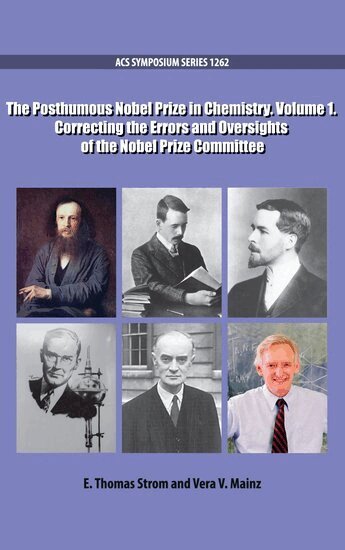
Posthumous Nobel Prize in Chemistry Volume 1
Correcting the Errors and Oversights of the Nobel Prize Committee
Inbunden, Engelska, 2018
1 680 kr
Skickas inom 5-8 vardagar
The Nobel Prize is the only scientific prize that has achieved worldwide recognition among the general public. Each year, announcement of the prizes is covered by the national news media, and countries and universities brag about how many Nobel Prize winners they have. As of 2015, 172 individuals have received the Nobel Prize in chemistry. This book explores the reasons why the Nobel Prize has not been awarded to various deserving chemists over the years, and pointsspecifically to eleven deceased chemists in particular who did not receive the Nobel Prize in Chemistry.
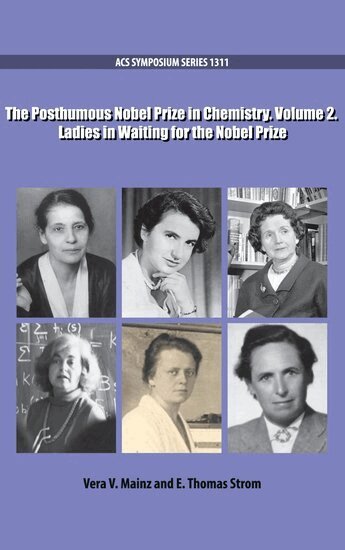
Posthumous Nobel Prize in Chemistry
Ladies in Waiting for the Nobel Prize (Volume 2)
Inbunden, Engelska, 2019
2 004 kr
Skickas inom 5-8 vardagar
The symposium on which this book is based originated after Tom Strom organized a successful American Chemical Society (ACS) symposium in March 2016, on the Posthumous Nobel Prize in Chemistry. Afterward, Vera Mainz pointed out that the chemists represented in that symposium and its subsequent symposium volume were "all dead white guys." The fact that only white men were included in the first symposium partly reflects the prevailing past (and continuing) gender imbalance in chemistry, but it also shows the power of the Matilda effect, first articulated by Matilda Joslyn Gage (1826-1898). The Matilda effect is an implicit bias against acknowledging the achievements of women scientists, whose work is often attributed to their male colleagues. An implicit bias is one which is not conscious or deliberate, but nevertheless real. Thegender imbalance in the previous symposium was also noted in the on-line comments for the Chemical and Engineering News article that reported on it. Redressing that imbalance was the purpose of the current symposium entitled "Ladies in Waiting for the Nobel Prize in Chemistry. OverlookedAccomplishments of Women Chemists." This symposium, which took place in August 2017, was sponsored by the ACS History of Chemistry Division (HIST), the Women Chemists Committee (WCC), and ACS President Allison Campbell. In the Preface to The Posthumous Nobel Prize in Chemistry, Volume 1: Correcting the Errors and Oversights of the Nobel Prize, Mainz and Strom noted that "any chemist with a decent background in chemical history could readily add other deserving chemists to our list." Undoubtedly, this is also the case for the current symposium: There are other women as well as noteworthy scientists of color who could have been included. These men and women should be the topic of a future symposium. Byhighlighting this group of extraordinary women scientists, this book raises awareness of the Matilda effect, but more importantly, it honors them and their accomplishments.