Earl Hopper – författare
Visar alla böcker från författaren Earl Hopper. Handla med fri frakt och snabb leverans.
24 produkter
Trauma and Organizations
Av Earl Hopper
Inbunden, 2019
2433 kr
Lägg i varukorg
This book is concerned with the study of organizations of various kinds. It examines the patterns of conscious and unconscious life of those organizations in which traumatic experience is ubiquitous and understanding the variations in individual, group, and organizations.
Social Unconscious in Persons, Groups and Societies
Mainly Theory
Inbunden, 2019
2441 kr
Lägg i varukorg
The social unconscious is vital for understanding persons and their groupings, ranging from families to societies, committees to organisations, and from small to median to large therapeutic groups, and essential for comprehensive clinical work. This series of volumes of contributions from an …
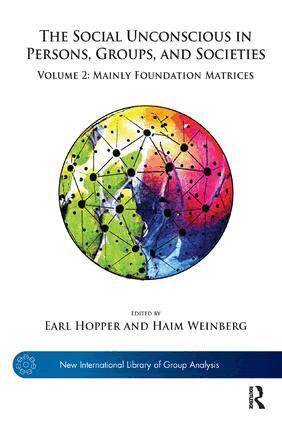
Social Unconscious in Persons, Groups, and Societies
Volume 2: Mainly Foundation Matrices
Inbunden, 2019
2433 kr
Lägg i varukorg
This book is concerned with the study of myths, which are an important element in the cultural dimension of the foundation matrices of all societies. It focuses on topics such as transmission, the foundation matrix, the social unconscious, totalitarianism, massification, and identity formation.
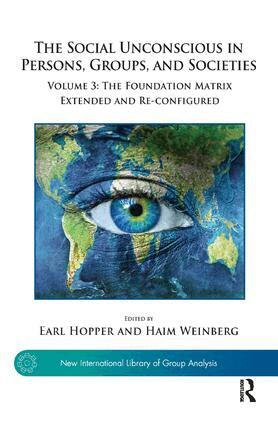
Social Unconscious in Persons, Groups, and Societies
Volume 3: The Foundation Matrix Extended and Re-configured
Inbunden, 2019
2578 kr
Lägg i varukorg
In this book, the authors develop the theory of the tripartite matrix, consider music as a form of non-verbal communication as a sub-dimension of the matrix, and present empirical studies of the matrices of peoples in three societies in the Middle East. It aids in the project of group analysis.
Social Unconscious in Persons, Groups and Societies
Mainly Theory
E-bok, 2018
774 kr
Lägg i varukorg
The social unconscious is vital for understanding persons and their groupings, ranging from families to societies, committees to organisations, and from small to median to large therapeutic groups, and essential for comprehensive clinical work. This series of volumes of contributions from an …
Social Unconscious in Persons, Groups, and Societies
Volume 2: Mainly Foundation Matrices
E-bok, 2018
607 kr
Lägg i varukorg
This book is concerned with the study of myths, which are an important element in the cultural dimension of the foundation matrices of all societies. It focuses on topics such as transmission, the foundation matrix, the social unconscious, totalitarianism, massification, and identity formation.
Social Unconscious in Persons, Groups, and Societies
Volume 3: The Foundation Matrix Extended and Re-configured
E-bok, 2018
589 kr
Lägg i varukorg
In this book, the authors develop the theory of the tripartite matrix, consider music as a form of non-verbal communication as a sub-dimension of the matrix, and present empirical studies of the matrices of peoples in three societies in the Middle East. It aids in the project of group analysis.
Trauma and Organizations
Av Earl Hopper
E-bok, 2018
741 kr
Lägg i varukorg
This book is concerned with the study of organizations of various kinds. It examines the patterns of conscious and unconscious life of those organizations in which traumatic experience is ubiquitous and understanding the variations in individual, group, and organizations.
Social Unconscious in Persons, Groups and Societies
Mainly Theory
E-bok, 2018
774 kr
Lägg i varukorg
The social unconscious is vital for understanding persons and their groupings, ranging from families to societies, committees to organisations, and from small to median to large therapeutic groups, and essential for comprehensive clinical work. This series of volumes of contributions from an …
Social Unconscious in Persons, Groups, and Societies
Volume 2: Mainly Foundation Matrices
E-bok, 2018
607 kr
Lägg i varukorg
This book is concerned with the study of myths, which are an important element in the cultural dimension of the foundation matrices of all societies. It focuses on topics such as transmission, the foundation matrix, the social unconscious, totalitarianism, massification, and identity formation.
Social Unconscious in Persons, Groups, and Societies
Volume 3: The Foundation Matrix Extended and Re-configured
E-bok, 2018
589 kr
Lägg i varukorg
In this book, the authors develop the theory of the tripartite matrix, consider music as a form of non-verbal communication as a sub-dimension of the matrix, and present empirical studies of the matrices of peoples in three societies in the Middle East. It aids in the project of group analysis.
Trauma and Organizations
Av Earl Hopper
E-bok, 2018
741 kr
Lägg i varukorg
This book is concerned with the study of organizations of various kinds. It examines the patterns of conscious and unconscious life of those organizations in which traumatic experience is ubiquitous and understanding the variations in individual, group, and organizations.
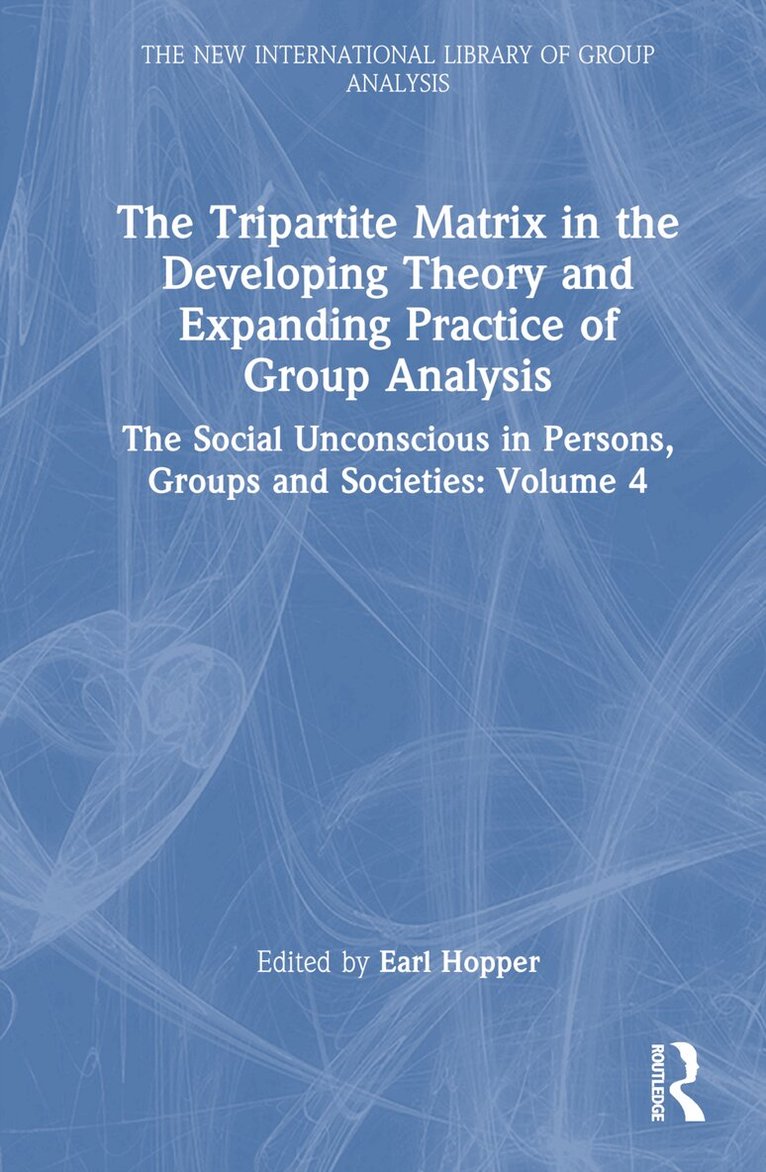
Tripartite Matrix in the Developing Theory and Expanding Practice of Group Analysis
The Social Unconscious in Persons, Groups and Societies: Volume 4
Av Earl Hopper
E-bok, 2023
642 kr
Lägg i varukorg
The Tripartite Matrix in the Developing Theory and Expanding Practice of Group Analysis explores the social unconscious in persons, groups and societies in terms of the "un-acknowledged" restraints and constraints of our social and cultural groupings. In this context, Earl Hopper and an …
Tripartite Matrix in the Developing Theory and Expanding Practice of Group Analysis
The Social Unconscious in Persons, Groups and Societies: Volume 4
Av Earl Hopper
E-bok, 2023
628 kr
Lägg i varukorg
The Tripartite Matrix in the Developing Theory and Expanding Practice of Group Analysis explores the social unconscious in persons, groups and societies in terms of the "un-acknowledged" restraints and constraints of our social and cultural groupings. In this context, Earl Hopper and an …
Tripartite Matrix in the Developing Theory and Expanding Practice of Group Analysis
The Social Unconscious in Persons, Groups and Societies: Volume 4
Av Earl Hopper
Häftad, 2023
545 kr
Lägg i varukorg
The Tripartite Matrix in the Developing Theory and Expanding Practice of Group Analysis explores the social unconscious in persons, groups and societies in terms of the "un-acknowledged" restraints and constraints of our social and cultural groupings. In this context, Earl Hopper and an …
Tripartite Matrix in the Developing Theory and Expanding Practice of Group Analysis
The Social Unconscious in Persons, Groups and Societies: Volume 4
Av Earl Hopper
Inbunden, 2023
2578 kr
Lägg i varukorg
The Tripartite Matrix in the Developing Theory and Expanding Practice of Group Analysis explores the social unconscious in persons, groups and societies in terms of the "un-acknowledged" restraints and constraints of our social and cultural groupings. In this context, Earl Hopper and an …
Social Unconscious in Persons, Groups, and Societies
Volume 2: Mainly Foundation Matrices
Häftad, 2015
486 kr
Lägg i varukorg
The social unconscious is vital for understanding persons and their groupings, ranging from families to societies, committees to organisations, and from small to median to large therapeutic groups, and essential for comprehensive clinical work. This series of volumes of contributions from an …
Social Unconscious in Persons, Groups, and Societies
Volume 3: The Foundation Matrix Extended and Re-configured
Häftad, 2017
620 kr
Lägg i varukorg
In this book the authors develop the theory of the tripartite matrix, consider music as a form of non-verbal communication as a sub-dimension of the matrix, and to present empirical studies of the matrices of peoples in three societies in the Middle-East. The first volume of this series addressed …
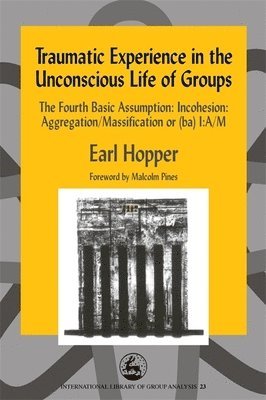
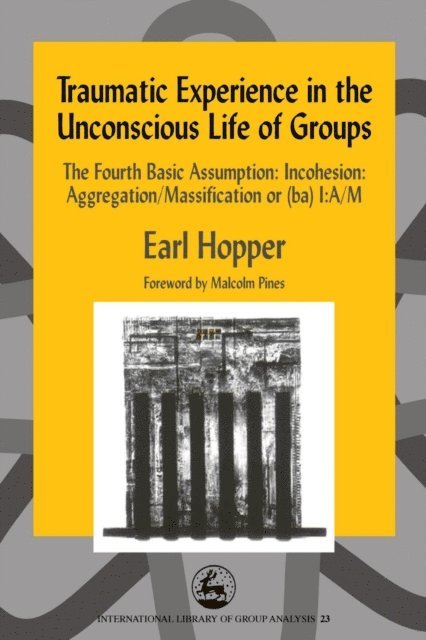
Traumatic Experience in the Unconscious Life of Groups
The Fourth Basic Assumption: Incohesion: Aggregation/Massification or (ba) I:A/M
Av Earl Hopper
Häftad, 2003
832 kr
Lägg i varukorg
Earl Hopper, in his important, profound and well reasoned book introduces a fourth Basic Assumption (Incohesion) to the three Basic assumptions (of Flight/ Fight, Pairing and Dependency) introduced by Bion. Hopper's theory of Incohesion provides us with a new way of thinking about annihilation …
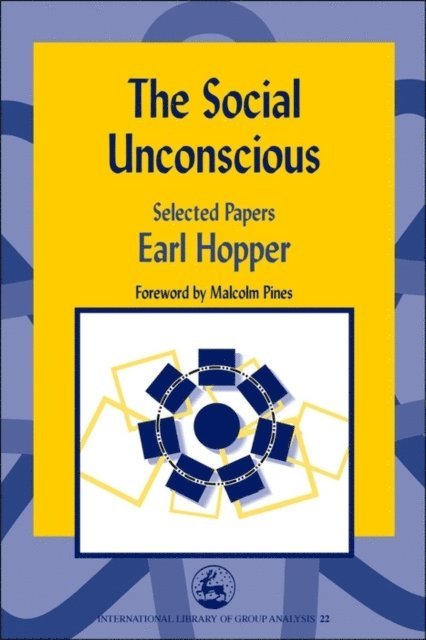
Social Unconscious
Selected Papers
Av Earl Hopper
Häftad, 2002
757 kr
Lägg i varukorg
In this text, Earl Hopper has made a major contribution to the understanding of the depth and breadth of individuals and how we might help them to know more of their patterns of relatedness with others, inter-personally, socially and culturally. Of particular note is the open honest manner of his …
Social Unconscious
Selected Papers
Av Earl Hopper
E-bok, 2002
813 kr
Lägg i varukorg
In this text, Earl Hopper has made a major contribution to the understanding of the depth and breadth of individuals and how we might help them to know more of their patterns of relatedness with others, inter-personally, socially and culturally. Of particular note is the open honest manner of his …
Traumatic Experience in the Unconscious Life of Groups
The Fourth Basic Assumption: Incohesion: Aggregation/Massification or (ba) I:A/M
Av Earl Hopper
E-bok, 2003
761 kr
Lägg i varukorg
'Earl Hopper, in his important, profound and well reasoned book introduces a fourth Basic Assumption (Incohesion) to the three Basic assumptions (of Flight/ Fight, Pairing and Dependency) introduced by Bion. Hopper's theory of Incohesion provides us with a new way of thinking about annihilation …
Social Unconscious in Persons, Groups and Societies
Mainly Theory
Häftad, 2011
740 kr
Lägg i varukorg
The social unconscious is vital for understanding persons and their groupings, ranging from families to societies, committees to organisations, and from small to median to large therapeutic groups, and essential for comprehensive clinical work. This series of volumes of contributions from an …
Trauma and Organizations
Häftad, 2012
627 kr
Lägg i varukorg
This collection of new contributions from psychoanalysts, group analysts and organisational consultants from Europe, Australia and the United States examines the patterns of conscious and unconscious life of those organisations in which traumatic experience is ubiquitous. Among the organisations …