Eberhard Gwinner – författare
Visar alla böcker från författaren Eberhard Gwinner. Handla med fri frakt och snabb leverans.
7 produkter
7 produkter
Inbunden, Engelska, 2003
3 258 kr
Skickas inom 10-15 vardagar
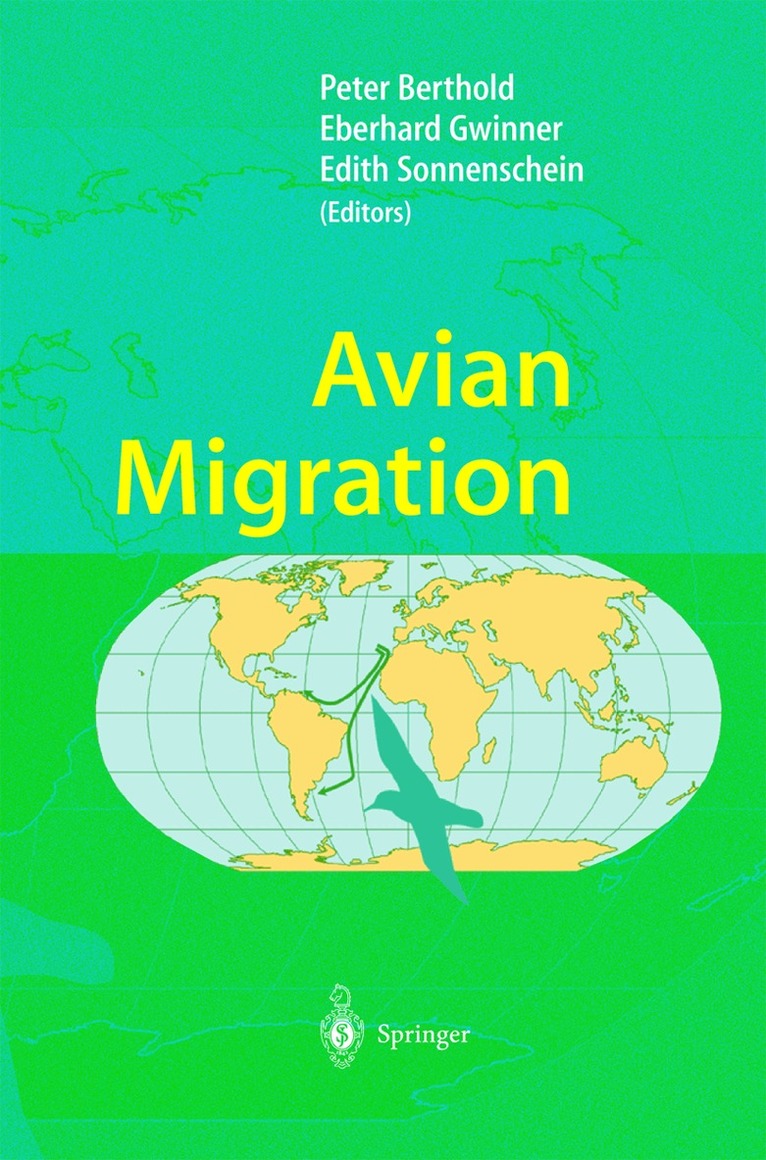
The reader of this comprehensive presentation benefits from an outstanding overview of all aspects of the fascinating phenomenon of bird migration. The book is written by leading experts from around the world. The text summarizes reviews and discussions of the most recent hypotheses. In doing so, it covers the entire research field from phenomenology through to ecology, physiology, control mechanisms, orientation, evolutionary aspects and conservation measures. It also examines the most modern methodological approaches including, satellite trakcking, molecular techniques or stable isotope investigations and envisages forthcoming developments in the course of global warming.
Häftad, Engelska, 2010
3 258 kr
Skickas inom 10-15 vardagar
P. Berthold and E. Gwinnd Bird migration is an intriguing aspect of the living world - so much so that it has been investigated for as long, and as thoroughly, as almost any other natural phenomenon. Aristotle, who can count as the founder of scientific ornithology, paid very close attention to the migrations of the birds he ob served, but it was not until the reign of Friedrich II, in the first half of the 13th century, that reliable data began to be obtained. From then on, the data base grew rapidly. Systematic studies of bird migration were introduced when the Vogelwarte Rossitten was founded, as the first ornithological biological observation station in the world (see first chapter "In Memory of Vogelwarte Rossitten"). This area later received enormous impetus when ex perimental research on the subject was begun: the large-scale bird-ringing experiment initiated in Rossitten in 1903 by Johannes Thienemann (who was inspired by the pioneering studies of C. C. M. Mortensen), the experiments on photoperiodicity carried out by William Rowan in the 1920s in Canada and retention and release experiments performed by Thienemann in the 1930s in Rossitten, the first experimental study on the orientation of migratory birds. After the Second World War, migration research, while continuing in the previous areas, also expanded into new directions such as radar ornithology, ecophysiology and hormonal control mechanisms, studies of evolution, ge netics, telemetry and others.
E-bok
PDF, Engelska, 20122 741 kr
Läs direkt efter köp
E. GWINNER! The phenomenon of bird migration with its large scale dimensions has attracted the attention of naturalists for centuries. Worldwide billions of birds leave their breeding grounds every autumn to migrate to areas with seasonally more favor able conditions. Many of these migrants travel only over a few hundred kilo meters but others cover distances equivalent to the circumference of the earth. Among these long-distance migrants are several billion birds that invade Africa every autumn from their West and Central Palaearctic breeding areas. In the Americas and in Asia the scope of bird migration is of a similar magnitude. Just as impressive as the numbers of birds are their achievements. They have to cope with the enormous energetic costs of long-distance flying. particularly while crossing oceans and deserts that do not allow replenishment of depleted fat reserves. They have to appropriately time the onset and end of migrations. both on a daily and annual basis. And finally. they have to orient their migratory movements in space to reach their species- or population-specific wintering and breeding grounds, irrespective of the variable climatic conditions along their migratory routes.
Häftad, Engelska, 2011
2 174 kr
Skickas inom 10-15 vardagar
E. GWINNER! The phenomenon of bird migration with its large scale dimensions has attracted the attention of naturalists for centuries. Worldwide billions of birds leave their breeding grounds every autumn to migrate to areas with seasonally more favor able conditions. Many of these migrants travel only over a few hundred kilo meters but others cover distances equivalent to the circumference of the earth. Among these long-distance migrants are several billion birds that invade Africa every autumn from their West and Central Palaearctic breeding areas. In the Americas and in Asia the scope of bird migration is of a similar magnitude. Just as impressive as the numbers of birds are their achievements. They have to cope with the enormous energetic costs of long-distance flying. particularly while crossing oceans and deserts that do not allow replenishment of depleted fat reserves. They have to appropriately time the onset and end of migrations. both on a daily and annual basis. And finally. they have to orient their migratory movements in space to reach their species- or population-specific wintering and breeding grounds, irrespective of the variable climatic conditions along their migratory routes.
E-bok
PDF, Engelska, 20121 367 kr
Läs direkt efter köp
In addition to the more or less static properties of the environ ment, plants and animals must cope with its temporal variations. Among the most conspicuous temporal changes to which organisms are exposed are periodic phenomena generated by the rotation of the earth about its axis, its revolution around the sun, and the more complex movements of the moon in relation to both sun and earth. The first two of these astronomical cycles are basic to the familiar daily and annual rhythms, respectively, in the environment. The third generates somewhat more complex cycles, such as those in moonlight and variations in tides. These environmental cycles have provided challenges and opportunities for organisms to adjust their physiology and behavior to them. Indeed, the predictability inherent to these periodic processes has enabled organisms to evolve innate endogenous rhythmic programs that match the environmental cycles and allow, in a variety of different ways, adjustment of biological activities to the cycles of environmental changes. The endogenous nature of rhythmicity was first clearly recognized in the 1930''s in daily periodicities, the most widely distributed and best investigated class of biological rhythms of this type. In the 1950''s, demonstrations of endogenous tidal and lunar rhythms, which occur in some littoral and marine organisms, ensued. Another decade passed before endogenous annual periodicities were first demonstrated unambiguously.
Del 18 - Zoophysiology
Circannual Rhythms
Endogenous Annual Clocks in the Organization of Seasonal Processes
Häftad, Engelska, 2011
1 091 kr
Skickas inom 10-15 vardagar
In addition to the more or less static properties of the environ ment, plants and animals must cope with its temporal variations. Among the most conspicuous temporal changes to which organisms are exposed are periodic phenomena generated by the rotation of the earth about its axis, its revolution around the sun, and the more complex movements of the moon in relation to both sun and earth. The first two of these astronomical cycles are basic to the familiar daily and annual rhythms, respectively, in the environment. The third generates somewhat more complex cycles, such as those in moonlight and variations in tides. These environmental cycles have provided challenges and opportunities for organisms to adjust their physiology and behavior to them. Indeed, the predictability inherent to these periodic processes has enabled organisms to evolve innate endogenous rhythmic programs that match the environmental cycles and allow, in a variety of different ways, adjustment of biological activities to the cycles of environmental changes. The endogenous nature of rhythmicity was first clearly recognized in the 1930's in daily periodicities, the most widely distributed and best investigated class of biological rhythms of this type. In the 1950's, demonstrations of endogenous tidal and lunar rhythms, which occur in some littoral and marine organisms, ensued. Another decade passed before endogenous annual periodicities were first demonstrated unambiguously.
E-bok
PDF, Engelska, 20133 809 kr
Läs direkt efter köp
P. Berthold and E. Gwinnd Bird migration is an intriguing aspect of the living world - so much so that it has been investigated for as long, and as thoroughly, as almost any other natural phenomenon. Aristotle, who can count as the founder of scientific ornithology, paid very close attention to the migrations of the birds he ob served, but it was not until the reign of Friedrich II, in the first half of the 13th century, that reliable data began to be obtained. From then on, the data base grew rapidly. Systematic studies of bird migration were introduced when the Vogelwarte Rossitten was founded, as the first ornithological biological observation station in the world (see first chapter "In Memory of Vogelwarte Rossitten"). This area later received enormous impetus when ex perimental research on the subject was begun: the large-scale bird-ringing experiment initiated in Rossitten in 1903 by Johannes Thienemann (who was inspired by the pioneering studies of C. C. M. Mortensen), the experiments on photoperiodicity carried out by William Rowan in the 1920s in Canada and retention and release experiments performed by Thienemann in the 1930s in Rossitten, the first experimental study on the orientation of migratory birds. After the Second World War, migration research, while continuing in the previous areas, also expanded into new directions such as radar ornithology, ecophysiology and hormonal control mechanisms, studies of evolution, ge netics, telemetry and others.