Ed F. Deprettere – författare
Visar alla böcker från författaren Ed F. Deprettere. Handla med fri frakt och snabb leverans.
4 produkter
4 produkter
Inbunden, Engelska, 2010
2 138 kr
Skickas inom 10-15 vardagar
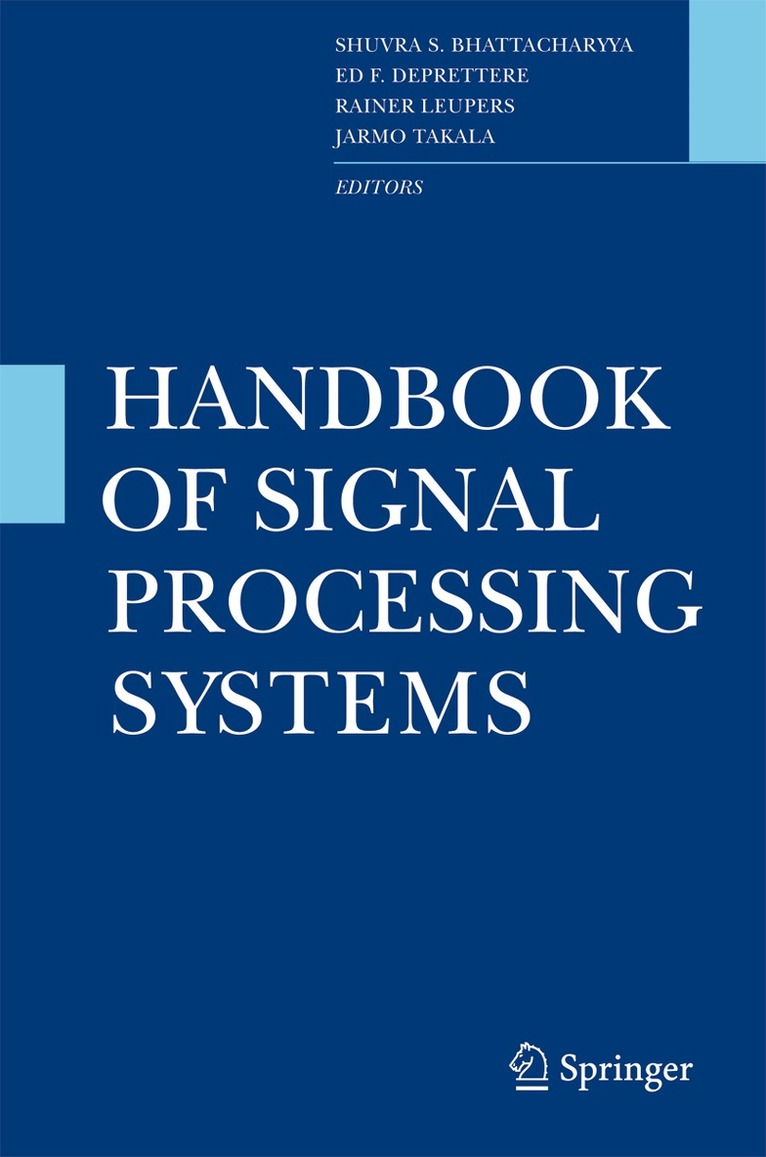
It gives me immense pleasure to introduce this timely handbook to the research/- velopment communities in the ?eld of signal processing systems (SPS). This is the ?rst of its kind and represents state-of-the-arts coverage of research in this ?eld. The driving force behind information technologies (IT) hinges critically upon the major advances in both component integration and system integration. The major breakthrough for the former is undoubtedly the invention of IC in the 50’s by Jack S. Kilby, the Nobel Prize Laureate in Physics 2000. In an integrated circuit, all components were made of the same semiconductor material. Beginning with the pocket calculator in 1964, there have been many increasingly complex applications followed. In fact, processing gates and memory storage on a chip have since then grown at an exponential rate, following Moore’s Law. (Moore himself admitted that Moore’s Law had turned out to be more accurate, longer lasting and deeper in impact than he ever imagined. ) With greater device integration, various signal processing systems have been realized for many killer IT applications. Further breakthroughs in computer sciences and Internet technologies have also catalyzed large-scale system integration. All these have led to today’s IT revolution which has profound impacts on our lifestyle and overall prospect of humanity. (It is hard to imagine life today without mobiles or Internets!) The success of SPS requires a well-concerted integrated approach from mul- ple disciplines, such as device, design, and application.
4 155 kr
Skickas inom 10-15 vardagar
In this new edition of the Handbook of Signal Processing Systems, many of the chapters from the previous editions have been updated, and several new chapters have been added. The new contributions include chapters on signal processing methods for light field displays, throughput analysis of dataflow graphs, modeling for reconfigurable signal processing systems, fast Fourier transform architectures, deep neural networks, programmable architectures for histogram of oriented gradients processing, high dynamic range video coding, system-on-chip architectures for data analytics, analysis of finite word-length effects in fixed-point systems, and models of architecture. There are more than 700 tables and illustrations; in this edition over 300 are in color.This new edition of the handbook is organized in three parts. Part I motivates representative applications that drive and apply state-of-the art methods for design and implementation of signal processing systems; Part II discusses architectures for implementing these applications; and Part III focuses on compilers, as well as models of computation and their associated design tools and methodologies.
4 155 kr
Skickas inom 10-15 vardagar
In this new edition of the Handbook of Signal Processing Systems, many of the chapters from the previous editions have been updated, and several new chapters have been added. The new contributions include chapters on signal processing methods for light field displays, throughput analysis of dataflow graphs, modeling for reconfigurable signal processing systems, fast Fourier transform architectures, deep neural networks, programmable architectures for histogram of oriented gradients processing, high dynamic range video coding, system-on-chip architectures for data analytics, analysis of finite word-length effects in fixed-point systems, and models of architecture. There are more than 700 tables and illustrations; in this edition over 300 are in color.This new edition of the handbook is organized in three parts. Part I motivates representative applications that drive and apply state-of-the art methods for design and implementation of signal processing systems; Part II discusses architectures for implementing these applications; and Part III focuses on compilers, as well as models of computation and their associated design tools and methodologies.
Häftad, Engelska, 2002
556 kr
Skickas inom 10-15 vardagar
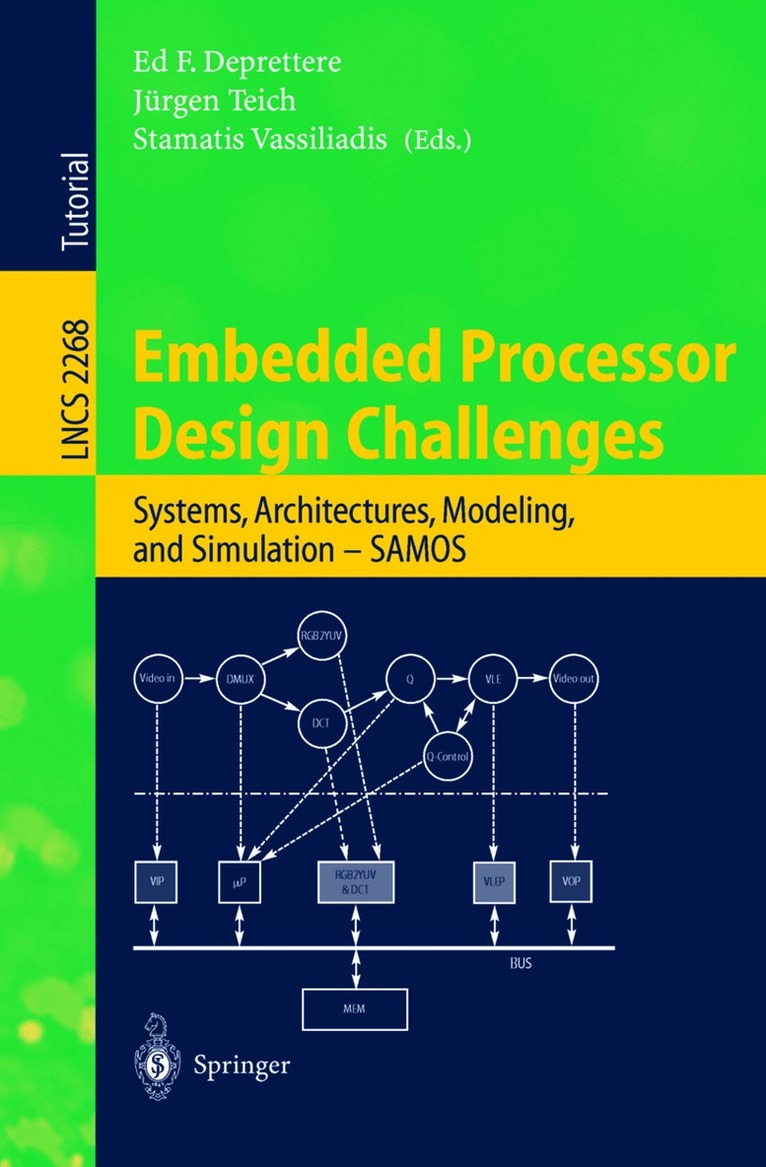
This textbook is intended to give an introduction to and an overview of sta- of-the-art techniques in the design of complex embedded systems. The book title is SAMOS for two major reasons. First, it tries to focus on the actual distinct, yet important problem ?elds of System-Level design of embedded systems, including mapping techniques and synthesis,Architectural design,Modeling issues such as speci?cation languages, formal models, and- nallySimulation. The second reason is that the volume includes a number of papers presented at a workshop with the same name on the Island of Samos, Greece, in July 2001. In order to receive international attention, a number of reputed researchers were invited to this workshop to present their current work. Participation was by invitation only. For the volume presented here, a number of additional papers where selected based on a call for papers. All contributions were refereed. This volume presents a selection of 18 of the refereed papers, including 2 invited papers. The textbook is organized according to four topics: The ?rst isA)System- LevelDesignandSimulation.Inthissection,wepresentacollectionofpapers that give an overview of the challenging goal to design and explore alternatives of embedded system implementations at the system-level. One paper gives an overview of models and tools used in system-level design. The other papers present new models to describe applications, provide models for re?nement and design space exploration, and for tradeo? analysis between cost and ?exibility of an implementation.