Edison T. Liu – författare
Visar alla böcker från författaren Edison T. Liu. Handla med fri frakt och snabb leverans.
3 produkter
3 produkter
E-bok
Engelska, 2009962 kr
Läs direkt efter köp
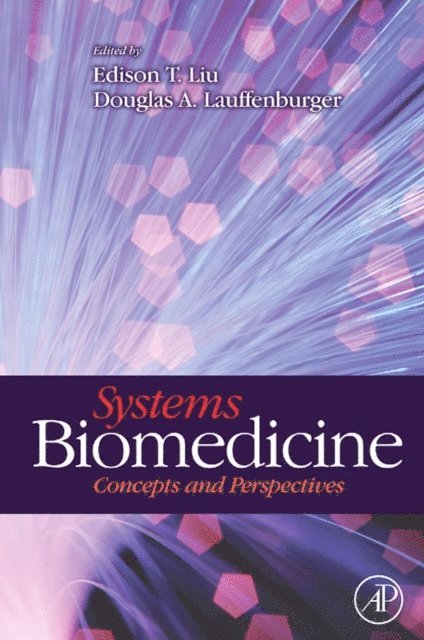
Systems biology is a critical emerging field that quantifies and annotates the complexity of biological systems in order to construct algorithmic models to predict outcomes from component input. Applications in medicine are revolutionizing our understanding of biological processes and systems.Systems Biomedicine is organized around foundations, computational modeling, network biology, and integrative biology, with the extension of examples from human biology and pharmacology, to focus on the applications of systems approaches to medical problems. An integrative approach to the underlying genomic, proteomic, and computational biology principles provides researchers with guidance in the use of qualitative systems and hypothesis generators. To reflect the highly interdisciplinary nature of the field, careful detail has been extended to ensure explanations of complex mathematical and biological principles are clear with minimum technical jargon.- Organized to reflect the important distinguishing characteristics of systems strategies in experimental biology and medicine- Provides precise and comprehensive measurement tools for constructing a model of the system and tools for defining complexity as an experimental dependent variable- Includes a thorough discussion of the applications of quantitative principles to biomedical problems
Häftad, Engelska, 1988
1 123 kr
Skickas inom 10-15 vardagar
"Cancer viruses" have played a paradoxical role in the history of cancer research. Discovered in 1911 by Peyton Rous (1) at the Rockefeller Institute, they were largely ignored for several decades. Witness his eventual recognition for a Nobel Prize, but not until 1966-setting an all time record for latency, and testimony to one more advantage of longevity. In the 1950s, another Rockefeller Nobelist, Wendell Stanley, spearheaded a campaign to focus attention on viruses as etiological agents in cancer, his plat form having been the chemical characterization of the tobacco mosaic virus as a pure protein-correction, ribonucleoprotein-in 1935 (2). This doctrine was a centerpiece of the U.S. National Cancer Crusade of 1971: if human cancers were caused by viruses, the central task was to isolate them and prepare vaccines for immunization. At that point, many observers felt that perhaps too much attention was being devoted to cancer viruses. It was problematic whether viruses played an etiological role in more than a handful of human cancers.
E-bok
PDF, Engelska, 20121 408 kr
Läs direkt efter köp
"Cancer viruses" have played a paradoxical role in the history of cancer research. Discovered in 1911 by Peyton Rous (1) at the Rockefeller Institute, they were largely ignored for several decades. Witness his eventual recognition for a Nobel Prize, but not until 1966-setting an all time record for latency, and testimony to one more advantage of longevity. In the 1950s, another Rockefeller Nobelist, Wendell Stanley, spearheaded a campaign to focus attention on viruses as etiological agents in cancer, his plat form having been the chemical characterization of the tobacco mosaic virus as a pure protein-correction, ribonucleoprotein-in 1935 (2). This doctrine was a centerpiece of the U.S. National Cancer Crusade of 1971: if human cancers were caused by viruses, the central task was to isolate them and prepare vaccines for immunization. At that point, many observers felt that perhaps too much attention was being devoted to cancer viruses. It was problematic whether viruses played an etiological role in more than a handful of human cancers.