Edith R. Jiménez Huerta – författare
Visar alla böcker från författaren Edith R. Jiménez Huerta. Handla med fri frakt och snabb leverans.
4 produkter
Housing Policy in Latin American Cities
A New Generation of Strategies and Approaches for 2016 UN-HABITAT III
Av Peter M. Ward, Edith R. Jiménez Huerta m. fl.
Inbunden, 2014
2504 kr
Lägg i varukorg
After the 1960s, rapid urbanization in developing regions in Latin America, Africa, and Asia was marked by the expansion of low-income "irregular" settlements that developed informally and which, by the 2000s, often constituted between 20-60 percent of the built-up area of metropolitan areas and …
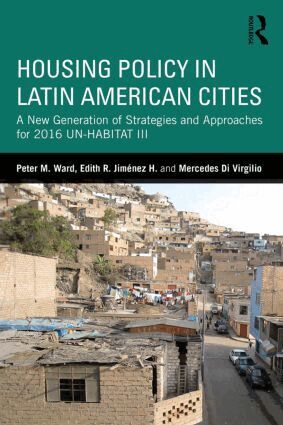
Housing Policy in Latin American Cities
A New Generation of Strategies and Approaches for 2016 UN-HABITAT III
Av Peter M. Ward, Edith R. Jiménez Huerta m. fl.
Häftad, 2014
780 kr
Lägg i varukorg
After the 1960s, rapid urbanization in developing regions in Latin America, Africa, and Asia was marked by the expansion of low-income "irregular" settlements that developed informally and which, by the 2000s, often constituted between 20-60 percent of the built-up area of metropolitan areas and …
Housing Policy in Latin American Cities
A New Generation of Strategies and Approaches for 2016 UN-HABITAT III
Av Maria Mercedes Di Virgilio, Edith R. Jimenez Huerta m. fl.
E-bok, 2015
908 kr
Lägg i varukorg
After the 1960s, rapid urbanization in developing regions in Latin America, Africa, and Asia was marked by the expansion of low-income "irregular" settlements that developed informally and which, by the 2000s, often constituted between 20-60 percent of the built-up area of metropolitan areas and …
Housing Policy in Latin American Cities
A New Generation of Strategies and Approaches for 2016 UN-HABITAT III
Av Maria Mercedes Di Virgilio, Edith R. Jimenez Huerta m. fl.
E-bok, 2015
935 kr
Lägg i varukorg
After the 1960s, rapid urbanization in developing regions in Latin America, Africa, and Asia was marked by the expansion of low-income "irregular" settlements that developed informally and which, by the 2000s, often constituted between 20-60 percent of the built-up area of metropolitan areas and …