Edmund M. Clarke Jr. - Böcker
Visar alla böcker från författaren Edmund M. Clarke Jr.. Handla med fri frakt och snabb leverans.
5 produkter
5 produkter
726 kr
Tillfälligt slut
1 797 kr
Skickas inom 10-15 vardagar
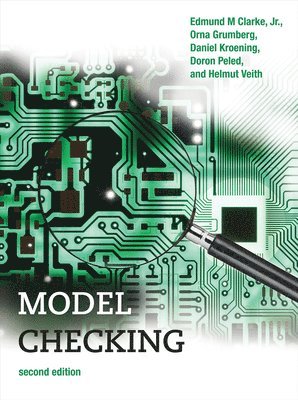
Model checking is a computer-assisted method for the analysis of dynamical systems that can be modeled by state-transition systems. Drawing from research traditions in mathematical logic, programming languages, hardware design, and theoretical computer science, model checking is now widely used for the verification of hardware and software in industry.The editors and authors of this handbook are among the world's leading researchers in this domain, and the 32 contributed chapters present a thorough view of the origin, theory, and application of model checking. In particular, the editors classify the advances in this domain and the chapters of the handbook in terms of two recurrent themes that have driven much of the research agenda: the algorithmic challenge, that is, designing model-checking algorithms that scale to real-life problems; and the modeling challenge, that is, extending the formalism beyond Kripke structures and temporal logic.The book will be valuable for researchers and graduate students engaged with the development of formal methods and verification tools.
1 524 kr
Skickas inom 10-15 vardagar
Model checking is a computer-assisted method for the analysis of dynamical systems that can be modeled by state-transition systems. Drawing from research traditions in mathematical logic, programming languages, hardware design, and theoretical computer science, model checking is now widely used for the verification of hardware and software in industry.The editors and authors of this handbook are among the world's leading researchers in this domain, and the 32 contributed chapters present a thorough view of the origin, theory, and application of model checking. In particular, the editors classify the advances in this domain and the chapters of the handbook in terms of two recurrent themes that have driven much of the research agenda: the algorithmic challenge, that is, designing model-checking algorithms that scale to real-life problems; and the modeling challenge, that is, extending the formalism beyond Kripke structures and temporal logic.The book will be valuable for researchers and graduate students engaged with the development of formal methods and verification tools.
Computer-Aided Verification
2nd Internatonal Conference, CAV '90, New Brunswick, NJ, USA, June 18-21, 1990. Proceedings
Häftad, Engelska, 1991
533 kr
Skickas inom 10-15 vardagar
This volume contains the proceedings of the second workshopon Computer Aided Verification, held at DIMACS, RutgersUniversity, June 18-21, 1990. Itfeatures theoreticalresults that lead to new or more powerful verificationmethods. Among these are advances in the use of binarydecision diagrams, dense time, reductions based upon partialorder representations and proof-checking in controllerverification. The motivation for holding a workshop oncomputer aided verification was to bring together work oneffective algorithms or methodologies for formalverification - as distinguished, say,from attributes oflogics or formal languages. The considerable interestgenerated by the first workshop, held in Grenoble, June 1989(see LNCS 407), prompted this second meeting. The generalfocus of this volume is on the problem of making formalverification feasible for various models of computation. Specific emphasis is on models associated with distributedprograms, protocols, and digital circuits. The general testof algorithm feasibility is to embed it into a verificationtool, and exercise that tool on realistic examples: theworkshop included sessionsfor the demonstration of newverification tools.
Logic for Programming, Artificial Intelligence, and Reasoning
16th International Conference, LPAR-16, Dakar, Senegal, April 25--May 1, 2010, Revised Selected Papers
Häftad, Engelska, 2011
549 kr
Skickas inom 10-15 vardagar
This book constitutes the thoroughly refereed post-conference proceedings of the 16th International Conference on Logic for Programming, Artificial Intelligence, and Reasoning, LPAR 2010, whichtook place in Dakar, Senegal, in April/May 2010.The 27 revised full papers and 9 revised short papers presented together with 1 invited talk were carefully revised and selected from 47 submissions. The papers address all current issues in automated reasoning, computational logic, programming languages and deal with logic programming, logic-based program manipulation, formal methods, and various kinds of AI logics. Subjects covered range from theoretical aspects to various applications such as automata, linear arithmetic, verification, knowledge representation, proof theory, quantified constraints, as well as modal and temporal logics.