Eduardo Grüner – författare
Visar alla böcker från författaren Eduardo Grüner. Handla med fri frakt och snabb leverans.
5 produkter
5 produkter
Inbunden, Engelska, 2019
747 kr
Skickas inom 5-8 vardagar
It is impossible to understand capitalism without analyzing slavery, an institution that tied together three world regions: Europe, the Americas, and Africa. The exploitation of slave labor led to a form of proto-globalization in which violence was indispensable to the production of wealth. Against the background of this expanding circulation of capital and slave labor, the first revolution in Latin America took place: the Haitian Revolution, which began in 1791 and culminated with Haiti’s declaration of independence in 1804. Taking the Haitian Revolution as a paradigmatic case, Grüner shows that modernity is not a linear evolution from the center to the periphery but, rather, a co-production developed in the context of highly unequal power relations, where extreme forms of conquest and exploitation were an indispensable part of capital accumulation. He also shows that the Haitian Revolution opened up a path to a different kind of modernity, or “counter-modernity,” a path along which Latin America and the Caribbean have traveled ever since.A key work of critical theory from a Latin American perspective, this book will be of great interest to students and scholars of critical and cultural theory and of Latin America, as well as anyone concerned with the global impact of capitalism, colonialism, and race.

Häftad, Engelska, 2019
261 kr
Skickas inom 5-8 vardagar
It is impossible to understand capitalism without analyzing slavery, an institution that tied together three world regions: Europe, the Americas, and Africa. The exploitation of slave labor led to a form of proto-globalization in which violence was indispensable to the production of wealth. Against the background of this expanding circulation of capital and slave labor, the first revolution in Latin America took place: the Haitian Revolution, which began in 1791 and culminated with Haiti’s declaration of independence in 1804. Taking the Haitian Revolution as a paradigmatic case, Grüner shows that modernity is not a linear evolution from the center to the periphery but, rather, a co-production developed in the context of highly unequal power relations, where extreme forms of conquest and exploitation were an indispensable part of capital accumulation. He also shows that the Haitian Revolution opened up a path to a different kind of modernity, or “counter-modernity,” a path along which Latin America and the Caribbean have traveled ever since.A key work of critical theory from a Latin American perspective, this book will be of great interest to students and scholars of critical and cultural theory and of Latin America, as well as anyone concerned with the global impact of capitalism, colonialism, and race.

Häftad, Spanska, 2024
212 kr
Skickas inom 5-8 vardagar
E-bok
Spanska, 202067 kr
Läs direkt efter köp
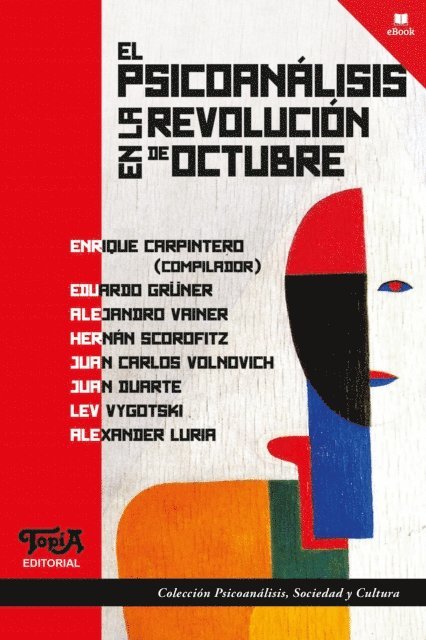
La historia oficial construyó un relato donde el Psicoanálisis y la Revolución de Octubre fueron por caminos separados. Una Revolución, que supuestamente abjuró del psicoanálisis. Un Psicoanálisis, que siguiendo las instrucciones de Freud, se opuso a cualquier encuentro con el marxismo.Sin embargo, la historia fue otra. Este libro pone luz sobre aquellos sucesos que fueron enterrados por las hegemonías. Un conjunto de investigaciones ideadas y compiladas por Enrique Carpintero toman distintos tópicos de lo sucedido en el psicoanálisis atravesado por la Revolución de Octubre.Walter Benjamin sostenía que "La historia es objeto de construcción cuyo marco no es el tiempo homogéneo y vacío, sino un ámbito lleno de ´tiempo actual´". A cien años de la Revolución de Octubre nos encontramos con un mundo que ha cambiado radicalmente. Un mundo atravesado por la crisis de un sujeto que hace necesario seguir sosteniendo la esperanza de un proyecto emancipatorio social y político. La actualidad de nuestro tiempo hace necesario recordar. Y este es el propósito de este libro.
E-bok
PDF, Spanska, 202356 kr
Läs direkt efter köp
Este libro reúne los aportes de un grupo de investigadores convocados por una inquietud común en torno a un campo de problemas que la figura de Louis Althusser no agota, pero de algún modo hace converger. Abordajes diferentes confluyen sobre un mismo gesto: volver a Althusser; regresar sobre sus lecturas de Marx, Maquiavelo, Hegel, Spinoza, Freud y Levi-Strauss; ponerlo a dialogar con Lacan, Deleuze, Badiou, Zizek y Laclau; revisar la fecundidad de sus categorías con interrogantes renovados sobre teoría, historia, ideología y política. En resumen, se trata de agitar lecturas perimidas para encontrar, al pie de la letra, la potencia de un campo teórico de suma vitalidad. Si la posición de una teoría constituye un encuentro que sólo habrá comenzado si es capaz de durar, este libro quiere ser el vehículo de ese impulso intelectual y político que disloca segmentaciones disciplinares y cánones generacionales, para volver insistentemente sobre la pregunta central de toda teoría que se quiera comprometida con las cuestiones de su tiempo.