Eduardo J. Gómez - Böcker
Visar alla böcker från författaren Eduardo J. Gómez. Handla med fri frakt och snabb leverans.
4 produkter
4 produkter
Geopolitics in Health
Confronting Obesity, AIDS, and Tuberculosis in the Emerging BRICS Economies
Häftad, Engelska, 2018
417 kr
Skickas inom 7-10 vardagar
In recent years, political leaders in Brazil, Russia, India, China, and South Africa, collectively known as the BRICS, have worked to reformulate international discussions and policies on issues ranging from fair and free trade to human rights. When it comes to health epidemics, however, the BRICS have differed greatly in terms of how-and when-they respond, highlighting important differences in their political commitment to meeting healthcare needs. In Geopolitics in Health, Eduardo J. Gomez takes a critical look at how the emerging BRICS economies dealt with the obesity, AIDS, and tuberculosis epidemics. Despite the countries having similar international political and economic ambitions, Gomez finds that domestic policy responses were driven mainly by international, as opposed to domestic, pressures and interests. Using a theoretical framework called geopolitical positioning, Gomez explores how nations respond to international pressures and policy criticisms, as well as their willingness to receive financial and technical assistance, to use domestic policy innovations, and, ultimately, to engage in global health diplomacy in order to bolster their international reputation.Gomez draws on extensive data and case studies and argues that leaders aspiring to build their reputations among elite nations have a ready way to demonstrate their status through quick and effective public health responses, whereas those who scorn the international community tend to react slowly and ineffectively to the same type of crises. The first book of its kind to conduct an in-depth comparative historical analysis of how the BRICS deal with public health threats, Geopolitics in Health demonstrates the value of positive geopolitical positioning and strong partnerships with other governments, nongovernmental organizations, and social health movements.
Junk Food Politics
How Beverage and Fast Food Industries Are Reshaping Emerging Economies
Inbunden, Engelska, 2023
390 kr
Skickas
Why do sugary beverage and fast food industries thrive in the emerging world?An interesting public health paradox has emerged in some developing nations. Despite government commitment to eradicating noncommunicable diseases and innovative prevention programs aimed at reducing obesity and type 2 diabetes, sugary beverage and fast food industries are thriving. But political leaders in countries such as Mexico, Brazil, India, China, and Indonesia are reluctant to introduce policies regulating the marketing and sale of their products, particularly among vulnerable groups like children and the poor. Why?In Junk Food Politics, Eduardo J. Gómez argues that the challenge lies with the strategic politics of junk food industries in these countries. Industry leaders have succeeded in creating supportive political coalitions by, ironically, partnering with governments to promote soda taxes, food labeling, and initiatives focused on public awareness and exercise while garnering presidential support (and social popularity) through contributions to government anti-hunger and anti-poverty campaigns. These industries have also manipulated scientific research by working with academic allies while creating their own support bases among the poor through employment programs and community services. Taken together, these tactics have hampered people's ability to mobilize in support of stricter regulation for the marketing and sale of unhealthy products made by companies such as Coca-Cola, PepsiCo, and Nestlé.Drawing on detailed historical case studies, Junk Food Politics proposes an alternative political science framework that emphasizes how junk food corporations restructure politics and society before agenda-setting ever takes place. This pathbreaking book also reveals how these global corporations further their policy influence through the creation of transnational nongovernmental organizations that support industry views.
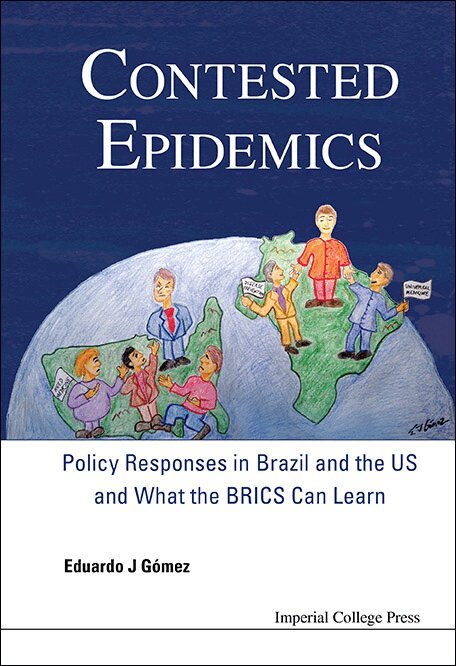
Contested Epidemics: Policy Responses In Brazil And The Us And What The Brics Can Learn
Inbunden, Engelska, 2014
1 690 kr
Skickas inom 5-8 vardagar
Despite their similar political and economic structures, Brazil and the United States have contrasting relationships with the international community as well as different policy approaches to the prevention and treatment of epidemics. In this regard, an interesting empirical puzzle arises: how and why was Brazil able to outpace the United States in its health policy response to epidemics?The aim of this book is to introduce a new, comparative area of scholarly research, combining for the first time international relations and domestic institutional theory to examine the United States and Brazil's health policy systems and their respective responses to epidemics. Conclusions are drawn from an in-depth examination of the actions taken and policies made with regard to tuberculosis, polio and HIV/AIDS epidemics in the two countries. Finally, the questions of what emerging BRICS nations can learn from the case of Brazil and to what extent they can adopt Brazil's innovative institutional and policy response to epidemics is considered, with a look to the future of global health diplomacy.This is the first book of its kind to compare the United States and Brazil in such a way, as well as the first to consider what other emerging BRICS countries can learn from Brazil. This fascinating comparison is a must-read for health policy and medical practitioners, academic scholars and students, and the general public with an interest in the international and domestic political conditions leading to policy adoption and implementation.
Decentralization in Asia and Latin America
Towards a Comparative Interdisciplinary Perspective
Inbunden, Engelska, 2006
2 417 kr
Skickas inom 7-10 vardagar
Although decentralization and reactions against it have become increasingly important policy trends in developing countries, the study of this nearly ubiquitous phenomenon has been largely fractured across academic disciplines, geographic regions, and the academic-practitioner divide. The contributors to this edited volume begin to cross some of these constraining, artificial boundaries. Considering decentralization from an interdisciplinary, historical, and comparative perspective, they collectively explore why it has evolved in particular ways and with varied outcomes. In addition to taking an atypically comparative perspective, the volume highlights the importance of an historical analysis of decentralization and links this to institutional and public policy outcomes. Placing decentralization in this context illustrates why it has taken dissimilar shapes and produced varying results over time in different countries. This in turn helps to clarify the types of institutions and conditions required for the development and survival of decentralization, paving the way for more creative thinking and informed policymaking. The countries covered include: Cambodia, China, India, Indonesia, Vietnam, Bolivia, Argentina, Mexico, Peru and Brazil. Students and scholars of economics, political science and development will find the policy and theoretical discussions enlightening. The volume will also prove useful to policymakers and development institutions confronting issues of decentralization.