Edward F. Rossomando - Böcker
Visar alla böcker från författaren Edward F. Rossomando. Handla med fri frakt och snabb leverans.
2 produkter
2 produkter
3 995 kr
Skickas inom 7-10 vardagar
The use of High Performance Liquid Chromatography (HPLC) techniques in the study of enzymatic reactions has grown significantly since the publication of the first edition of this highly successful book: the role of enzymes in biological research has expanded; the application of HPLC and enzymes has extended to more disciplines; advances in separation techniques and instrumentation have increased the capability of HPLC; and the discovery of new enzymes has spawned new methods of analysis. High Performance Liquid Chromatography in Enzymatic Analysis, Second Edition addresses these developments in its coverage of the refinements of HPLC methods and their use in a wide range of laboratory applications. It offers the same practical approach found in the first edition, incorporates a wealth of new information into existing chapters, and adds new chapters to deal with new applications, including capillary electrophoresis, forensic chemistry, microdialysis, and the polymerase chain reaction. Topics include:* Application of HPLC to the assay of enzymatic activities* Concepts and principles of HPLC, including the latest technological advances* Concepts and principles of capillary electrophoresis (CE)* Strategy for design of an HPLC/CE system for assay of enzyme activity* Preparation of enzymatic activities from tissues and single cells* Analysis of enzymatic activities in body fluids, including chromatobiosis* HPLC for the identification of new enzymatic activities* Fundamentals of the polymerase chain reaction* HPLC in forensics* Survey of enzymatic activities assayed by the HPLC method, including many new categories* Multienzyme systems, including many new examples* HPLC in the analysis of contaminated food "It is the ability of HPLC to accomplish separations completely and rapidly that led to its original application to problems in the life sciences, particularly those related to purification. An analysis of the literature revealed that this technique was used primarily for the purification of small molecules, macromolecules such as peptides and proteins, and more recently, antibodies. This application to purification has all but dominated the use of the method, and there has been a plethora of books, symposia, and conferences on the use of HPLC for these purposes. However, it was only a matter of time before others began to look beyond and to explore the possibilities that result from the capacity to make separations quickly and efficiently." --from the preface to the First Edition Easy to read and full of practical advice and hundreds of diagrams and examples, High Performance Liquid Chromatography in Enzymatic Analysis, Second Edition is an invaluable resource for students, researchers, and laboratory workers in analytical chemistry and biochemistry, molecular biology and cell biology, and for anyone interested in keeping up with this fast-growing field.
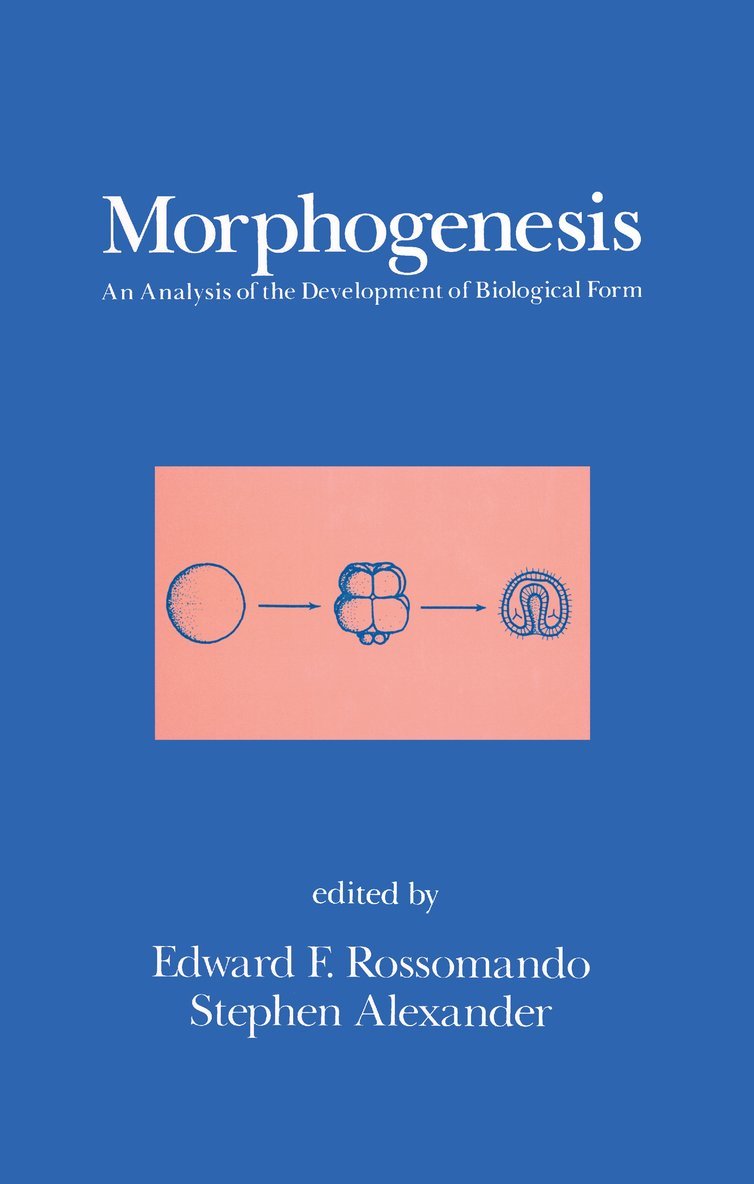
Morphogenesis
An Analysis of the Development of Biological Form: An Analysis of the Development of Biological Form
Inbunden, Engelska, 1992
4 595 kr
Skickas inom 10-15 vardagar
An integrated reference which could form the basis for advanced courses on development or become a resource for individuals teaching basic courses. Following an introduction by the volume editors, the 11 chapters represent 11 different systems, arranged phylogenetically. This in-depth volume explores all the major morphogenic systems from bacteria to vertebrates. Presenting a comprehensive picture of the events and mechanisms that contribute to the development of the mature biological form. Written by internationally recognised authorities in the field ‘Morphogenesis’ provides novel insights into the function of multicellularity and morphogens in morphogenesis… details prokaryotic and eukaryotic systems as well as the more complex morphogenesis of mammals and birds…analyses the similarities and differences between the morphogenic strategies used by diverse organisms and identifies the unique advantages of each…describes basic concepts of each biological system, current research developments, and future directions in research…considers the impact on each system of gene function, the environment., pattern formation, and the intercellular communication and information transfer…examines that biochemical, molecular biological, and genetic approaches used to study each system and more. Generously referenced with more than 1525 bibliographic citations, ‘Morphogenesis’ is essential reading for molecular., cell, and developmental biologists; biochemists; microbiologists, and upper level undergraduate and graduate students in these disciplines.