Edward Griffith – författare
Visar alla böcker från författaren Edward Griffith. Handla med fri frakt och snabb leverans.
16 produkter
Animal Kingdom
The Class Mammalia
Av Georges Cuvier (Baron), Edward Griffith m. fl.
Inbunden, 2023
503 kr
Lägg i varukorg
Animal Kingdom
The Class Mammalia
Av Georges Cuvier (Baron), Edward Griffith m. fl.
Häftad, 2023
384 kr
Lägg i varukorg
The Animal Kingdom
Arranged in Conformity with its Organization
Av Georges Cuvier, Edward Griffith
Häftad, 2012
764 kr
Lägg i varukorg
Georges Cuvier (1769-1832), made a peer of France in 1819 in recognition of his work, was perhaps the most important European scientist of his day. His most famous work, Le Règne Animal, was published in French in 1817; Edward Griffith (1790-1858), a solicitor and amateur naturalist, embarked on in …
The Animal Kingdom
Arranged in Conformity with its Organization
Av Georges Cuvier, Edward Griffith
Häftad, 2012
846 kr
Lägg i varukorg
Georges Cuvier (1769-1832), made a peer of France in 1819 in recognition of his work, was perhaps the most important European scientist of his day. His most famous work, Le Règne Animal, was published in French in 1817; Edward Griffith (1790-1858), a solicitor and amateur naturalist, embarked on in …
The Animal Kingdom
Arranged in Conformity with its Organization
Av Georges Cuvier, Edward Griffith
Häftad, 2012
846 kr
Lägg i varukorg
Georges Cuvier (1769-1832), made a peer of France in 1819 in recognition of his work, was perhaps the most important European scientist of his day. His most famous work, Le Règne Animal, was published in French in 1817; Edward Griffith (1790-1858), a solicitor and amateur naturalist, embarked on in …
The Animal Kingdom
Arranged in Conformity with its Organization
Av Georges Cuvier, Edward Griffith
Häftad, 2012
846 kr
Lägg i varukorg
Georges Cuvier (1769-1832), made a peer of France in 1819 in recognition of his work, was perhaps the most important European scientist of his day. His most famous work, Le Règne Animal, was published in French in 1817; Edward Griffith (1790-1858), a solicitor and amateur naturalist, embarked on in …
The Animal Kingdom
Arranged in Conformity with its Organization
Av Georges Cuvier, Edward Griffith
Häftad, 2012
764 kr
Lägg i varukorg
Georges Cuvier (1769-1832), created a peer of France in 1819 in recognition of his work, was perhaps the most important European scientist of his day. His most famous work, Le Règne Animal, was published in French in 1817; Edward Griffith (1790-1858), a solicitor and amateur naturalist, embarked on …
The Animal Kingdom
Arranged in Conformity with its Organization
Av Georges Cuvier, Edward Griffith
Häftad, 2012
828 kr
Lägg i varukorg
Georges Cuvier (1769-1832), made a peer of France in 1819 in recognition of his work, was perhaps the most important European scientist of his day. His most famous work, Le Règne Animal, was published in French in 1817; Edward Griffith (1790-1858), a solicitor and amateur naturalist, embarked on in …
The Animal Kingdom
Arranged in Conformity with its Organization
Av Georges Cuvier, Edward Griffith
Häftad, 2012
976 kr
Lägg i varukorg
Georges Cuvier (1769-1832), made a peer of France in 1819 in recognition of his work, was perhaps the most important European scientist of his day. His most famous work, Le Règne Animal, was published in French in 1817; Edward Griffith (1790-1858), a solicitor and amateur naturalist, embarked on in …
The Animal Kingdom
Arranged in Conformity with its Organization
Av Georges Cuvier, Edward Griffith
Häftad, 2012
976 kr
Lägg i varukorg
Georges Cuvier (1769-1832), made a peer of France in 1819 in recognition of his work, was perhaps the most important European scientist of his day. His most famous work, Le Règne Animal, was published in French in 1817; Edward Griffith (1790-1858), a solicitor and amateur naturalist, embarked on in …
The Animal Kingdom
Arranged in Conformity with its Organization
Av Georges Cuvier, Edward Griffith
Häftad, 2012
876 kr
Lägg i varukorg
Georges Cuvier (1769-1832), made a peer of France in 1819 in recognition of his work, was perhaps the most important European scientist of his day. His most famous work, Le Règne Animal, was published in French in 1817; Edward Griffith (1790-1858), a solicitor and amateur naturalist, embarked on in …
The Animal Kingdom
Arranged in Conformity with its Organization
Av Georges Cuvier, Edward Griffith
Häftad, 2012
1058 kr
Lägg i varukorg
Georges Cuvier (1769-1832), made a peer of France in 1819 in recognition of his work, was perhaps the most important European scientist of his day. His most famous work, Le Règne Animal, was published in French in 1817; Edward Griffith (1790-1858), a solicitor and amateur naturalist, embarked on in …
The Animal Kingdom
Arranged in Conformity with its Organization
Av Georges Cuvier, Edward Griffith m. fl.
Häftad, 2012
1058 kr
Lägg i varukorg
Georges Cuvier (1769-1832), made a peer of France in 1819 in recognition of his work, was perhaps the most important European scientist of his day. His most famous work, Le Règne Animal, was published in French in 1817; Edward Griffith (1790-1858), a solicitor and amateur naturalist, embarked on in …
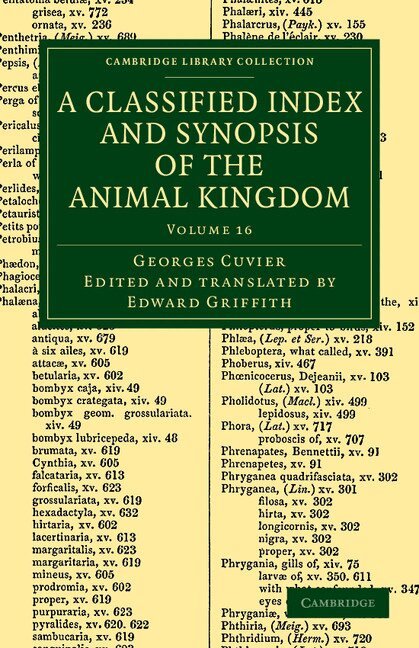
A Classified Index and Synopsis of the Animal Kingdom
Arranged in Conformity with its Organization
Av Georges Cuvier, Edward Griffith
Häftad, 2012
650 kr
Lägg i varukorg
Georges Cuvier (1769-1832), made a peer of France in 1819 in recognition of his work, was perhaps the most important European scientist of his day. His most famous work, Le Règne Animal, was published in French in 1817; Edward Griffith (1790-1858), a solicitor and amateur naturalist, embarked on in …
Animal Kingdom
Synopsis Of The Species Of The Class Mammalia, As Arranged With Reference To Their Organization By Cuvier And Other Naturalists: With Specific Characters, Synonyma, &c. &c. 1827
Av Georges Cuvier (Baron), Edward Griffith m. fl.
Inbunden, 2023
514 kr
Tillfälligt slut
Animal Kingdom
Synopsis Of The Species Of The Class Mammalia, As Arranged With Reference To Their Organization By Cuvier And Other Naturalists: With Specific Characters, Synonyma, &c. &c. 1827
Av Georges Cuvier (Baron), Edward Griffith m. fl.
Häftad, 2023
388 kr
Tillfälligt slut