Edward Nye – författare
Visar alla böcker från författaren Edward Nye. Handla med fri frakt och snabb leverans.
8 produkter
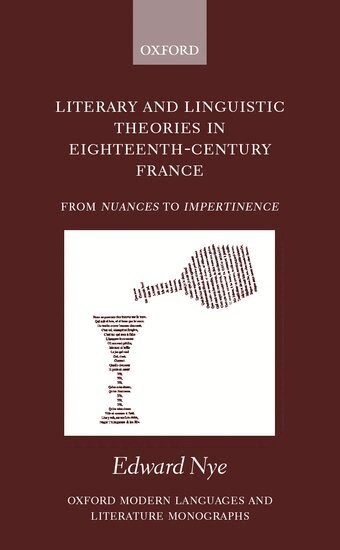
Literary and Linguistic Theories in Eighteenth-Century France
From Nuances to Impertinence
Av Edward Nye
Inbunden, 2000
4454 kr
Lägg i varukorg
Linguistic' theories in the eighteenth-century are also theories of literature and art, and it is probably better, therefore, to think of them as 'aesthetic' theories. As such, they are answers to the age-old question 'what is beauty?', but formulated, also, to respond to contemporary concerns. …
Deburau
Pierrot, Mime, and Culture
Av Edward Nye
Inbunden, 2022
2890 kr
Lägg i varukorg
This volume analyses the nature of the mime art of Deburau and of the pantomime performances of the Théâtre des Funambules in Paris in the context of Romantic art, literature and socio-political thought. Deburau and the Théâtre des Funambules are characteristic of Romantic art in that they are …
Deburau
Pierrot, Mime, and Culture
Av Edward Nye
E-bok, 2022
876 kr
Lägg i varukorg
This volume analyses the nature of the mime art of Deburau and of the pantomime performances of the Théâtre des Funambules in Paris in the context of Romantic art, literature and socio-political thought. Deburau and the Théâtre des Funambules are characteristic of Romantic art in that they are …
Deburau
Pierrot, Mime, and Culture
Av Edward Nye
E-bok, 2022
876 kr
Lägg i varukorg
This volume analyses the nature of the mime art of Deburau and of the pantomime performances of the Théâtre des Funambules in Paris in the context of Romantic art, literature and socio-political thought. Deburau and the Théâtre des Funambules are characteristic of Romantic art in that they are …
Correspondence; Images of the eighteenth century; Polemic, Style and aesthetics
Av Dorothy Medlin, Arnold Heertje m. fl.
Häftad, 2004
1655 kr
Lägg i varukorg
Deburau
Pierrot, Mime, and Culture
Av Edward Nye
Häftad, 2024
745 kr
Lägg i varukorg
This volume analyses the nature of the mime art of Deburau and of the pantomime performances of the Théâtre des Funambules in Paris in the context of Romantic art, literature and socio-political thought. Deburau and the Théâtre des Funambules are characteristic of Romantic art in that they are …
Mime, Music and Drama on the Eighteenth-Century Stage
The Ballet d'Action
Av Edward Nye
Inbunden, 2011
1559 kr
Lägg i varukorg
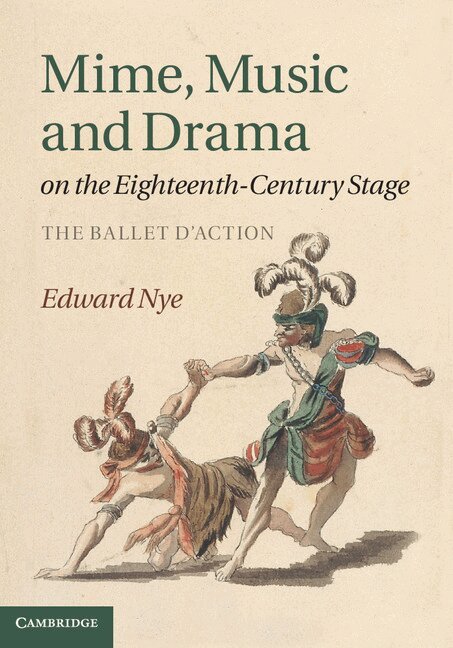
The 'ballet d'action' was one of the most successful and controversial forms of theatre in the early modern period. A curious hybrid of dance, mime and music, its overall and overriding intention was to create drama. It was danced drama rather than dramatic dance, musical drama rather than dramatic …
Sur quel pied danser?
Danse et littérature
Av Edward Nye
Häftad, 2005
1634 kr
Lägg i varukorg
La danse a inspiré la littérature, et la littérature a inspiré la danse. Mais comment fonctionne exactement l’articulation entre les deux, et quelles sont les conséquences de leur réciprocité ? Cet ouvrage analyse ce lien depuis la Renaissance jusqu’à l’époque moderne, de d’Aubigné à Francis Ponge, …