Eiji Oki – författare
967 kr
Skickas inom 10-15 vardagar
1 143 kr
Läs direkt efter köp
The rapid growth in communications and internet has changed our way of life, and our requirement for communication bandwidth. Optical networks can enable us to meet the continued demands for this bandwidth, although conventional optical networks struggle in achieving this, due to the limitation of the electrical bandwidth barrier. Flexgrid technology is a promising solution for future high-speed network design. To promote an efficient and scalable implementation of elastic optical technology in the telecommunications infrastructure, many challenging issues related to routing and spectrum allocation (RSA), resource utilization, fault management and quality of service provisioning must be addressed. This book reviews the development of elastic optical networks (EONs), and addresses RSA problems with spectrum fragment issues, which degrade the quality of service provisioning. The book starts with a brief introduction to optical fiber transmission system, and then provides an overview of the wavelength division multiplexing (WDM), and WDM optical networks. It discusses the limitations of conventional WDM optical networks, and discusses how EONs overcome these limitations. It presents the architecture of the EONs and its operation principle. To complete the discussion of network architecture, this book focuses on the different node architectures, and compares their performance in terms of scalability and flexibility. It reviews and classifies different RSA approaches, including their pros and cons. It focuses on different aspects related to RSA. The spectrum fragmentation is a serious issue in EONs, which needs to be managed. The book explains the fragmentation problem in EONs, discusses, and analyzes the major conventional spectrum allocation policies in terms of the fragmentation effect in a network. The taxonomies of the fragmentation management approaches are presented along with different node architectures. State-of-the-art fragmentation management approaches are looked at. A useful feature of this book is that it provides mathematical modeling and analyzes theoretical computational complexity for different problems in elastic optical networks. Finally, this book addresses the research challenges and open issues in EONs and provides future directions for future research.
1 143 kr
Läs direkt efter köp
The rapid growth in communications and internet has changed our way of life, and our requirement for communication bandwidth. Optical networks can enable us to meet the continued demands for this bandwidth, although conventional optical networks struggle in achieving this, due to the limitation of the electrical bandwidth barrier. Flexgrid technology is a promising solution for future high-speed network design. To promote an efficient and scalable implementation of elastic optical technology in the telecommunications infrastructure, many challenging issues related to routing and spectrum allocation (RSA), resource utilization, fault management and quality of service provisioning must be addressed. This book reviews the development of elastic optical networks (EONs), and addresses RSA problems with spectrum fragment issues, which degrade the quality of service provisioning. The book starts with a brief introduction to optical fiber transmission system, and then provides an overview of the wavelength division multiplexing (WDM), and WDM optical networks. It discusses the limitations of conventional WDM optical networks, and discusses how EONs overcome these limitations. It presents the architecture of the EONs and its operation principle. To complete the discussion of network architecture, this book focuses on the different node architectures, and compares their performance in terms of scalability and flexibility. It reviews and classifies different RSA approaches, including their pros and cons. It focuses on different aspects related to RSA. The spectrum fragmentation is a serious issue in EONs, which needs to be managed. The book explains the fragmentation problem in EONs, discusses, and analyzes the major conventional spectrum allocation policies in terms of the fragmentation effect in a network. The taxonomies of the fragmentation management approaches are presented along with different node architectures. State-of-the-art fragmentation management approaches are looked at. A useful feature of this book is that it provides mathematical modeling and analyzes theoretical computational complexity for different problems in elastic optical networks. Finally, this book addresses the research challenges and open issues in EONs and provides future directions for future research.
1 623 kr
Skickas inom 3-6 vardagar
1 995 kr
Skickas inom 5-8 vardagar
2 604 kr
Skickas
1 564 kr
Läs direkt efter köp
This book is intended to provide a comprehensive technical overview and survey of advanced internet protocols, first providing a solid introduction and going on to discuss internetworking technologies, architectures and protocols. The book also shows application of the concepts in next generation networks and discusses protection and restoration, as well as various tunnelling protocols and applications. The book ends with a thorough discussion of emerging topics.
1 564 kr
Läs direkt efter köp
This book is intended to provide a comprehensive technical overview and survey of advanced internet protocols, first providing a solid introduction and going on to discuss internetworking technologies, architectures and protocols. The book also shows application of the concepts in next generation networks and discusses protection and restoration, as well as various tunnelling protocols and applications. The book ends with a thorough discussion of emerging topics.
784 kr
Skickas inom 10-15 vardagar
2 622 kr
Skickas inom 10-15 vardagar
2 858 kr
Läs direkt efter köp
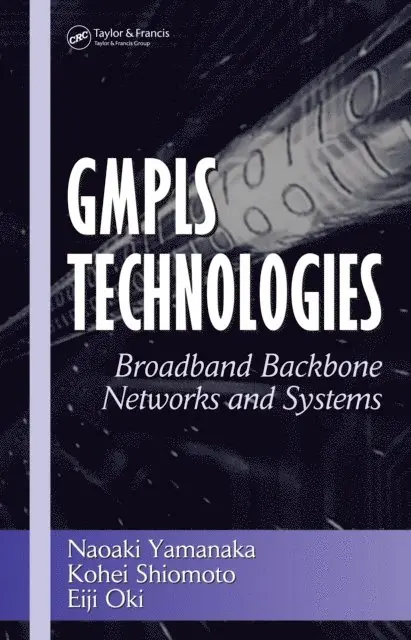
Multi-Protocol Label Switch (MPLS) and Generalized MPLS (GMPLS) are key technologies for next-generation IP backbone networks. Until now, however, engineers have been forced to search for technical papers on this subject and read them in an ad-hoc manner. At last there is a book that explains both MPLS and GMPLS concepts in a systematic way. GMPLS Technologies: Broadband Backbone Networks and Systems addresses the basic concepts, network architectures, protocols, and traffic engineering needed to operate MPLS and GMPLS networks. The book begins with an introduction of the nature and requirements of broadband networks. It describes the basics of control-oriented networks and Internet Protocol (IP).The text then examines the fundamentals of MPLS, explaining why MPLS is preferable to IP packet-based forwarding. This volume covers MPLS applications, details IP router structures, illustrates GMPLS, and explores important studies on traffic engineering in GMPLS Networks. The text concludes with a description of IP, MPLS, and GMPLS standardization topics. Network equipment design engineers and network service provision engineers can reference this book to understand the crucial techniques for building MPLS/GMPLS-based networks.Features
Addresses the basic concepts, network architectures, protocols, and traffic engineering needed to operate MPLS and GMPLS networks Covers the fundamentals of connection-oriented networks including TCP/IP, flow control mechanism, and ATM protocol Analyzes MPLS issues and applications, such as label switched paths (LSPs) and VPNs Highlights IP router structures, examining technologies of data path function - switch architecture, packet scheduling, and forwarding engine Explores multi-layer traffic engineering, survivable networks, and wavelength-routed optical networks Demonstrates GMPLS-based routers2 858 kr
Läs direkt efter köp
Multi-Protocol Label Switch (MPLS) and Generalized MPLS (GMPLS) are key technologies for next-generation IP backbone networks. Until now, however, engineers have been forced to search for technical papers on this subject and read them in an ad-hoc manner. At last there is a book that explains both MPLS and GMPLS concepts in a systematic way. GMPLS Technologies: Broadband Backbone Networks and Systems addresses the basic concepts, network architectures, protocols, and traffic engineering needed to operate MPLS and GMPLS networks. The book begins with an introduction of the nature and requirements of broadband networks. It describes the basics of control-oriented networks and Internet Protocol (IP).The text then examines the fundamentals of MPLS, explaining why MPLS is preferable to IP packet-based forwarding. This volume covers MPLS applications, details IP router structures, illustrates GMPLS, and explores important studies on traffic engineering in GMPLS Networks. The text concludes with a description of IP, MPLS, and GMPLS standardization topics. Network equipment design engineers and network service provision engineers can reference this book to understand the crucial techniques for building MPLS/GMPLS-based networks.Features
Addresses the basic concepts, network architectures, protocols, and traffic engineering needed to operate MPLS and GMPLS networks Covers the fundamentals of connection-oriented networks including TCP/IP, flow control mechanism, and ATM protocol Analyzes MPLS issues and applications, such as label switched paths (LSPs) and VPNs Highlights IP router structures, examining technologies of data path function - switch architecture, packet scheduling, and forwarding engine Explores multi-layer traffic engineering, survivable networks, and wavelength-routed optical networks Demonstrates GMPLS-based routers1 913 kr
Skickas inom 10-15 vardagar
1 084 kr
Skickas inom 10-15 vardagar
1 416 kr
Läs direkt efter köp
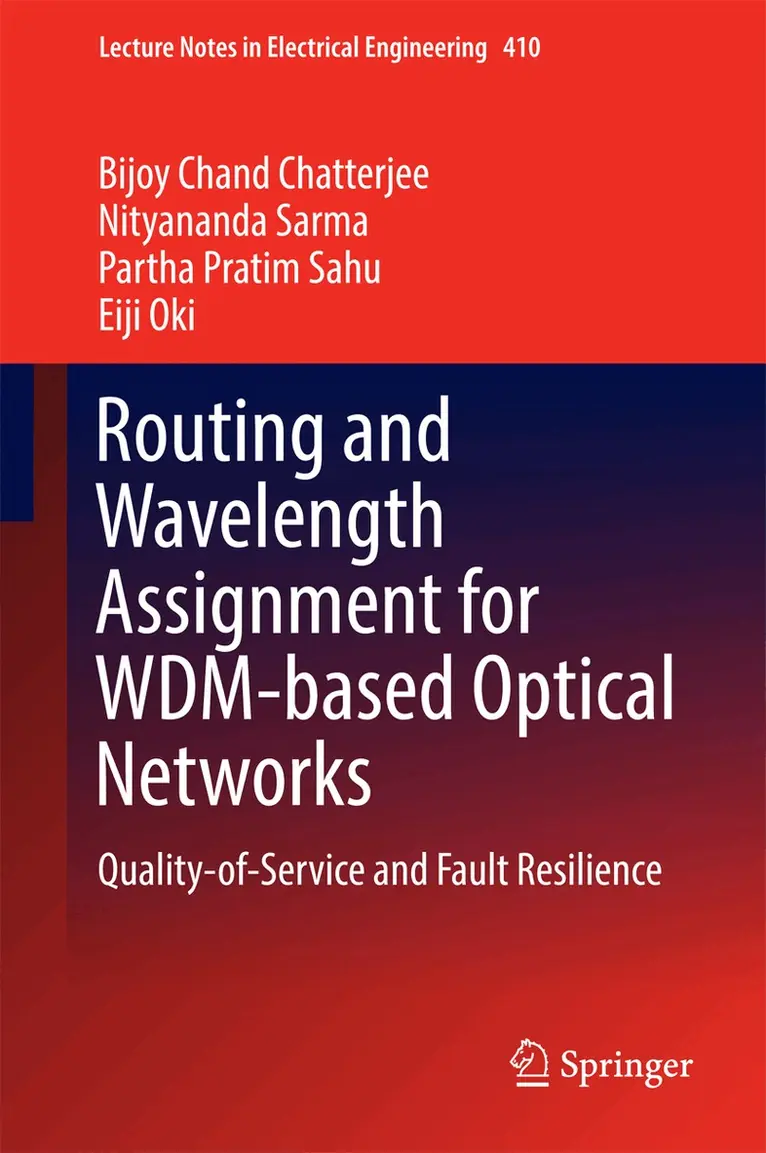
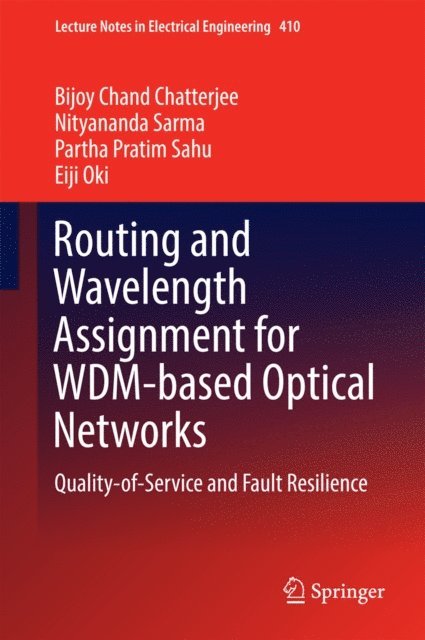
This book presents an in-depth treatment of routing and wavelength assignment for optical networks, and focuses specifically on quality-of-service and fault resiliency issues. It reports on novel approaches for the development of routing and wavelength assignment schemes for fault-resilient optical networks, which improve their performance in terms of signal quality, call blocking, congestion level and reliability, without a substantial increase in network setup cost.
The book first presents a solution for reducing the effect of the wavelength continuity constraint during the routing and wavelength assignment phase. Further, it reports on an approach allowing the incorporation of a traffic grooming mechanism with routing and wavelength assignment to enhance the effective channel utilization of a given capacity optical network using fewer electrical-optical-electrical conversions. As a third step, it addresses a quality of service provision scheme for wavelength-division multiplexing (WDM)-based optical networks. Lastly, the book describes the inclusion of a tree-based fault resilience scheme in priority-based dispersion-reduced wavelength assignment schemes for the purpose of improving network reliability, while maintaining a better utilization of network resources.
Mainly intended for graduate students and researchers, the book provides them with extensive information on both fundamental and advanced technologies for routing and wavelength assignment in optical networks. The topics covered will also be of interest to network planners and designers.
1 084 kr
Skickas inom 10-15 vardagar