Elena A. Erosheva – författare
Visar alla böcker från författaren Elena A. Erosheva. Handla med fri frakt och snabb leverans.
4 produkter
4 produkter
Häftad, Engelska, 2021
1 072 kr
Skickas inom 10-15 vardagar
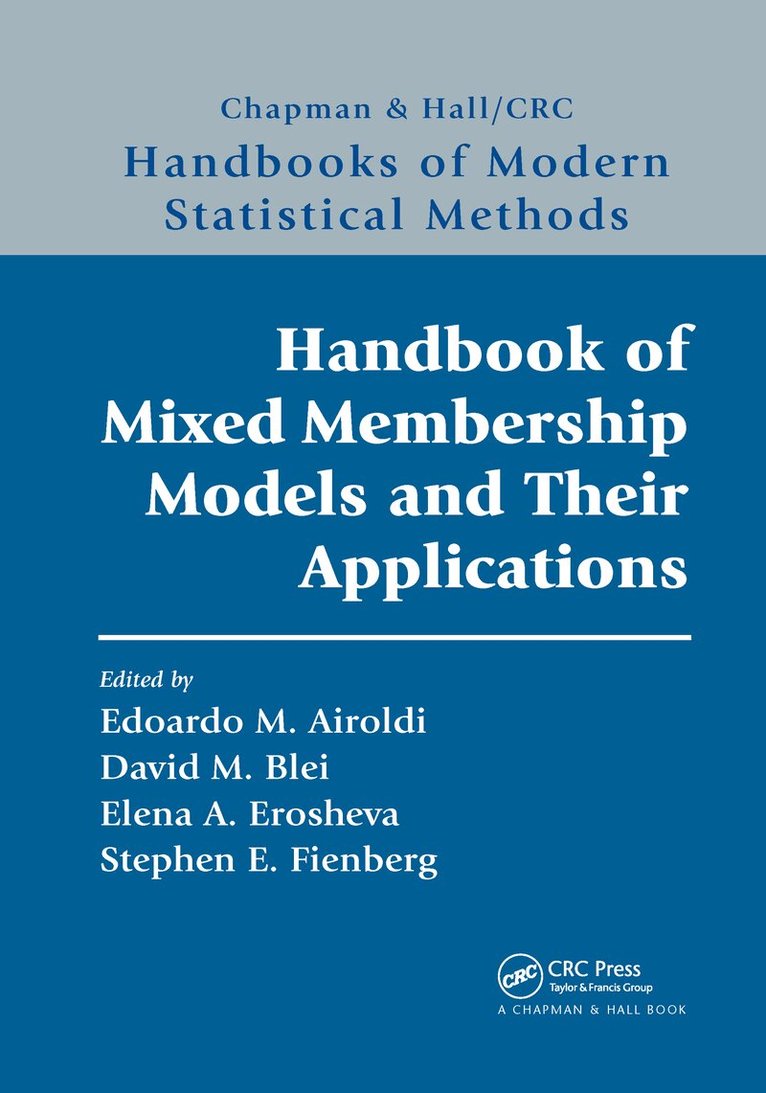
In response to scientific needs for more diverse and structured explanations of statistical data, researchers have discovered how to model individual data points as belonging to multiple groups. Handbook of Mixed Membership Models and Their Applications shows you how to use these flexible modeling tools to uncover hidden patterns in modern high-dimensional multivariate data. It explores the use of the models in various application settings, including survey data, population genetics, text analysis, image processing and annotation, and molecular biology.Through examples using real data sets, you’ll discover how to characterize complex multivariate data in:Studies involving genetic databasesPatterns in the progression of diseases and disabilities Combinations of topics covered by text documentsPolitical ideology or electorate voting patternsHeterogeneous relationships in networks, and much moreThe handbook spans more than 20 years of the editors’ and contributors’ statistical work in the field. Top researchers compare partial and mixed membership models, explain how to interpret mixed membership, delve into factor analysis, and describe nonparametric mixed membership models. They also present extensions of the mixed membership model for text analysis, sequence and rank data, and network data as well as semi-supervised mixed membership models.
E-bok
Engelska, 20141 233 kr
Läs direkt efter köp
Incorporating more than 20 years of the editors'' and contributors'' statistical work in mixed membership modeling, this handbook shows how to use these flexible modeling tools to uncover hidden patterns in modern high-dimensional multivariate data. It explores the use of the models in various application settings, including survey data, population genetics, text analysis, image processing and annotation, and molecular biology. Through examples using real data sets, readers will discover how to characterize complex multivariate data in a range of areas.
Inbunden, Engelska, 2014
2 769 kr
Skickas inom 10-15 vardagar
In response to scientific needs for more diverse and structured explanations of statistical data, researchers have discovered how to model individual data points as belonging to multiple groups. Handbook of Mixed Membership Models and Their Applications shows you how to use these flexible modeling tools to uncover hidden patterns in modern high-dimensional multivariate data. It explores the use of the models in various application settings, including survey data, population genetics, text analysis, image processing and annotation, and molecular biology.Through examples using real data sets, you’ll discover how to characterize complex multivariate data in:Studies involving genetic databasesPatterns in the progression of diseases and disabilities Combinations of topics covered by text documentsPolitical ideology or electorate voting patternsHeterogeneous relationships in networks, and much moreThe handbook spans more than 20 years of the editors’ and contributors’ statistical work in the field. Top researchers compare partial and mixed membership models, explain how to interpret mixed membership, delve into factor analysis, and describe nonparametric mixed membership models. They also present extensions of the mixed membership model for text analysis, sequence and rank data, and network data as well as semi-supervised mixed membership models.
E-bok
PDF, Engelska, 20141 233 kr
Läs direkt efter köp
Incorporating more than 20 years of the editors'' and contributors'' statistical work in mixed membership modeling, this handbook shows how to use these flexible modeling tools to uncover hidden patterns in modern high-dimensional multivariate data. It explores the use of the models in various application settings, including survey data, population genetics, text analysis, image processing and annotation, and molecular biology. Through examples using real data sets, readers will discover how to characterize complex multivariate data in a range of areas.