Elizabeth Deeds Ermarth - Böcker
Visar alla böcker från författaren Elizabeth Deeds Ermarth. Handla med fri frakt och snabb leverans.
3 produkter
3 produkter
576 kr
Skickas inom 7-10 vardagar
Sequel to History offers a comprehensive definition of postmodernism as a reformation of time. Elizabeth Deeds Ermarth uses a diversified theoretical approachdrawing on post-structuralism, feminism, new historicism, and twentieth-century scienceto demonstrate the crisis of our dominant idea of history and its dissolution in the rhythmic time of postmodernism. She enlarges this definition in discussions of several crises of cultural identity: the crisis of the object, the crisis of the subject, and the crisis of the sign. Finally, she explores the relation between language and time in post-modernism, proposing an arresting theory of her own about the rhythmic nature of postmodern temporality. Because the postmodern construction of time appears so clearly in narrative writing, each part of this work is punctuated by a "rhythm section" on a postmodern narrative (Robbe-Grillet's Jealousy, Cortezar's Hopscotch, and Nabokov's Ada); these extended readings provide concrete illustrations of Ermarth's theoretical positions.As in her critically acclaimed Realism and Consensus in the English Novel, Ermarth ranges across disciplines from anthropology and the visual arts to philosophy and history. For its interdisciplinary character and its lucid definition of postmodernism, Sequel to History will appeal to all those interested in the humanities.
2 164 kr
Skickas inom 10-15 vardagar
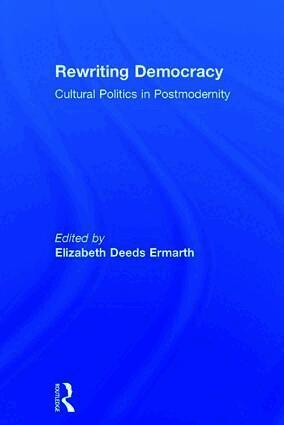
Illuminating and comprehensive, this excellent volume addresses the problematic relationship between democratic institutions and the current critique of enlightenment and modernity. Since at least the beginning of the twentieth century, and across the range of practice from science to politics to art, various cultural shifts have unsettled assumptions that have been fundamental to the development of democratic institutions: assumptions concerning individual identity, the nature of political systems, and the viability of egalitarian ideals. Can democracy survive these changes to the value systems upon which it has been based for over two centuries? This study does not focus on the often repeated particulars of past or current events such as 9/11 or the genocide in Darfur, but instead examines the terms and conditions under which it would be possible to prevent such events in the future.
632 kr
Skickas inom 10-15 vardagar
Illuminating and comprehensive, this excellent volume addresses the problematic relationship between democratic institutions and the current critique of enlightenment and modernity. Since at least the beginning of the twentieth century, and across the range of practice from science to politics to art, various cultural shifts have unsettled assumptions that have been fundamental to the development of democratic institutions: assumptions concerning individual identity, the nature of political systems, and the viability of egalitarian ideals. Can democracy survive these changes to the value systems upon which it has been based for over two centuries? This study does not focus on the often repeated particulars of past or current events such as 9/11 or the genocide in Darfur, but instead examines the terms and conditions under which it would be possible to prevent such events in the future.