
Elizabeth DeIuliis - Böcker
Visar alla böcker från författaren Elizabeth DeIuliis. Handla med fri frakt och snabb leverans.
7 produkter
7 produkter
2 012 kr
Skickas inom 10-15 vardagar
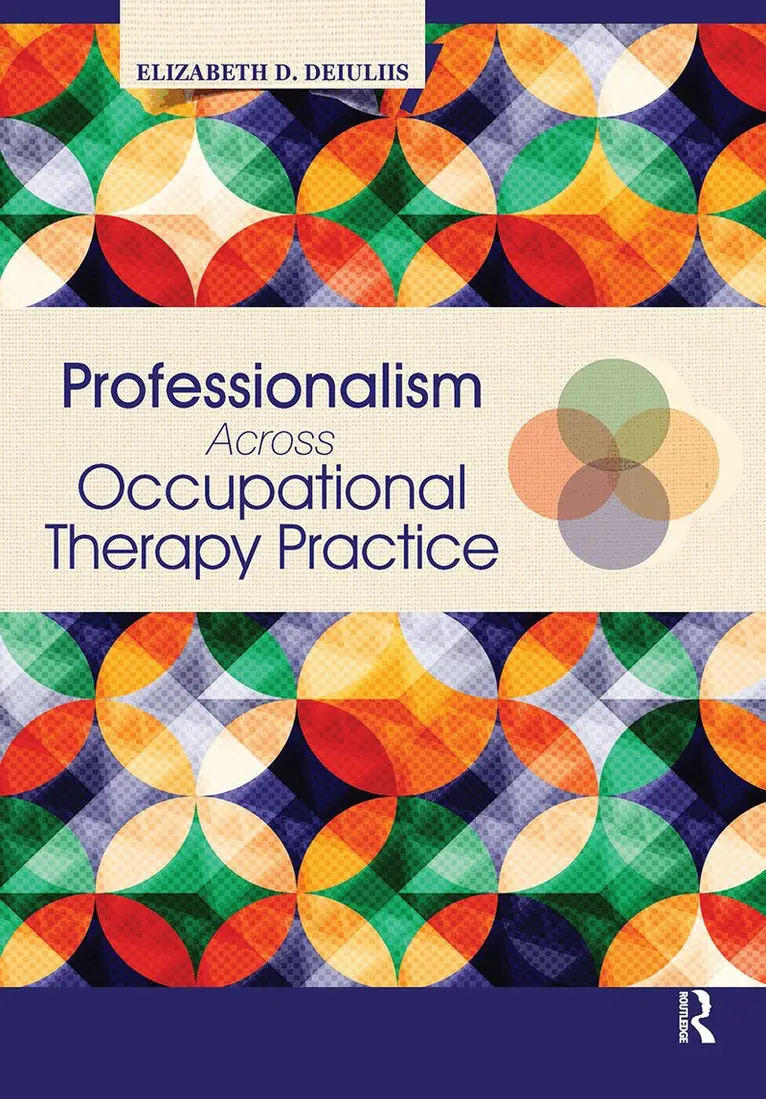
When most people think of professionalism, ethics, or moralism, they often think of a set of rules for distinguishing between right and wrong, such as the proverbial Golden Rule. However, the true definition of professionalism is not an easy one, and it is not necessarily black and white. In fact, it could be argued that it is often easier to describe what is not professional versus what is professional. It could also be disputed that although professionalism can be recognized when you see it, you may not necessarily be able to put your finger on what “it” is exactly.Professionalism Across Occupational Therapy Practice by Dr. Elizabeth D. DeIuliis provides an overview of the wide-ranging knowledge, skills, and attitudes that encompass professionalism across the occupational therapy profession. While there is no formal endorsed definition of professionalism in occupational therapy practice, suggestions are provided to serve as a blueprint for use.“Professionalism in occupational therapy practice is a dynamic sophistication, exemplified by a combination of an individual’s personal skill set, knowledge, behaviors, and attitudes, and the adoption of the moral and ethical values of the profession and society.”Dr. DeIuliis illustrates the concept of professionalism as a unique combination of intrinsic and extrinsic qualities surrounding key constructs of ethics, responsibility, competency and behavior. Professionalism Across Occupational Therapy Practice discusses these various expectations in the academic setting, the clinic, workplace, and in general society.Professionalism Across Occupational Therapy Practice utilizes a developmental approach to teaching and learning, paralleling the Revised Bloom’s Taxonomy (2001). This classification system provides a graded, holistic methodology to human teaching and learning. The concept of professionalism will be exemplified by using both a knowledge-based approach to subject matter requiring higher-level learning such as metacognition, which is a crucial component of professionalism. The chapter objectives and learning activities will challenge the reader to recall, comprehend, apply analysis, synthesize, evaluate, and create knowledge directly to their context.Instructors in educational settings can visit www.efacultylounge.com for additional materials such as informative appendices and resources include sample statements for syllabi & policy manuals, resume and CV templates, interview guidelines, professional development plans and more to be used for teaching in the classroom.Occupational Therapy practitioners at all levels, including fieldwork educators, leaders, managers and researchers will also benefit Professionalism Across Occupational Therapy Practice as it provides a synopsis of professional expectations beyond the classroom and fieldwork setting. Due to recent changes in healthcare, educational standards, and societal influence, the expectation of professionalism has been under greater scrutiny across health and social care professions. Professionalism Across Occupational Therapy Practice is the ideal text to provide a blueprint for occupational therapy students, faculty, and practitioners to fulfill our profession’s potential and achieve the American Occupational Therapy Association’s Vision 2025.

2 012 kr
Skickas inom 10-15 vardagar
A new, comprehensive resource for fieldwork educators and academic fieldwork coordinators, Fieldwork Educator’s Guide to Level II Fieldwork provides a blueprint for designing, implementing, and managing Level II fieldwork programs for occupational therapy and occupational therapy assistant students across practice settings.Drawing from the expertise of renowned individuals in the field, Drs. Elizabeth D. DeIuliis and Debra Hanson provide the tools for fieldwork educators and academic fieldwork coordinators to put together learning frameworks, educational theories, and clinical instructional techniques within and outside occupational therapy in order to create and maintain high-quality Level II learning experiences. Fieldwork Educator’s Guide to Level II Fieldwork challenges fieldwork educators and academic fieldwork coordinators to shift their mindset to facilitating skill acquisition and to adjust their teaching approach to match the learning needs and developmental level of the student.Designed to meet the definition of Level II fieldwork according to the 2018 Accreditation Council for Occupational Therapy Education standards, and in response to common pitfalls and challenges in clinical education today, Fieldwork Educator’s Guide to Level II Fieldwork is the go-to guide for the busy practitioner and academic fieldwork coordinator.What is included in Fieldwork Educator’s Guide to Level II Fieldwork:Expansive overviews of supervision models and vignettes illustrating use across practice settingsExamples and templates to construct a learning plan, site-specific learning objectives, orientation, weekly schedules, and learning contractsTools and strategies to uniquely develop and foster clinical reasoning in fieldworkModels for dually approaching supervision and mentorshipStrategies for addressing unique student learning and supervision needsFieldwork Educator’s Guide to Level II Fieldwork can be used as a standalone resource or as a complement to Fieldwork Educator’s Guide to Level I Fieldwork, which was designed in-tandem with this text to holistically address Levels I and II fieldwork education.

2 012 kr
Skickas inom 10-15 vardagar
A new resource for occupational therapy academic fieldwork coordinators and fieldwork educators, Fieldwork Educator's Guide to Level I Fieldwork is a practical guide for faculty and clinicians to design and implement Level I fieldwork experiences for occupational therapy and occupational therapy assistant students.Fieldwork Educator's Guide to Level I Fieldwork was designed to address the challenges of integrating Level I fieldwork with classroom learning experiences. Expansive and versatile, the book meets the recently expanded definition of Level I fieldwork according to the 2018 Accreditation Council for Occupational Therapy Education standards, including faculty-led experiences, standardized patients, simulation, and supervision by a fieldwork educator in a practice environment.Each unit of the text builds upon the previous unit. The first unit provides fundamental knowledge on experiential learning and includes an orientation to the purpose of Level I fieldwork in occupational therapy. Building on this foundation, the second unit equips the reader with resources to develop a Level I fieldwork learning plan suitable for their setting. The final units focus on situational scenarios that emerge during Level I fieldwork placements and provides a framework for assessing student learning during Level I fieldwork. While each chapter is designed to build upon one another, they also can be used as stand-alone resources depending on the needs of the reader.What is included in Fieldwork Educator’s Guide to Level I Fieldwork:Up-to-date terminologyExperiential learning frameworks and models in diverse contexts, including role emerging and simulationStrategies for addressing anxiety and student stress management and supporting students with disabilitiesModels to support clinical reasoning development during Level I fieldworkMechanisms to foster student professional development and communication skillsBe sure to also look into the successive textbook, Fieldwork Educator’s Guide to Level II Fieldwork, which was designed in-tandem with this book to be a progressive resource that exclusively focuses on Level II fieldwork.

887 kr
Skickas inom 10-15 vardagar
When most people think of professionalism, ethics, or moralism, they often think of a set of rules for distinguishing between right and wrong, such as the proverbial Golden Rule. However, the true definition of professionalism is not an easy one, and it is not necessarily black and white. In fact, it could be argued that it is often easier to describe what is not professional versus what is professional. It could also be disputed that although professionalism can be recognized when you see it, you may not necessarily be able to put your finger on what “it” is exactly.Professionalism Across Occupational Therapy Practice by Dr. Elizabeth D. DeIuliis provides an overview of the wide-ranging knowledge, skills, and attitudes that encompass professionalism across the occupational therapy profession. While there is no formal endorsed definition of professionalism in occupational therapy practice, suggestions are provided to serve as a blueprint for use.“Professionalism in occupational therapy practice is a dynamic sophistication, exemplified by a combination of an individual’s personal skill set, knowledge, behaviors, and attitudes, and the adoption of the moral and ethical values of the profession and society.”Dr. DeIuliis illustrates the concept of professionalism as a unique combination of intrinsic and extrinsic qualities surrounding key constructs of ethics, responsibility, competency and behavior. Professionalism Across Occupational Therapy Practice discusses these various expectations in the academic setting, the clinic, workplace, and in general society.Professionalism Across Occupational Therapy Practice utilizes a developmental approach to teaching and learning, paralleling the Revised Bloom’s Taxonomy (2001). This classification system provides a graded, holistic methodology to human teaching and learning. The concept of professionalism will be exemplified by using both a knowledge-based approach to subject matter requiring higher-level learning such as metacognition, which is a crucial component of professionalism. The chapter objectives and learning activities will challenge the reader to recall, comprehend, apply analysis, synthesize, evaluate, and create knowledge directly to their context.Instructors in educational settings can visit www.efacultylounge.com for additional materials such as informative appendices and resources include sample statements for syllabi & policy manuals, resume and CV templates, interview guidelines, professional development plans and more to be used for teaching in the classroom.Occupational Therapy practitioners at all levels, including fieldwork educators, leaders, managers and researchers will also benefit Professionalism Across Occupational Therapy Practice as it provides a synopsis of professional expectations beyond the classroom and fieldwork setting. Due to recent changes in healthcare, educational standards, and societal influence, the expectation of professionalism has been under greater scrutiny across health and social care professions. Professionalism Across Occupational Therapy Practice is the ideal text to provide a blueprint for occupational therapy students, faculty, and practitioners to fulfill our profession’s potential and achieve the American Occupational Therapy Association’s Vision 2025.
Entry Level Occupational Therapy Doctorate Capstone
A Framework for the Experience and Project
Häftad, Engelska, 2019
1 458 kr
Skickas
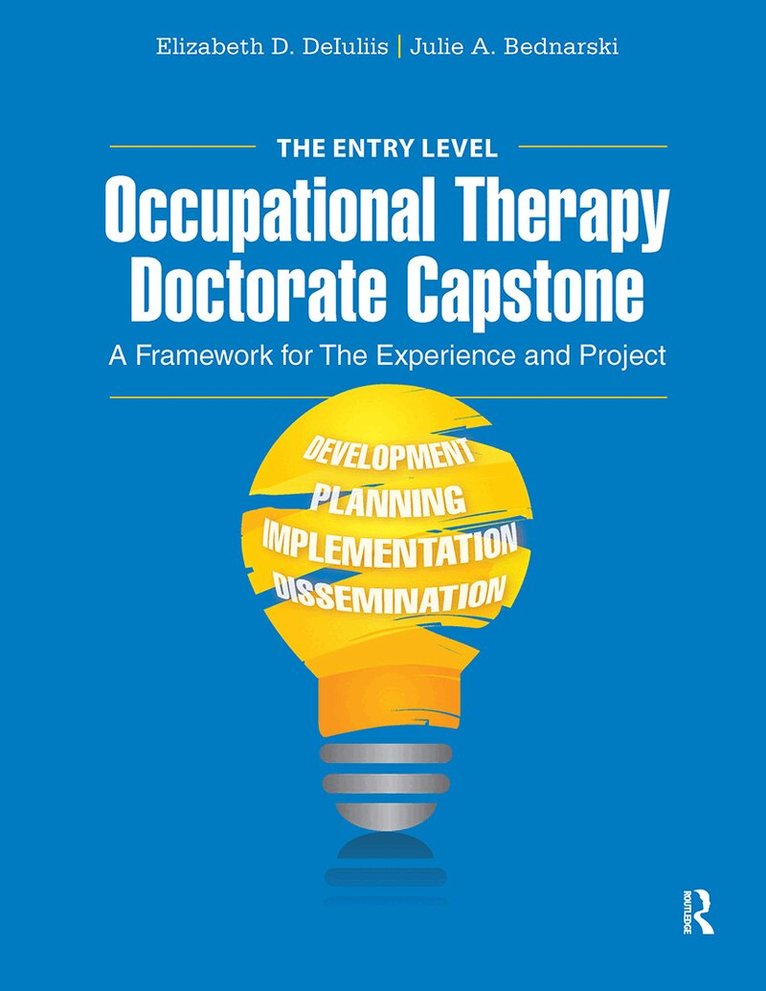
The purpose of The Entry Level Occupational Therapy Doctorate Capstone: A Framework for The Experience and Project is to provide a step-by-step guide for the development, planning, implementation and dissemination of the entry-level occupational therapy doctoral capstone experience and project.The first entry-level occupational therapy doctorate program was established in 1999, but even now there is a scarcity of occupational therapy resources to guide faculty, prepare students and to socialize mentors to the capstone experience and project. The Entry Level Occupational Therapy Doctorate Capstone by Drs. Elizabeth DeIuliis and Julie Bednarski is the first available resource in the field of occupational therapy devoted to the doctoral capstone.Each chapter provides sample resources and useful documents appropriate for use with occupational therapy doctoral students, faculty, capstone coordinators and site mentors.Included Inside:Templates to develop the MOU, individualized doctoral student objectives, and evaluationsExamples of how to structure capstone project proposalsLearning activities to guide the literature search and development of a problem statementStrategies of how to approach sustainability and program evaluation of the capstone projectRecommendations for structure and formatting of the final written documentAdditional scholarly products derived from the projectOther scholarly deliverables including formats for professional presentations and submissible papersThe Entry Level Occupational Therapy Doctorate Capstone: A Framework for The Experience and Project will be the first of its kind to serve as a textbook to provide recommendations that will benefit various stakeholders among the capstone team.
747 kr
Skickas inom 10-15 vardagar
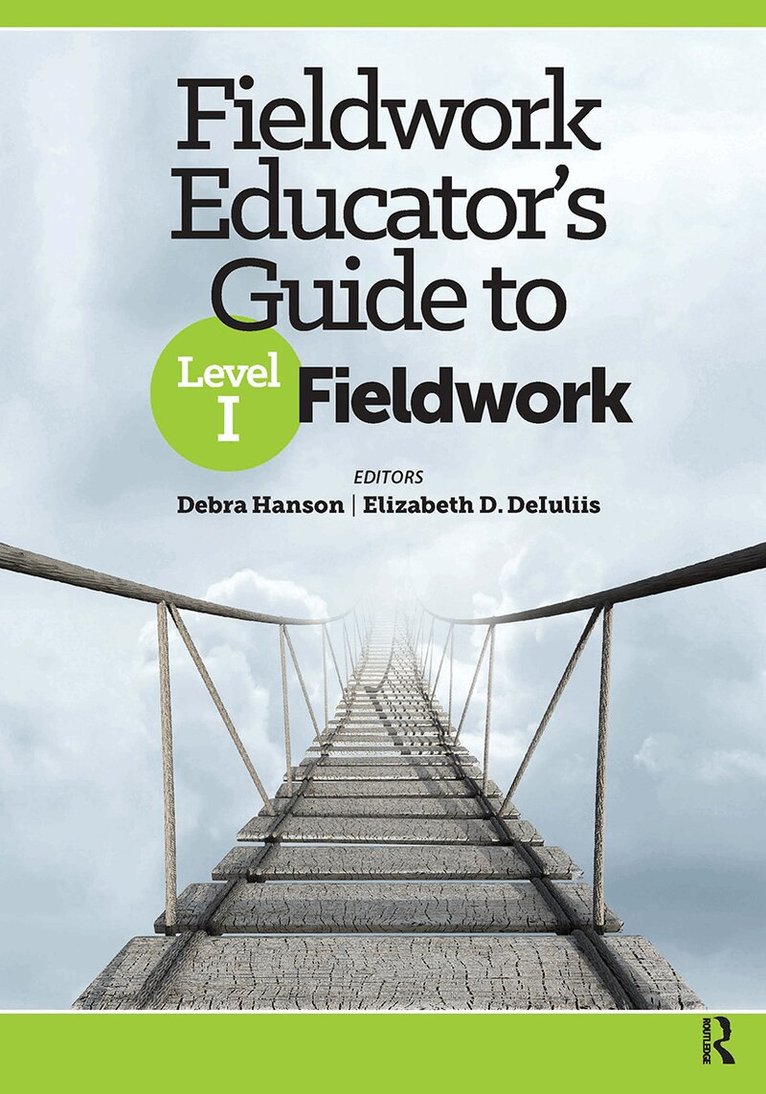
A new resource for occupational therapy academic fieldwork coordinators and fieldwork educators, Fieldwork Educator's Guide to Level I Fieldwork is a practical guide for faculty and clinicians to design and implement Level I fieldwork experiences for occupational therapy and occupational therapy assistant students.Fieldwork Educator's Guide to Level I Fieldwork was designed to address the challenges of integrating Level I fieldwork with classroom learning experiences. Expansive and versatile, the book meets the recently expanded definition of Level I fieldwork according to the 2018 Accreditation Council for Occupational Therapy Education standards, including faculty-led experiences, standardized patients, simulation, and supervision by a fieldwork educator in a practice environment.Each unit of the text builds upon the previous unit. The first unit provides fundamental knowledge on experiential learning and includes an orientation to the purpose of Level I fieldwork in occupational therapy. Building on this foundation, the second unit equips the reader with resources to develop a Level I fieldwork learning plan suitable for their setting. The final units focus on situational scenarios that emerge during Level I fieldwork placements and provides a framework for assessing student learning during Level I fieldwork. While each chapter is designed to build upon one another, they also can be used as stand-alone resources depending on the needs of the reader.What is included in Fieldwork Educator’s Guide to Level I Fieldwork:Up-to-date terminologyExperiential learning frameworks and models in diverse contexts, including role emerging and simulationStrategies for addressing anxiety and student stress management and supporting students with disabilitiesModels to support clinical reasoning development during Level I fieldworkMechanisms to foster student professional development and communication skillsBe sure to also look into the successive textbook, Fieldwork Educator’s Guide to Level II Fieldwork, which was designed in-tandem with this book to be a progressive resource that exclusively focuses on Level II fieldwork.

747 kr
Skickas inom 10-15 vardagar
A new, comprehensive resource for fieldwork educators and academic fieldwork coordinators, Fieldwork Educator’s Guide to Level II Fieldwork provides a blueprint for designing, implementing, and managing Level II fieldwork programs for occupational therapy and occupational therapy assistant students across practice settings.Drawing from the expertise of renowned individuals in the field, Drs. Elizabeth D. DeIuliis and Debra Hanson provide the tools for fieldwork educators and academic fieldwork coordinators to put together learning frameworks, educational theories, and clinical instructional techniques within and outside occupational therapy in order to create and maintain high-quality Level II learning experiences. Fieldwork Educator’s Guide to Level II Fieldwork challenges fieldwork educators and academic fieldwork coordinators to shift their mindset to facilitating skill acquisition and to adjust their teaching approach to match the learning needs and developmental level of the student.Designed to meet the definition of Level II fieldwork according to the 2018 Accreditation Council for Occupational Therapy Education standards, and in response to common pitfalls and challenges in clinical education today, Fieldwork Educator’s Guide to Level II Fieldwork is the go-to guide for the busy practitioner and academic fieldwork coordinator.What is included in Fieldwork Educator’s Guide to Level II Fieldwork:Expansive overviews of supervision models and vignettes illustrating use across practice settingsExamples and templates to construct a learning plan, site-specific learning objectives, orientation, weekly schedules, and learning contractsTools and strategies to uniquely develop and foster clinical reasoning in fieldworkModels for dually approaching supervision and mentorshipStrategies for addressing unique student learning and supervision needsFieldwork Educator’s Guide to Level II Fieldwork can be used as a standalone resource or as a complement to Fieldwork Educator’s Guide to Level I Fieldwork, which was designed in-tandem with this text to holistically address Levels I and II fieldwork education.