Elizabeth Varner – författare
Visar alla böcker från författaren Elizabeth Varner. Handla med fri frakt och snabb leverans.
3 produkter
3 produkter
E-bok
PDF, Engelska, 20201 501 kr
Läs direkt efter köp
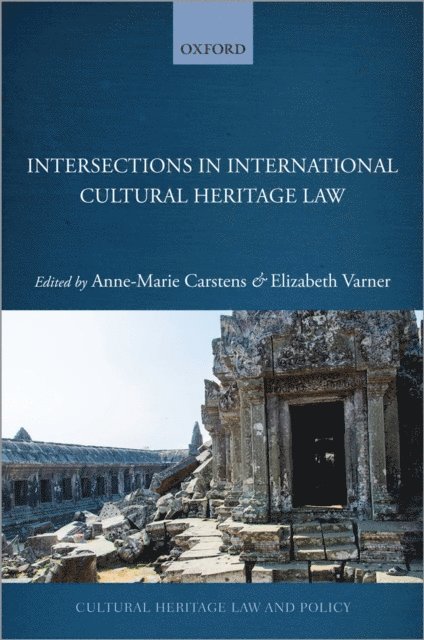
The recent spate of threats to cultural heritage, including in Iraq, Mali, Nepal, Syria, and Yemen, has led to increased focus on the sources of international cultural heritage law. This edited volume shows that international cultural heritage law is not a discrete and contained body of law, but one whose component parts are drawn from diverse fields of public international law. It shows how cultural heritage law has been shaped by its interaction with other areasof international law, and how it has contributed to international law in turn.In this volume, scholars and practitioners explore some of the primary points of intersection between international cultural heritage law and public international law. Chapters explore instersections with the law of armed conflict, international and transnational criminal law, international human rights, the international movement, regulation, and restitution of cultural artefacts, and the UN system. The result is a cohesive collection that not only explores many facets of the intersections ofcultural heritage law and public international law, but also examines how the regimes operate together and how the relationship between them largely facilitates, but also sometimes hinders, the development of international law governing the protection of cultural heritage.
E-bok
Engelska, 20201 501 kr
Läs direkt efter köp
The recent spate of threats to cultural heritage, including in Iraq, Mali, Nepal, Syria, and Yemen, has led to increased focus on the sources of international cultural heritage law. This edited volume shows that international cultural heritage law is not a discrete and contained body of law, but one whose component parts are drawn from diverse fields of public international law. It shows how cultural heritage law has been shaped by its interaction with other areasof international law, and how it has contributed to international law in turn.In this volume, scholars and practitioners explore some of the primary points of intersection between international cultural heritage law and public international law. Chapters explore instersections with the law of armed conflict, international and transnational criminal law, international human rights, the international movement, regulation, and restitution of cultural artefacts, and the UN system. The result is a cohesive collection that not only explores many facets of the intersections ofcultural heritage law and public international law, but also examines how the regimes operate together and how the relationship between them largely facilitates, but also sometimes hinders, the development of international law governing the protection of cultural heritage.
Inbunden, Engelska, 2020
2 248 kr
Skickas inom 3-6 vardagar
The recent spate of threats to cultural heritage, including in Iraq, Mali, Nepal, Syria, and Yemen, has led to increased focus on the sources of international cultural heritage law. This edited volume shows that international cultural heritage law is not a discrete and contained body of law, but one whose component parts are drawn from diverse fields of public international law. It shows how cultural heritage law has been shaped by its interaction with other areas of international law, and how it has contributed to international law in turn. In this volume, scholars and practitioners explore some of the primary points of intersection between international cultural heritage law and public international law. Chapters explore instersections with the law of armed conflict, international and transnational criminal law, international human rights, the international movement, regulation, and restitution of cultural artefacts, and the UN system. The result is a cohesive collection that not only explores many facets of the intersections of cultural heritage law and public international law, but also examines how the regimes operate together and how the relationship between them largely facilitates, but also sometimes hinders, the development of international law governing the protection of cultural heritage.