Emanuel S. Savas – författare
Visar alla böcker från författaren Emanuel S. Savas. Handla med fri frakt och snabb leverans.
7 produkter
Alternatives For Delivering Public Services
Toward Improved Performance
Inbunden, 2019
2504 kr
Lägg i varukorg
This book is the result of a program undertaken nine years ago by the Diebold Institute for Public Policy Studies, Inc., to identify and analyze potentials for private sector involvement in the delivery of public services. Since its founding in 1968, the Diebold Institute has focused on this …
Alternatives For Delivering Public Services
Toward Improved Performance
Häftad, 2021
689 kr
Lägg i varukorg
This book is the result of a program undertaken nine years ago by the Diebold Institute for Public Policy Studies, Inc., to identify and analyze potentials for private sector involvement in the delivery of public services. Since its founding in 1968, the Diebold Institute has focused on this …
Alternatives For Delivering Public Services
Toward Improved Performance
E-bok, 2019
814 kr
Lägg i varukorg
This book is the result of a program undertaken nine years ago by the Diebold Institute for Public Policy Studies, Inc., to identify and analyze potentials for private sector involvement in the delivery of public services. Since its founding in 1968, the Diebold Institute has focused on this …
Alternatives For Delivering Public Services
Toward Improved Performance
E-bok, 2019
814 kr
Lägg i varukorg
This book is the result of a program undertaken nine years ago by the Diebold Institute for Public Policy Studies, Inc., to identify and analyze potentials for private sector involvement in the delivery of public services. Since its founding in 1968, the Diebold Institute has focused on this …
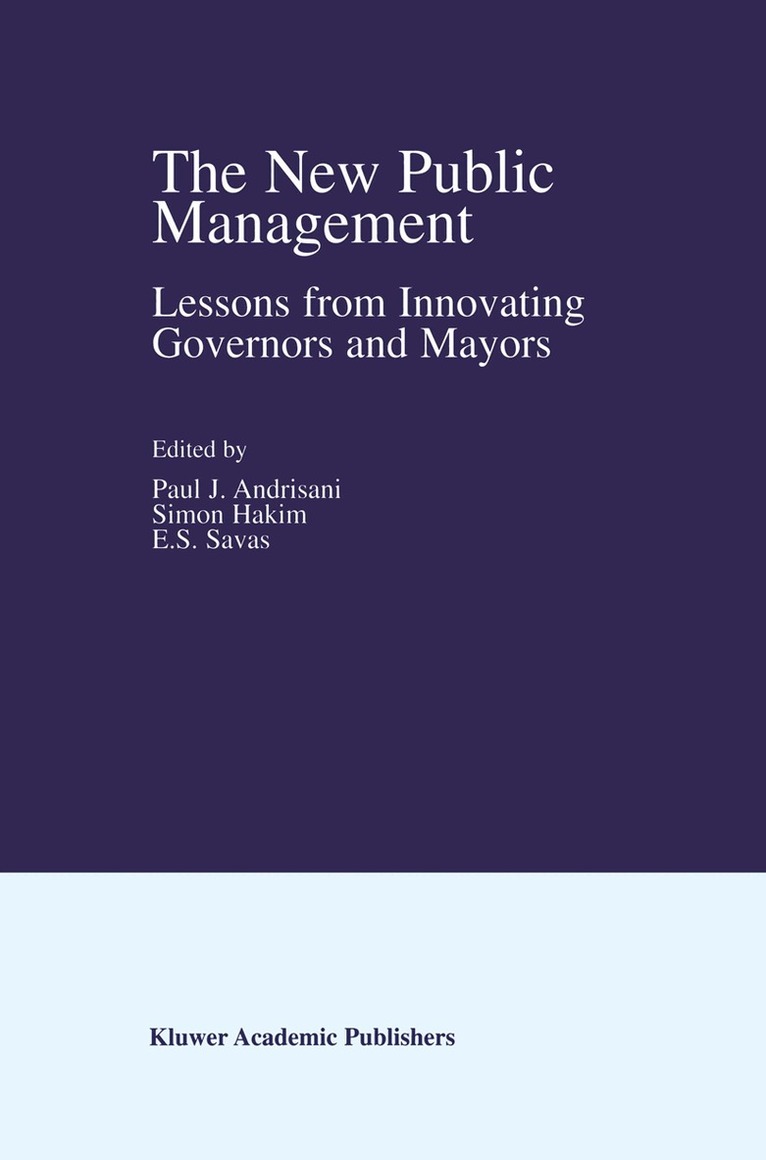
New Public Management
Lessons from Innovating Governors and Mayors
Av Emanuel S. Savas, Paul J. Andrisani m. fl.
Häftad, 2002
551 kr
Lägg i varukorg
This volume brings together the innovative ideas of 21 of America's leading governors and mayors expressed in their own words. The book features contributions carefully collected and selected over several years, including chapters by former Governors George Bush of Texas and Tommy Thompson of …
Privatization and Public-Private Partnerships
Häftad, 1999
2171 kr
Lägg i varukorg
Savas provides a complete guide to privatization––the background, theory, and practical reality. This book explains what, why, when, and how to privatize. Contracting services, using franchises and vouchers, divesting government-owned businesses, privatizing infrastructure through public-private …
Privatization in the City
Successes, Failures, Lessons
Häftad, 2005
1690 kr
Lägg i varukorg
In Privatization in the City, E .S. Savas comprehensively examines the evolution and implementation of former New York Mayor Rudolph W. Giuliani’s aggressive privatization program in the face of a city council generally hostile to privatization. Savas identifies, examines, evaluates, and documents …