Emil Roduner – författare
Visar alla böcker från författaren Emil Roduner. Handla med fri frakt och snabb leverans.
5 produkter
5 produkter
624 kr
Skickas inom 5-8 vardagar
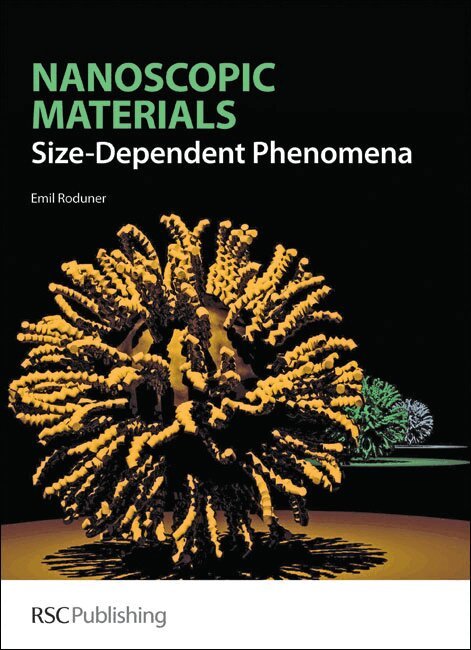
Nanotechnology has been hailed as a key technology of the 21st century. The scope of this field is huge and could have a wide influence on many aspects of life. Nanoscience; the manipulation of matter at the atomic and molecular level, and nanomaterials; materials so small that their behaviour and characteristics deviate from those of macroscopic specimens and may be predicted by scaling laws or by quantum confinement effects, are discussed in Nanoscopic Materials: Size - Dependent Phenomena.The book focuses on a qualitative and quantitative approach discussing all areas of nanotechnology with particular emphasis on the underlying physico-chemical and physical principles of nanoscience. Topics include electronic structure, magnetic properties, thermodynamics of size dependence and catalysis. There is also a section discussing the future potential of the field and the ethical implications of nanotechnology.The book is ideal for graduate students of chemistry and materials science and researchers new to the field of nanoscience and nanotechnology.
1 370 kr
Skickas inom 3-6 vardagar
Developments in optical spectroscopy have taken new directions in recent decades, with the focus shifting from understanding small gas phase molecules towards applications in materials and biological systems. This is due to significant interest in these topics, which has been facilitated by significant technological developments.Absorption, luminescence and excited state energy transfer properties have become of crucial importance on a large scale in materials related to light-harvesting in organic and inorganic third generation solar cells, for solar water splitting, and in light emitting diodes, TV screens and many other applications. In addition, Förster resonance energy transfer can be used as a ruler for the characterisation of the structure and dynamics of DNA, proteins and other biomolecules via labelling with fluorescing markers.This advanced textbook covers a range of these applications as well as the basics of absorption, emission and energy transfer of molecular systems in the condensed phase, in addition to the corresponding behaviour of metal nanoparticles and semiconductor quantum dots. Technical experimental requirements, aspects to avoid interfering perturbations and methods of quantitative data analysis make this book accessible and ideal for students and researchers in physical chemistry, biophysics and nanomaterials.
844 kr
Skickas inom 3-6 vardagar
Developments in optical spectroscopy have taken new directions in recent decades, with the focus shifting from understanding small gas phase molecules towards applications in materials and biological systems. This is due to significant interest in these topics, which has been facilitated by significant technological developments.Absorption, luminescence and excited state energy transfer properties have become of crucial importance on a large scale in materials related to light-harvesting in organic and inorganic third generation solar cells, for solar water splitting, and in light emitting diodes, TV screens and many other applications. In addition, Förster resonance energy transfer can be used as a ruler for the characterisation of the structure and dynamics of DNA, proteins and other biomolecules via labelling with fluorescing markers.This advanced textbook covers a range of these applications as well as the basics of absorption, emission and energy transfer of molecular systems in the condensed phase, in addition to the corresponding behaviour of metal nanoparticles and semiconductor quantum dots. Technical experimental requirements, aspects to avoid interfering perturbations and methods of quantitative data analysis make this book accessible and ideal for students and researchers in physical chemistry, biophysics and nanomaterials.
1 393 kr
Skickas inom 5-8 vardagar
In recent years there have been great advances in the development of new nanomaterials. To facilitate the progress of new materials it is essential to understand the underlying principles at the nanoscale. Nanoscopic Materials provides an accessible overview of the physico-chemical and physical principles of nanomaterials including electronic structure, magnetic properties, thermodynamics of size dependence and phase transitions and dynamics of clusters and two-dimensional systems. This new edition has been fully revised and updated to reflect recent developments in new nanomaterials including graphene and core–shell structures, properties of nano-structured and intelligent surfaces as well as applications in catalysis and energy. Additional chapters cover the development of nucleation and crystal shape engineering; self-assembly and biomimetics for fabricating nanostructures.With helpful illustrations and summaries of key points in every chapter, this advanced textbook is ideal for graduate students of chemistry and materials science and researchers new to the field of nanoscience and nanotechnology.
Del 49 - Lecture Notes in Chemistry
Positive Muon as a Probe in Free Radical Chemistry
Potential and Limitations of the μSR Techniques
Häftad, Engelska, 1988
534 kr
Skickas inom 10-15 vardagar
The work presented here is a result of an extended collaboration with a number of coworkers and guests. Particularly, I would like to thank Dr. P. Burkhard and Dr. W. Strub for their careful work performed for their Ph. D. thesis and Dr. M. Heming for his brilliant ideas and his dedication. Very fruitful and stimulating were collaborations with our guests, i. e. with G. A. Brinkman and P. W. F. Louwrier from NIKHEF-K in Amsterdam, B. C. Webster, M. J. Ramos and D. McKenna from the University of Glasgow, M. C. R. Symons, D. Geeson and C. J. Rhodes from the University of Leicester, S. F. J. Cox and C. A. Scott from the Rutherford Appleton Laboratory in Chilton, and R. De Renzi and M. Ricco from the University of Parma. Many invaluable discussions with friends and competitors in the field helped to address new viewpoints and to define new goals. I shall not forget my teacher and director of the radical chemistry group, Prof. H. Fischer, whom I wish to thank for his interest and active support and for the great liberty he allowed me for the planning and organization of the project. Last but not least, I thank my dear wife Hanny and our children Christian, Martin and Andrea who suffered, without complaint, daddy's absence for so many hours.