Emilia Simison - Böcker
Visar alla böcker från författaren Emilia Simison. Handla med fri frakt och snabb leverans.
4 produkter
4 produkter
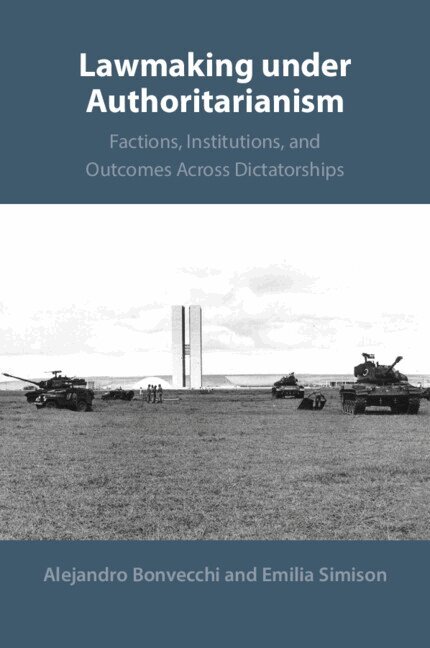
Lawmaking under Authoritarianism
Factions, Institutions, and Outcomes Across Dictatorships
Häftad, Engelska, 2026
428 kr
Skickas inom 7-10 vardagar
Why are legislatures in some authoritarian regimes more powerful than others? Why does influence on policies and politics vary across dictatorships? To answer these questions, Lawmaking under Authoritarianism extends the power-sharing theory of authoritarian government to argue that autocracies with balanced factional politics have more influential legislatures than regimes with unbalanced or unstable factional politics. Where factional politics is balanced, autocracies have reviser legislatures that amend and reject significant shares of executive initiatives and are able to block or reverse policies preferred by dictators. When factional politics is unbalanced, notary legislatures may amend executive bills but rarely reject them, and regimes with unstable factional politics oscillate between these two extremes. Lawmaking under Authoritarianism employs novel datasets based on extensive archival research to support these findings, including strong qualitative case studies for past dictatorships in Argentina, Brazil, and Spain.
Lawmaking under Authoritarianism
Factions, Institutions, and Outcomes Across Dictatorships
Inbunden, Engelska, 2026
1 258 kr
Skickas inom 7-10 vardagar
Why are legislatures in some authoritarian regimes more powerful than others? Why does influence on policies and politics vary across dictatorships? To answer these questions, Lawmaking under Authoritarianism extends the power-sharing theory of authoritarian government to argue that autocracies with balanced factional politics have more influential legislatures than regimes with unbalanced or unstable factional politics. Where factional politics is balanced, autocracies have reviser legislatures that amend and reject significant shares of executive initiatives and are able to block or reverse policies preferred by dictators. When factional politics is unbalanced, notary legislatures may amend executive bills but rarely reject them, and regimes with unstable factional politics oscillate between these two extremes. Lawmaking under Authoritarianism employs novel datasets based on extensive archival research to support these findings, including strong qualitative case studies for past dictatorships in Argentina, Brazil, and Spain.
549 kr
Kommande
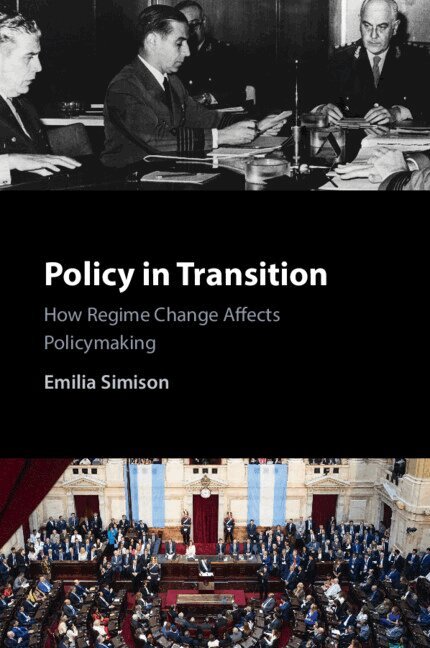
Regime transitions often raise expectations for sweeping policy change-yet those expectations are not always realized. Focusing on the mechanisms linking regime type and policy, Policy in Transition explains how, and under which conditions, policy changes are likely to occur after a regime transition. Whether policies change depends on how the transition reshapes the space for contestation and on the visibility of the policy in question. This finding argument is supported through an in-depth comparative historical analysis of the evolution of housing and financial policies across regime types changes in Argentina and Brazil since the 1960s. Drawing on extensive archival materials, public records, historical media, and interviews with key actors, the book studies policymaking across different authoritarian and democratic regimes providing nuanced insights into the relationship between political regimes and policy change.
1 498 kr
Kommande
Regime transitions often raise expectations for sweeping policy change-yet those expectations are not always realized. Focusing on the mechanisms linking regime type and policy, Policy in Transition explains how, and under which conditions, policy changes are likely to occur after a regime transition. Whether policies change depends on how the transition reshapes the space for contestation and on the visibility of the policy in question. This finding argument is supported through an in-depth comparative historical analysis of the evolution of housing and financial policies across regime types changes in Argentina and Brazil since the 1960s. Drawing on extensive archival materials, public records, historical media, and interviews with key actors, the book studies policymaking across different authoritarian and democratic regimes providing nuanced insights into the relationship between political regimes and policy change.