
Häftad, Engelska, 2010
307 kr
Tillfälligt slut
307 kr
Tillfälligt slut
126 kr
Tillfälligt slut
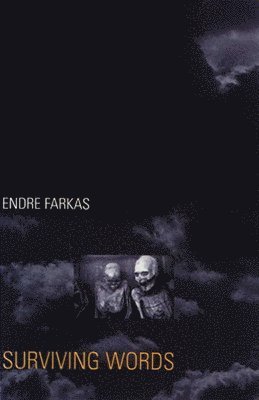
Surviving Words is Endre Farkas seventh book of poetry and his most powerful and accomplished to date. It is a collection of singular yet interwoven poems that, with haunting simplicity, evokes the horrors we inflict upon each other. The book begins with his parents experiences in Auschwitz and Mauthausen, moves on to deal with his childhood memories of the 1956 Hungarian Revolution, and concludes with poems about the ongoing acts of genocide. The poems in Surviving Words are striking for their imagery and tone. With subtle irony, they remind us that "nothing is forgotten/nothing is ever forgotten."

127 kr
Tillfälligt slut
"The horrifying actuality that is the Holocaust sits like an immovable altar to evil in the middle of the twentieth century. Fifty years later, Endre Farkas, child of Holocaust survivors, revisits its terrors through the stories of his parents and through his own journeys. His parents, who both survived concentration camps only to confront renewed xenophobia a dozen years later during the Hungarian revolution, were forced to escape with their young son to Canada. The book is a personal journey of sortsa journey to recover, if not innocence, perhaps lost hope."Canadian Literature

221 kr
Tillfälligt slut
The evolution of Farkas poetry since he began writing it 35 years ago illuminates one of Montreals key literary figures, first, as one of the Vehicule poets of the 1970s, an experimental group of writers bent on celebrating life and pushing the boundaries of their craft and, later, as one profoundly aware of his role as a poet engaged with the world, one with a social conscience and a moral obligation to speak about it. In many of his darker poems, he ruminates on oppression and injustice and on some of the sources of Mans more subtle discontent, but always somewhere in the shadows lurks a hopefulness, an awareness that the jazz that paints the night is also about love and human fellowshipand compassion. As a poet, Endre Farkas celebrates the flux, the internal energy of a poem. He is not afraid to "play" or to follow a poem down a strange road, sometimes detouring into unfamiliar territory. He has never been afraid to revisit a piece years later or to rethink it for the stage. Perhaps he has a little of the gypsy in him. Forced to flee his native Hungary at a young age, he saw himself, in the early days, as a writer in exile, an immigrant Canadian trying to make sense of a new reality and a complicated past. It is undoubtedly what informed his early writing and what, in subtler and more complex ways, continues to frame the more recent meanderings of his imagination. And just where have these meanderings led him? Down a myriad of roads, a map of which is here, in this selection. Leaving the Big questions to the philosophers, he has chosen, instead, to answer his own questions by writing about the quotidian, the everyday. For him, the poem is an act of consciousness-raising, a fragment that reflects a piece of the universe, the "here" of the moment he happens to occupy, ultimately nudging the reader along his own path into an awareness about that universe. In the end, the poem is a well of inspiration, hope, consolation, celebration. And, of course, it is food for thought.