Enrique L Palancar - Böcker
Visar alla böcker från författaren Enrique L Palancar. Handla med fri frakt och snabb leverans.
3 produkter
3 produkter
1 160 kr
Skickas inom 5-8 vardagar
2 272 kr
Skickas inom 5-8 vardagar
Tone is about melody and meaning, inflection is about grammar, and this book is about a bit of both. The contributions to this volume study possible and sometimes complex ways in which the tones of a language engage in the expression of grammatical categories. There is a widespread conception that tone is a lexical phenomenon only. This is partly a consequence of the main interest in tone coming from phonology, while the main interest in inflection has stemmed from segmental morphology. Similarly, textbooks on inflection and textbooks on tone give very few examples of the inflectional use of tone, and such examples are often the same ones or too similar. This volume aims to broaden our understanding of the link between tone and inflection by showing that there is more to tone than meets the eye. The book includes general chapters as well as case studies on lesser known languages of Asia, Africa and Papua New Guinea, with a special focus on the Oto-Manguean languages, a large and diverse linguistic stock of Mexico that inspired Kenneth Pike’s 1948 seminal work on tone. Most of the contributions to this volume provide first-hand data from recent fieldwork that stems from important language documentation activities.
Del 16 - Brill's Studies in the Indigenous Languages of the Americas
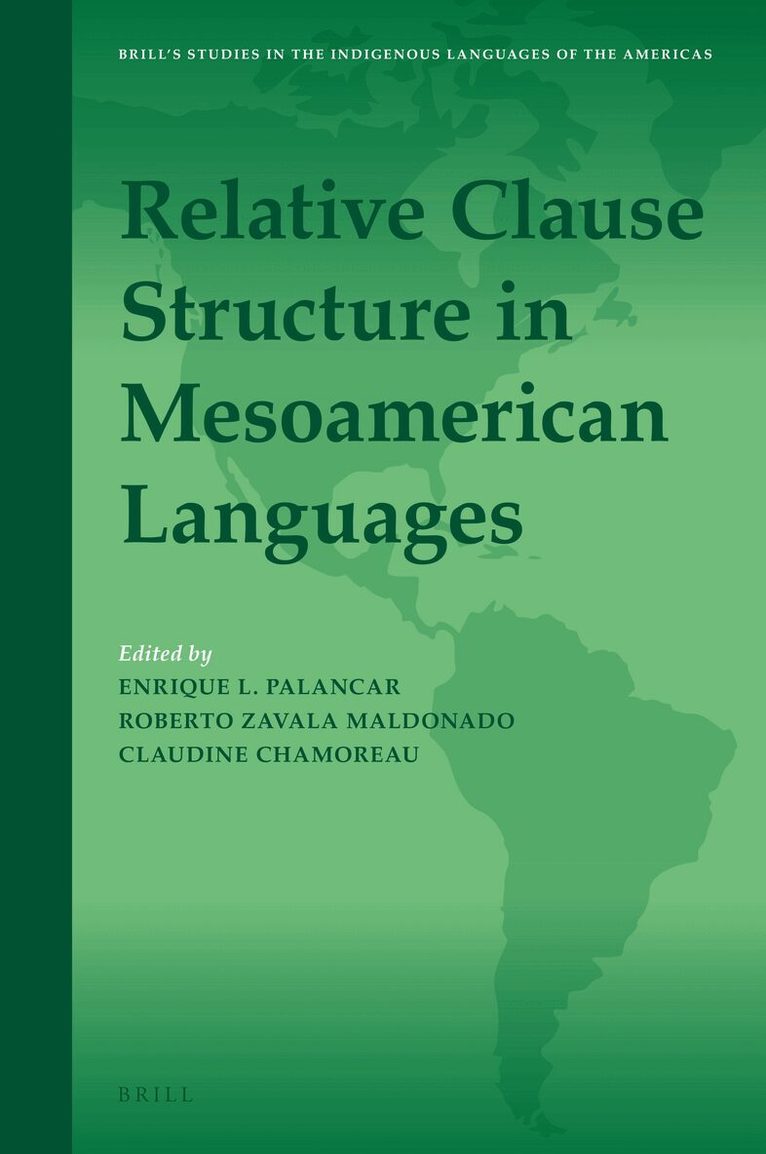
Relative Clause Structure in Mesoamerican Languages
Inbunden, Engelska, 2021
2 172 kr
Skickas inom 5-8 vardagar
As the first major survey of relative clause structure in the indigenous languages of Mesoamerica, this volume comprises a collection of original, in-depth studies of relative constructions in representative languages from across Mexico and Central America, based on empirical data collected by the authors themselves. The studies not only reveal the complex and fascinating nature of relative clauses in the languages in question, but they also shed invaluable light on how Mesoamerica came to be one of the richest and most diverse linguistic areas on our planet.