Erasmo Carrera – författare
1 402 kr
Skickas inom 10-15 vardagar
Thermal Stress Analysis of Composite Beams, Plates and Shells: Computational Modelling and Applications presents classic and advanced thermal stress topics in a cutting-edge review of this critical area, tackling subjects that have little coverage in existing resources. It includes discussions of complex problems, such as multi-layered cases using modern advanced computational and vibrational methods.
Authors Carrera and Fazzolari begin with a review of the fundamentals of thermoelasticity and thermal stress analysis relating to advanced structures and the basic mechanics of beams, plates, and shells, making the book a self-contained reference. More challenging topics are then addressed, including anisotropic thermal stress structures, static and dynamic responses of coupled and uncoupled thermoelastic problems, thermal buckling, and post-buckling behavior of thermally loaded structures, and thermal effects on panel flutter phenomena, amongst others.
Provides an overview of critical thermal stress theory and its relation to beams, plates, and shells, from classical concepts to the latest advanced theories Appeals to those studying thermoelasticity, thermoelastics, stress analysis, multilayered structures, computational methods, buckling, static response, and dynamic response Includes the authors' unified formulation (UF) theory, along with cutting-edge topics that receive little coverage in other references Covers metallic and composite structures, including a complete analysis and sample problems of layered structures, considering both mesh and meshless methods Presents a valuable resource for those working on thermal stress problems in mechanical, civil, and aerospace engineering settings1 378 kr
Skickas inom 5-8 vardagar
1 182 kr
Skickas inom 11-20 vardagar
1 617 kr
Läs direkt efter köp
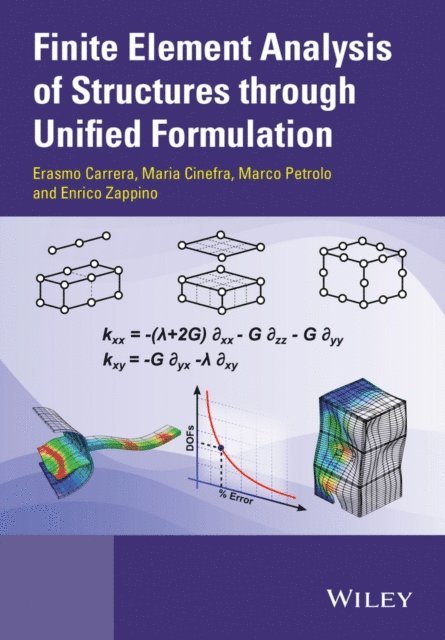
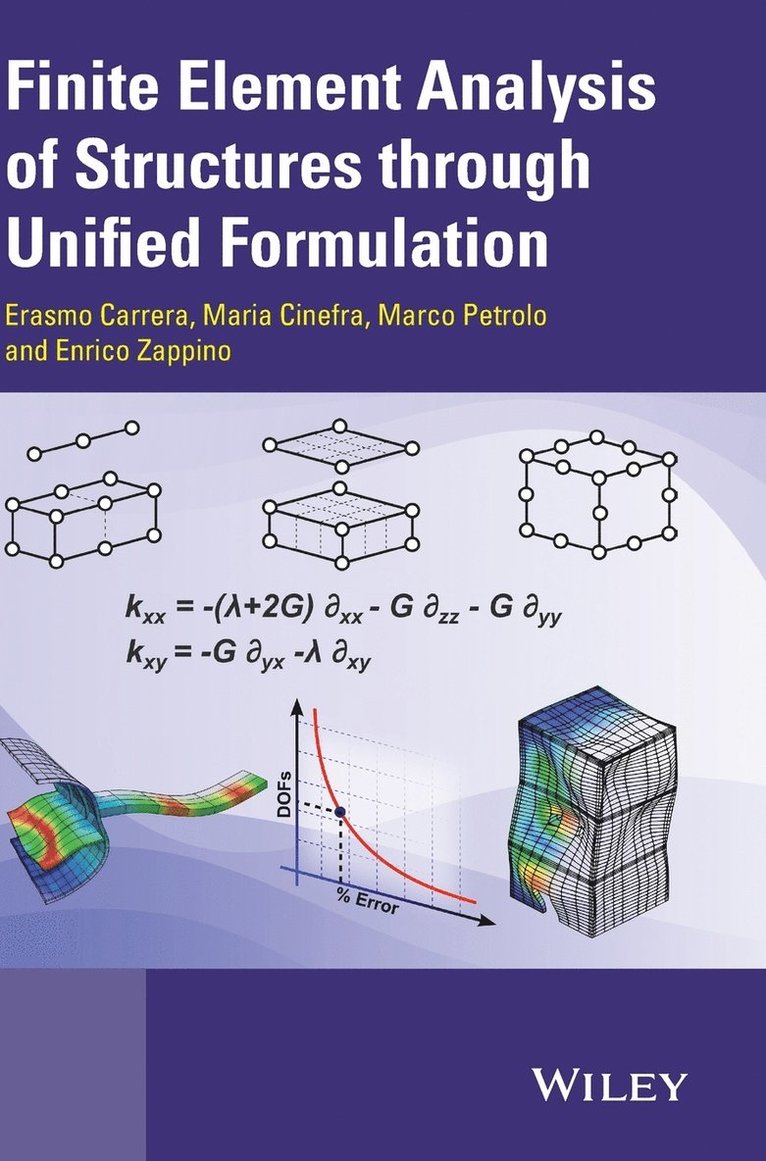
The finite element method (FEM) is a computational tool widely used to design and analyse complex structures. Currently, there are a number of different approaches to analysis using the FEM that vary according to the type of structure being analysed: beams and plates may use 1D or 2D approaches, shells and solids 2D or 3D approaches, and methods that work for one structure are typically not optimized to work for another.
Finite Element Analysis of Structures Through Unified Formulation deals with the FEM used for the analysis of the mechanics of structures in the case of linear elasticity. The novelty of this book is that the finite elements (FEs) are formulated on the basis of a class of theories of structures known as the Carrera Unified Formulation (CUF). It formulates 1D, 2D and 3D FEs on the basis of the same ''fundamental nucleus'' that comes from geometrical relations and Hooke''s law, and presents both 1D and 2D refined FEs that only have displacement variables as in 3D elements. It also covers 1D and 2D FEs that make use of ''real'' physical surfaces rather than ’artificial’ mathematical surfaces which are difficult to interface in CAD/CAE software.
Key features:
Covers how the refined formulation can be easily and conveniently used to analyse laminated structures, such as sandwich and composite structures, and to deal with multifield problems Shows the performance of different FE models through the ''best theory diagram'' which allows different models to be compared in terms of accuracy and computational cost Introduces an axiomatic/asymptotic approach that reduces the computational cost of the structural analysis without affecting the accuracy Introduces an innovative ''component-wise'' approach to deal with complex structures Accompanied by a website hosting the dedicated software package MUL2 (www.mul2.com)Finite Element Analysis of Structures Through Unified Formulation is a valuable reference for researchers and practitioners, and is also a useful source of information for graduate students in civil, mechanical and aerospace engineering.
1 603 kr
Läs direkt efter köp
The finite element method (FEM) is a computational tool widely used to design and analyse complex structures. Currently, there are a number of different approaches to analysis using the FEM that vary according to the type of structure being analysed: beams and plates may use 1D or 2D approaches, shells and solids 2D or 3D approaches, and methods that work for one structure are typically not optimized to work for another.
Finite Element Analysis of Structures Through Unified Formulation deals with the FEM used for the analysis of the mechanics of structures in the case of linear elasticity. The novelty of this book is that the finite elements (FEs) are formulated on the basis of a class of theories of structures known as the Carrera Unified Formulation (CUF). It formulates 1D, 2D and 3D FEs on the basis of the same ''fundamental nucleus'' that comes from geometrical relations and Hooke''s law, and presents both 1D and 2D refined FEs that only have displacement variables as in 3D elements. It also covers 1D and 2D FEs that make use of ''real'' physical surfaces rather than ’artificial’ mathematical surfaces which are difficult to interface in CAD/CAE software.
Key features:
Covers how the refined formulation can be easily and conveniently used to analyse laminated structures, such as sandwich and composite structures, and to deal with multifield problems Shows the performance of different FE models through the ''best theory diagram'' which allows different models to be compared in terms of accuracy and computational cost Introduces an axiomatic/asymptotic approach that reduces the computational cost of the structural analysis without affecting the accuracy Introduces an innovative ''component-wise'' approach to deal with complex structures Accompanied by a website hosting the dedicated software package MUL2 (www.mul2.com)Finite Element Analysis of Structures Through Unified Formulation is a valuable reference for researchers and practitioners, and is also a useful source of information for graduate students in civil, mechanical and aerospace engineering.
1 377 kr
Skickas inom 5-8 vardagar
1 542 kr
Läs direkt efter köp
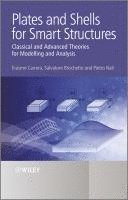
Plates and Shells for Smart Structures offers a complete guide and reference to smart structures under both mechanical and electrical loads, starting with the basic principles and working right up to the most advanced models. It provides an overview of classical plate and shell theories for piezoelectric elasticity and demonstrates their limitations in static and dynamic analysis with a number of example problems. This book also provides both analytical and finite element solutions, thus enabling the reader to compare strong and weak solutions to the problems.
Key features:
compares a large variety of classical and modern approaches to plates and shells, such as Kirchhoff-Love , Reissner-Mindlin assumptions and higher order, layer-wise and mixed theories introduces theories able to consider electromechanical couplings as well as those that provide appropriate interface continuity conditions for both electrical and mechanical variables considers both static and dynamic analysis accompanied by a companion website hosting dedicated software MUL2 that is used to obtain the numerical solutions in the book, allowing the reader to reproduce the examples given as well as solve problems of their ownThe models currently used have a wide range of applications in civil, automotive, marine and aerospace engineering. Researchers of smart structures, and structural analysts in industry, will find all they need to know in this concise reference. Graduate and postgraduate students of mechanical, civil and aerospace engineering can also use this book in their studies.
www.mul2.com
1 389 kr
Läs direkt efter köp
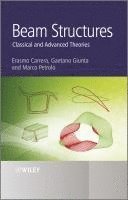
Beam Structures: Classical and Advanced Theories proposes a new original unified approach to beam theory that includes practically all classical and advanced models for beams and which has become established and recognised globally as the most important contribution to the field in the last quarter of a century.
The Carrera Unified Formulation (CUF) has hierarchical properties, that is, the error can be reduced by increasing the number of the unknown variables. This formulation is extremely suitable for computer implementations and can deal with most typical engineering challenges. It overcomes the problem of classical formulae that require different formulas for tension, bending, shear and torsion; it can be applied to any beam geometries and loading conditions, reaching a high level of accuracy with low computational cost, and can tackle problems that in most cases are solved by employing plate/shell and 3D formulations.
Key features:
compares classical and modern approaches to beam theory, including classical well-known results related to Euler-Bernoulli and Timoshenko beam theories pays particular attention to typical applications related to bridge structures, aircraft wings, helicopters and propeller blades provides a number of numerical examples including typical Aerospace and Civil Engineering problems proposes many benchmark assessments to help the reader implement the CUF if they wish to do so accompanied by a companion website hosting dedicated software MUL2 that is used to obtain the numerical solutions in the book, allowing the reader to reproduce the examples given in the book as well as to solve other problems of their own www.mul2.comResearchers of continuum mechanics of solids and structures and structural analysts in industry will find this book extremely insightful. It will also be of great interest to graduate and postgraduate students of mechanical, civil and aerospace engineering.
1 542 kr
Läs direkt efter köp
Plates and Shells for Smart Structures offers a complete guide and reference to smart structures under both mechanical and electrical loads, starting with the basic principles and working right up to the most advanced models. It provides an overview of classical plate and shell theories for piezoelectric elasticity and demonstrates their limitations in static and dynamic analysis with a number of example problems. This book also provides both analytical and finite element solutions, thus enabling the reader to compare strong and weak solutions to the problems.
Key features:
compares a large variety of classical and modern approaches to plates and shells, such as Kirchhoff-Love , Reissner-Mindlin assumptions and higher order, layer-wise and mixed theories introduces theories able to consider electromechanical couplings as well as those that provide appropriate interface continuity conditions for both electrical and mechanical variables considers both static and dynamic analysis accompanied by a companion website hosting dedicated software MUL2 that is used to obtain the numerical solutions in the book, allowing the reader to reproduce the examples given as well as solve problems of their ownThe models currently used have a wide range of applications in civil, automotive, marine and aerospace engineering. Researchers of smart structures, and structural analysts in industry, will find all they need to know in this concise reference. Graduate and postgraduate students of mechanical, civil and aerospace engineering can also use this book in their studies.
www.mul2.com
1 389 kr
Läs direkt efter köp
Beam Structures: Classical and Advanced Theories proposes a new original unified approach to beam theory that includes practically all classical and advanced models for beams and which has become established and recognised globally as the most important contribution to the field in the last quarter of a century.
The Carrera Unified Formulation (CUF) has hierarchical properties, that is, the error can be reduced by increasing the number of the unknown variables. This formulation is extremely suitable for computer implementations and can deal with most typical engineering challenges. It overcomes the problem of classical formulae that require different formulas for tension, bending, shear and torsion; it can be applied to any beam geometries and loading conditions, reaching a high level of accuracy with low computational cost, and can tackle problems that in most cases are solved by employing plate/shell and 3D formulations.
Key features:
compares classical and modern approaches to beam theory, including classical well-known results related to Euler-Bernoulli and Timoshenko beam theories pays particular attention to typical applications related to bridge structures, aircraft wings, helicopters and propeller blades provides a number of numerical examples including typical Aerospace and Civil Engineering problems proposes many benchmark assessments to help the reader implement the CUF if they wish to do so accompanied by a companion website hosting dedicated software MUL2 that is used to obtain the numerical solutions in the book, allowing the reader to reproduce the examples given in the book as well as to solve other problems of their own www.mul2.comResearchers of continuum mechanics of solids and structures and structural analysts in industry will find this book extremely insightful. It will also be of great interest to graduate and postgraduate students of mechanical, civil and aerospace engineering.
Advanced Topics in Mechanics of Materials, Structures and Construction
AToMech1-2023
1 684 kr
Skickas inom 5-8 vardagar
AToMech1-2023 Supplement
616 kr
Skickas inom 5-8 vardagar
764 kr
Skickas inom 10-15 vardagar
916 kr
Läs direkt efter köp
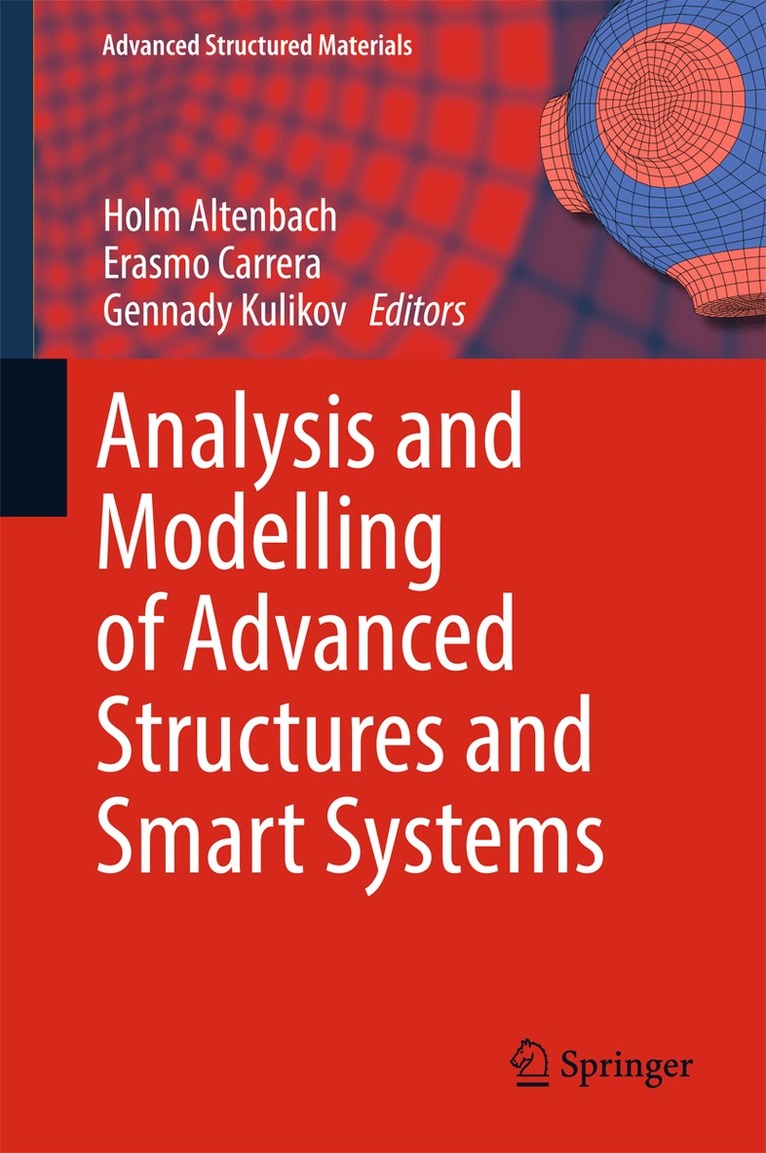
Analysis and Modelling of Advanced Structures and Smart Systems
1 605 kr
Skickas inom 10-15 vardagar
1 367 kr
Läs direkt efter köp
This book presents selected papers presented at the 8th International Conference "Design, Modeling and Experiments of Advanced Structures and Systems" (DeMEASS VIII, held in Moscow, Russia in May 2017) and reflects the modern state of sciences in this field.
The contributions contain topics like Piezoelectric, Ferroelectric, Ferroelastic and Magnetostrictive Materials, Shape Memory Alloys and Active Polymers, Functionally Graded Materials, Multi-Functional Smart Materials and Structures, Coupled Multi-Field Problems, Design and Modeling of Sensors and Actuators, Adaptive Structures.
Analysis and Modelling of Advanced Structures and Smart Systems
1 126 kr
Skickas inom 10-15 vardagar