
Erik Rifkin - Böcker
Visar alla böcker från författaren Erik Rifkin. Handla med fri frakt och snabb leverans.
4 produkter
4 produkter
550 kr
Skickas inom 10-15 vardagar
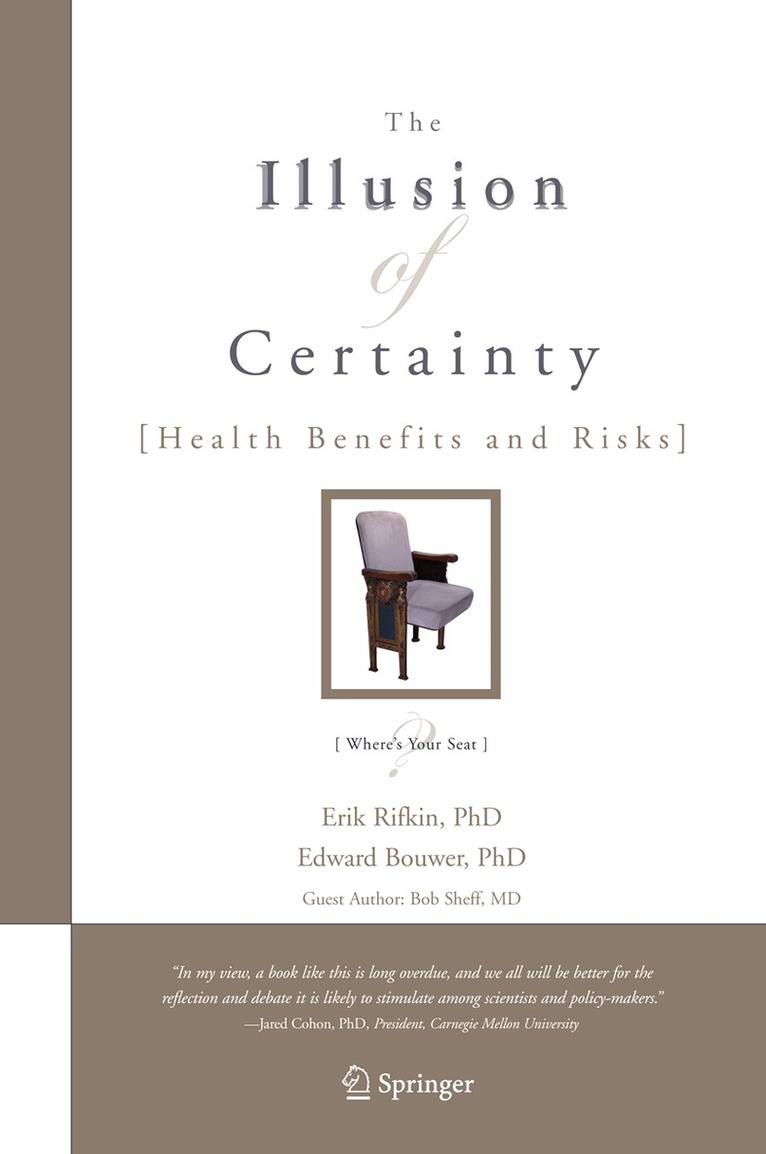
This book peels away the "veneer of certainty" which many of us attach to health risk and benefit information given to us in our daily lives. It was written and designed primarily to assist the public in comprehending and interpreting the uncertainty associated with the overwhelming amount of information on medical and environmental health risks. The book uses unique, visual presentations and case studies to explain the benefits of medical screening tests (e.g., mammography, prostate and colorectal cancer screening, cholesterol screening) and drugs (e.g., statins, Vioxx) and the risks associated with exposure to environmental contaminants (e.g., lead, dioxin, radon). This book will help patients and their families get more involved in making medical decisions, and citizens face critical questions about the environment. By putting the complexities of risk analysis in terms the general public can relate to, the authors are empowering people to make well-informed decisions. Erik Rifkin is the president of an environmental consulting firm that specializes in the characterization of ecological and human health risks from exposure to soil, water, air and sediments.His firm provides assistance and guidance to federal and state regulatory agencies and corporations regarding the nature and magnitude of environmental risks and potential remediation strategies.Dr. Rifkin's broad experience includes the communication of health risks and benefits to groups concerned with these issues. Edward J. Bouwer is Professor of Environmental Engineering at Johns Hopkins University in Baltimore, Maryland. He has extensive experience with water and soil pollution and treatment. His research provides guidance on defining and managing environmental risks and how to interpret human and ecological health risk data. Dr. Bouwer has served on several National Research Council committees that provide guidance on managing human and ecological risks to Congress, regulatory agencies, and the scientific community. Guest Author Bob Sheff, MD, received his medical training as a radiologist at UCLA and Johns Hopkins Medical Center. He spent his career praticing medicine and running one of the largest medical managed-care systems in the U.S. Now semi-retired, he devotes his time to helping non-profit organizations and individual people addess their medical concerns.He lives in Columbia, MD.
550 kr
Skickas inom 10-15 vardagar
Risk analysis and risk assessment have been with us long enough for the terms to sound familiar to most people. Standard fare for the nuclear power industry and the military for a half a century or more, risk assessment is now a routine aspect of environmental management, public health and individual medical decision making. There have been popular books on risk, and the current poker craze will likely spread risk concepts to an even wider (and younger) audience. Yet, despite all of this extensive and varied experience, we the analysts and practitioners have not done nearly enough to explain to the people who need to know what they need to know – especially the uncertainty inherent in risk estimates. There are many instances in which the failure to communicate risk information accurately or completely has had an important and material impact on decisions and actions. I have been involved in some of these, ranging from local plans for water management to national decisions about nuclear waste. I have seen first hand the effects of poorly done risk asse- ments and bad risk communication, and especially the way in which the uncertainly of risk estimates is handled (or mishandled). The con- quences of doing this wrong are high. It’s high time that we addressed this gap in understanding, and this book is an excellent and important step in doing so.
822 kr
Skickas inom 10-15 vardagar
This book demonstrates how a novel decision-aid, called a Benefit-Risk Characterization Theater (BRCT), can be used to:· Significantly improve accurate communication of health risks from exposure to COVID-19; and· Assess how to best contain and control COVID-19.To date, there have been far-reaching ramifications based on ineffective risk communication when clarifying these health endpoints.A BRCT is a familiar, theatrical chart representation of 1,000 people, with the risks and benefits shown by blackened seats. Since health outcomes can easily be put into such a chart, we show how BRCTs can be used objectively by professionals, the media and lay people. It allows characterization and communication of health benefits and risks of COVID-19 treatment and containment in an undemanding and straightforward way.BRCTs have been successfully used to assist patients in determining:· Their level of acceptable risk of various medical interventions;· If the benefits of intervention outweigh the risks;· Who should make the final decision regarding medical intervention; and· Whether the decision is evidence-based.Written by experts in the field, this book fills in a gap in communication between the medical community, the public and patients. It also provides an area of expertise in communication that is beneficial for medical providers and medical students.
Interpreting Health Benefits and Risks
A Practical Guide to Facilitate Doctor-Patient Communication
Häftad, Engelska, 2014
985 kr
Skickas inom 10-15 vardagar
This timely guide to communication in patient-centered medicine argues for greater clarity in explaining health risks versus benefits of an array of screening tests, procedures, and drug regimens. It reviews the growing trend toward patients' involvement in their own care, particularly in terms of chronic conditions, and details approaches physicians can use to prepare patients (and themselves) for collaborative decision-making based on informed choices and clear, meaningful knowledge. Chapters apply this lens to a wide range of common interventions as contentious as estrogen replacement therapy and antibiotics, and as widely prescribed as the daily aspirin and the annual physical. With this goal in mind, the authors also introduce an innovative decision-making tool that translates risks and benefits into a clear graphic format for fewer chances of miscommunication or misunderstanding.Among the topics covered:Involving the patient in decision making.Towards a universal decision aid.BRCT: the Benefit/Risk Characterization Theater.Breast Cancer Screening—Mammograms.Prostate Cancer Screening.Colon cancer screening with colonoscopy.Screening for and treating dementia.Statins, cholesterol, and coronary heart disease.Physicians in family and internal medicine will find Interpreting Health Benefits and Risks: A Practical Guide to Facilitate Doctor- Patient Communication a valuable resource for communicating with patients and new possibilities for working toward their better health and health education.This book considers several common and important situations where faulty decision-making makes overtreatment a serious risk. Clear, fair, referenced, and useful information is provided. And a powerful intuitive technique is introduced which allows patient and doctor to talk as equals as they work together in the exam room. The authorsemphasize that some patients who have been fully educated will still accept high risks of harm for a small chance of avoiding premature death. But as this book is accepted and its ideas and technique are extended, I feel sure that net harm to patients will be curtailed. And what is more, the integrity of the decision-making process will be improved.—Thomas Finucane, MD, Professor of Medicine, Division of Gerontology and Geriatric Medicine, The Johns Hopkins University School of Medicine