Erika Wada – författare
Visar alla böcker från författaren Erika Wada. Handla med fri frakt och snabb leverans.
5 produkter
Unfinished Business – Telecommunications after the Uruguay Round
Av Gary Clyde Hufbauer, Erika Wada m. fl.
Häftad, 1997
226 kr
Lägg i varukorg
Benefits of Price Convergence – Speculative Calculations
Av Gary Clyde Hufbauer, Erika Wada m. fl.
Häftad, 2002
399 kr
Lägg i varukorg
Benefits of Price Convergence
Speculative Calculations
Av Tony Warren, Erika Wada m. fl.
E-bok, 2002
137 kr
Lägg i varukorg
Price divergence is readily apparent to anyone who shops. Travelers from Manchester to London, or from Chicago to Paris, are hit by sticker shock. Products ranging from London Fog raincoats to Viagra are available over the Internet at half their retail store prices. Common experience tells us that …
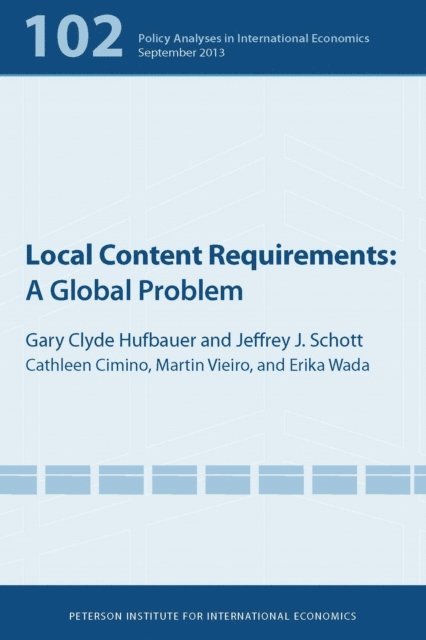
Local Content Requirements – A Global Problem
Av Gary Clyde Hufbauer, Jeffrey Schott m. fl.
Häftad, 2013
494 kr
Lägg i varukorg
Local Content Requirements
A Global Problem
Av Erika Wada, Martin Vieiro m. fl.
E-bok, 2013
130 kr
Lägg i varukorg
In the wake of the Great Recession of 2008–09, economists feared that protectionist policies might sweep the world economy, echoing the wave of tariff escalations during the Great Depression of the 1930s. To some surprise, officials were more restrained and largely avoided traditional forms of …