Erin Manning - Böcker
Visar alla böcker från författaren Erin Manning. Handla med fri frakt och snabb leverans.
22 produkter
22 produkter
284 kr
Skickas
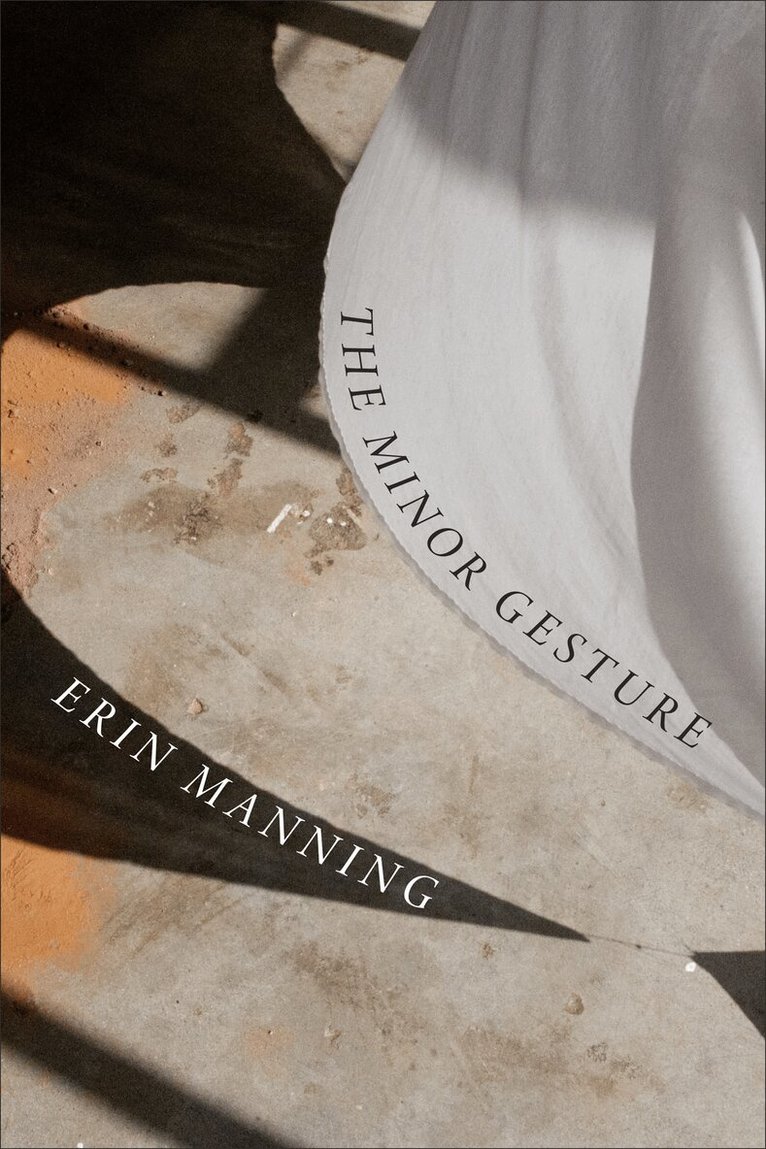
In this wide-ranging and probing book Erin Manning extends her previous inquiries into the politics of movement to the concept of the minor gesture. The minor gesture, although it may pass almost unperceived, transforms the field of relations. More than a chance variation, less than a volition, it requires rethinking common assumptions about human agency and political action. To embrace the minor gesture's power to fashion relations, its capacity to open new modes of experience and manners of expression, is to challenge the ways in which the neurotypical image of the human devalues alternative ways of being moved by and moving through the world-in particular what Manning terms "autistic perception." Drawing on Deleuze and Guattari's schizoanalysis and Whitehead's speculative pragmatism, Manning's far-reaching analyses range from fashion to depression to the writings of autistics, in each case affirming the neurodiversity of the minor and the alternative politics it gestures toward.
345 kr
Skickas
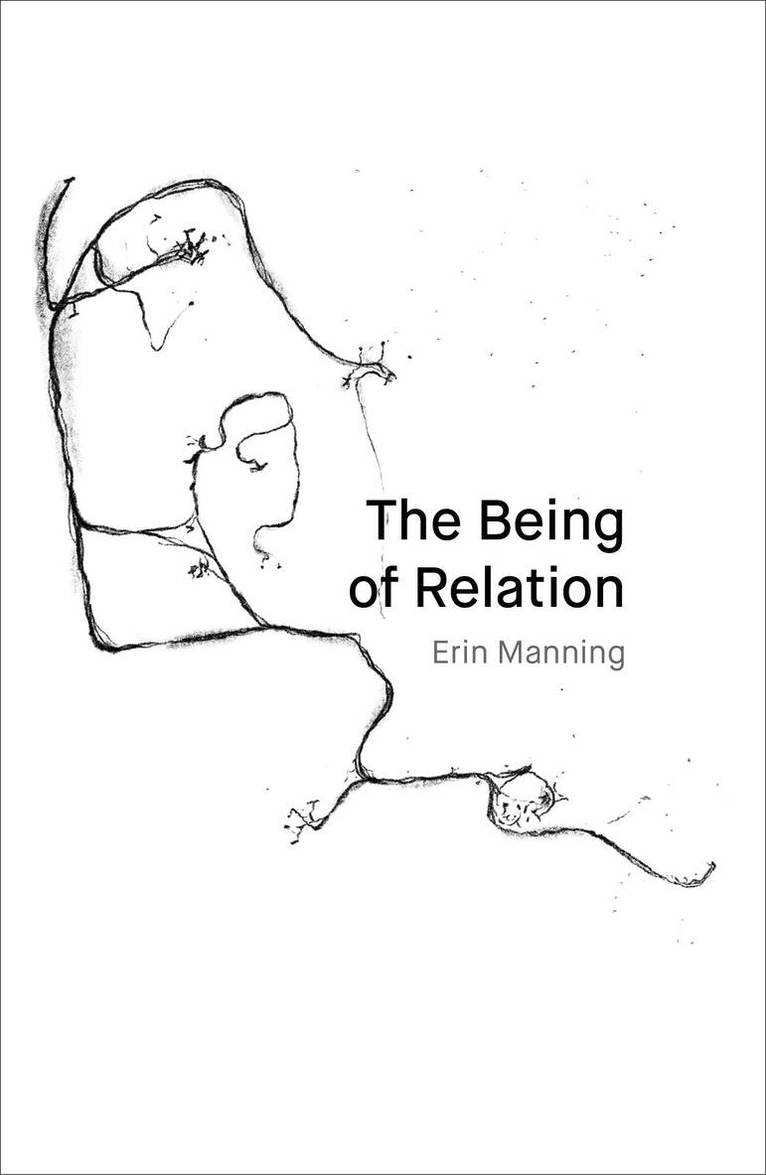
How does whiteness sediment worlds? How does it format individuality in the name of a neurotypicality that polices how one bodies, and how one comes to know? And how does a poetics of relation shift the very logic of this sedimentation?Edouard Glissant’s poetics of relation are bold in their call to “consent not to be a single being.” This transindividual consent, born in the process of worlds crafting themselves in what he would call an “aesthetics of the earth,” are felt in Fernand Deligny’s errant lines. These errant lines, traced to move with the complex gestures of autistics over a period of several years in Monoblet, France (1965-1970), offer an alternative to pathology, and individual psychological assessment. The Being of Relation brings these two projects into encounter, exploring what else blackness can be at this non-pathological juncture where what is foregrounded is the very being of relation. On the way, trails of whiteness are excavated and interrogated. The aim: to move toward parapedagogies of resistance, in a logic of a poetics of relation, a logic of neurodiversity, minor sociality and the kind of difference without separability that refuses the binary that holds neurotypicality – as whiteness – in place.
252 kr
Skickas inom 7-10 vardagar
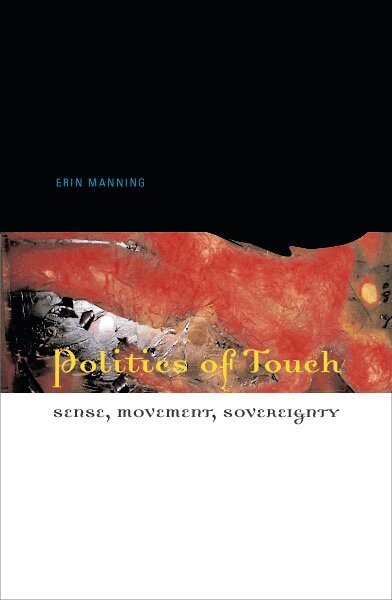
Political philosophy has long been bound by traditional thinking about the body and the senses. Through an engagement with the state-centered vocabulary of this discipline, Politics of Touch explores the ways in which sensing bodies continually run up against existing political structures. In this groundbreaking work, Erin Manning reconsiders how new politics can arise that challenge the national body politic.In Politics of Touch, Manning develops a new way to conceive the role of the senses, and of touch in particular. Exploring concepts of violence, gender, sexuality, security, democracy, and identity, she traces the ways in which touch informs and reforms the body. Specifically considering tango-a tactile, rhythmic, and improvisational dance- she foregrounds movement as the sensing body's intervention into the political. With a fresh vision and an original theoretical basis, Manning shows the ontogenetic potential of the body, and in doing so, redefines our understanding of the sense of touch in philosophical and political terms. Erin Manning is assistant professor of fine arts at Concordia University and the author of Ephemeral Territories (Minnesota, 2003).
293 kr
Skickas inom 7-10 vardagar
Explores questions of identity and belonging through the lens of Canadian cultural productionWhat does it mean to be at home? In a critical engagement with notions of territory, identity, racial difference, separatism, multiculturalism, and homelessness, this book delves into the question of what it means to belong-in particular, what it means to be at home in Canada. Ephemeral Territories weaves together many narratives and representations of Canadian identity-from political philosophy and cultural theory to art and films such as Srinivas Krishna’s Lulu, Clement Virgo’s Rude, and Charles Biname’s Eldorado-to develop and complicate familiar views of identity and selfhood.Canadian identity has historically been linked to a dual notion of culture traceable to the French and English strains of Canada’s colonial past. Erin Manning subverts this binary through readings that shift our attention from nationalist constructions of identity and territory to a more radical and pluralizing understanding of the political. As she brings together issues specific to Canada (such as Quebec separatism and Canadian landscape painting) and concerns that are more transnational (such as globalization and immigration), Manning emphasizes the truly cross-cultural nature of the problems of racism, gender discrimination, and homelessness. Thus this impassioned reading of Canadian texts also makes an important contribution to philosophical, cultural, and political discourses across the globe.
284 kr
Skickas inom 7-10 vardagar
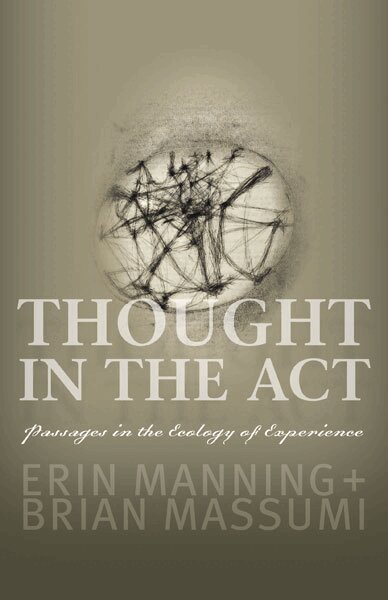
“Every practice is a mode of thought, already in the act. To dance: a thinking in movement. To paint: a thinking through color. To perceive in the everyday: a thinking of the world’s varied ways of affording itself.” -from Thought in the ActCombining philosophy and aesthetics, Thought in the Act is a unique exploration of creative practice as a form of thinking. Challenging the common opposition between the conceptual and the aesthetic, Erin Manning and Brian Massumi “think through” a wide range of creative practices in the process of their making, revealing how thinking and artfulness are intimately, creatively, and inseparably intertwined. They rediscover this intertwining at the heart of everyday perception and investigate its potential for new forms of activism at the crossroads of politics and art.Emerging from active collaborations, the book analyzes the experiential work of the architects and conceptual artists Arakawa and Gins, the improvisational choreographic techniques of William Forsythe, the recent painting practice of Bracha Ettinger, as well as autistic writers’ self-descriptions of their perceptual world and the experimental event making of the SenseLab collective. Drawing from the idiosyncratic vocabularies of each creative practice, and building on the vocabulary of process philosophy, the book reactivates rather than merely describes the artistic processes it examines. The result is a thinking-with and a writing-in-collaboration-with these processes and a demonstration of how philosophy co-composes with the act in the making. Thought in the Act enacts a collaborative mode of thinking in the act at the intersection of art, philosophy, and politics.
1 249 kr
Skickas inom 7-10 vardagar
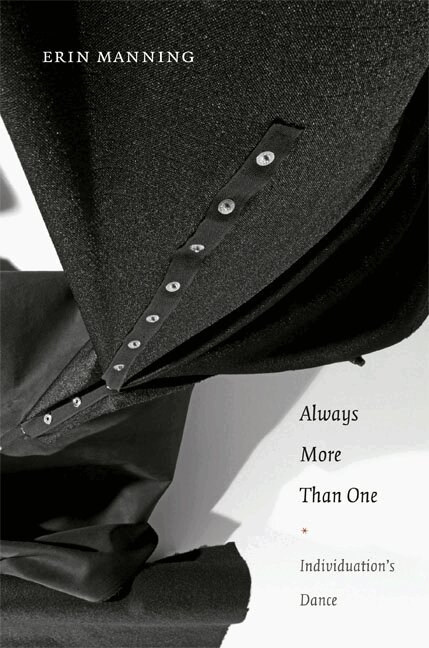
In Always More Than One, the philosopher, visual artist, and dancer Erin Manning explores the concept of the "more than human" in the context of movement, perception, and experience. Working from Whitehead's process philosophy and Simondon's theory of individuation, she extends the concepts of movement and relation developed in her earlier work toward the notion of "choreographic thinking." Here, she uses choreographic thinking to explore a mode of perception prior to the settling of experience into established categories. Manning connects this to the concept of "autistic perception," described by autistics as the awareness of a relational field prior to the so-called neurotypical tendency to "chunk" experience into predetermined subjects and objects. Autistics explain that, rather than immediately distinguishing objects-such as chairs and tables and humans-from one another on entering a given environment, they experience the environment as gradually taking form. Manning maintains that this mode of awareness underlies all perception. What we perceive is never first a subject or an object, but an ecology. From this vantage point, she proposes that we consider an ecological politics where movement and relation take precedence over predefined categories, such as the neurotypical and the neurodiverse, or the human and the nonhuman. What would it mean to embrace an ecological politics of collective individuation?
297 kr
Skickas
In Always More Than One, the philosopher, visual artist, and dancer Erin Manning explores the concept of the "more than human" in the context of movement, perception, and experience. Working from Whitehead's process philosophy and Simondon's theory of individuation, she extends the concepts of movement and relation developed in her earlier work toward the notion of "choreographic thinking." Here, she uses choreographic thinking to explore a mode of perception prior to the settling of experience into established categories. Manning connects this to the concept of "autistic perception," described by autistics as the awareness of a relational field prior to the so-called neurotypical tendency to "chunk" experience into predetermined subjects and objects. Autistics explain that, rather than immediately distinguishing objects-such as chairs and tables and humans-from one another on entering a given environment, they experience the environment as gradually taking form. Manning maintains that this mode of awareness underlies all perception. What we perceive is never first a subject or an object, but an ecology. From this vantage point, she proposes that we consider an ecological politics where movement and relation take precedence over predefined categories, such as the neurotypical and the neurodiverse, or the human and the nonhuman. What would it mean to embrace an ecological politics of collective individuation?
1 196 kr
Skickas inom 7-10 vardagar
In this wide-ranging and probing book Erin Manning extends her previous inquiries into the politics of movement to the concept of the minor gesture. The minor gesture, although it may pass almost unperceived, transforms the field of relations. More than a chance variation, less than a volition, it requires rethinking common assumptions about human agency and political action. To embrace the minor gesture's power to fashion relations, its capacity to open new modes of experience and manners of expression, is to challenge the ways in which the neurotypical image of the human devalues alternative ways of being moved by and moving through the world-in particular what Manning terms "autistic perception." Drawing on Deleuze and Guattari's schizoanalysis and Whitehead's speculative pragmatism, Manning's far-reaching analyses range from fashion to depression to the writings of autistics, in each case affirming the neurodiversity of the minor and the alternative politics it gestures toward.
461 kr
Skickas inom 5-8 vardagar
516 kr
Skickas inom 5-8 vardagar
489 kr
Skickas inom 5-8 vardagar
556 kr
Skickas inom 5-8 vardagar
287 kr
Skickas inom 5-8 vardagar
1 223 kr
Skickas inom 7-10 vardagar
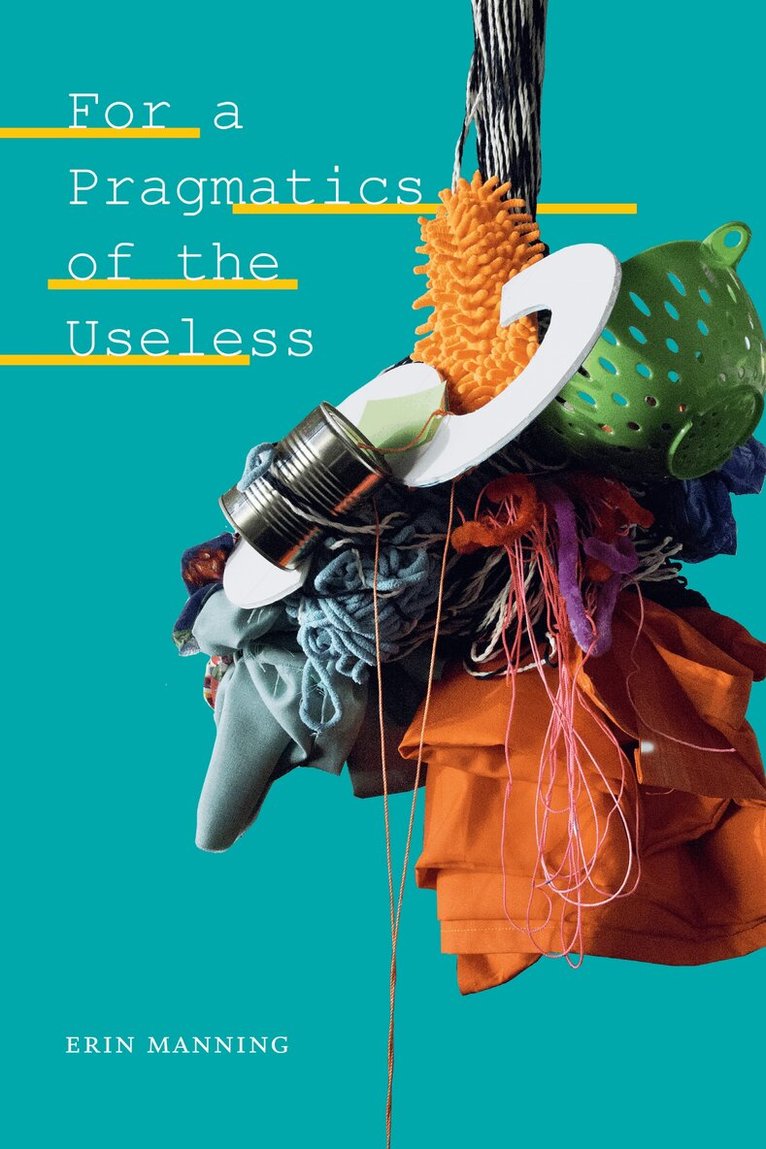
What has a use in the future, unforeseeably, is radically useless now. What has an effect now is not necessarily useful if it falls through the gaps. In For a Pragmatics of the Useless Erin Manning examines what falls outside the purview of already-known functions and established standards of value, not for want of potential but for carrying an excess of it. The figures are various: the infrathin, the artful, proprioceptive tactility, neurodiversity, black life. It is around the latter two that a central refrain echoes: "All black life is neurodiverse life." This is not an equation, but an "approximation of proximity." Manning shows how neurotypicality and whiteness combine to form a normative baseline for existence. Blackness and neurodiversity "schizz" around the baseline, uselessly, pragmatically, figuring a more-than of life living. Manning, in dialogue with FÉlix Guattari and drawing on the black radical tradition's accounts of black life and the aesthetics of black sociality, proposes a "schizoanalysis" of the more-than, charting a panoply of techniques for other ways of living and learning.
324 kr
Skickas inom 7-10 vardagar
What has a use in the future, unforeseeably, is radically useless now. What has an effect now is not necessarily useful if it falls through the gaps. In For a Pragmatics of the Useless Erin Manning examines what falls outside the purview of already-known functions and established standards of value, not for want of potential but for carrying an excess of it. The figures are various: the infrathin, the artful, proprioceptive tactility, neurodiversity, black life. It is around the latter two that a central refrain echoes: "All black life is neurodiverse life." This is not an equation, but an "approximation of proximity." Manning shows how neurotypicality and whiteness combine to form a normative baseline for existence. Blackness and neurodiversity "schizz" around the baseline, uselessly, pragmatically, figuring a more-than of life living. Manning, in dialogue with FÉlix Guattari and drawing on the black radical tradition's accounts of black life and the aesthetics of black sociality, proposes a "schizoanalysis" of the more-than, charting a panoply of techniques for other ways of living and learning.
188 kr
Skickas
178 kr
Skickas
294 kr
Skickas inom 5-8 vardagar
247 kr
Skickas inom 5-8 vardagar
1 083 kr
Skickas inom 5-8 vardagar
How does whiteness sediment worlds? How does it format individuality in the name of a neurotypicality that polices how one bodies, and how one comes to know? And how does a poetics of relation shift the very logic of this sedimentation?Edouard Glissant’s poetics of relation are bold in their call to “consent not to be a single being.” This transindividual consent, born in the process of worlds crafting themselves in what he would call an “aesthetics of the earth,” are felt in Fernand Deligny’s errant lines. These errant lines, traced to move with the complex gestures of autistics over a period of several years in Monoblet, France (1965-1970), offer an alternative to pathology, and individual psychological assessment. The Being of Relation brings these two projects into encounter, exploring what else blackness can be at this non-pathological juncture where what is foregrounded is the very being of relation. On the way, trails of whiteness are excavated and interrogated. The aim: to move toward parapedagogies of resistance, in a logic of a poetics of relation, a logic of neurodiversity, minor sociality and the kind of difference without separability that refuses the binary that holds neurotypicality – as whiteness – in place.
253 kr
Skickas inom 5-8 vardagar
265 kr
Skickas inom 5-8 vardagar