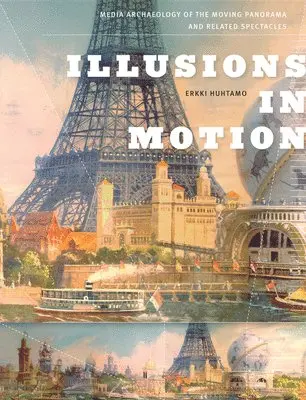
This book introduces an archaeological approach to the study of media - one that sifts through the evidence to learn how media were written about, used, designed, preserved, and sometimes discarded. Edited by Erkki Huhtamo and Jussi Parikka, with contributions from internationally prominent scholars from Europe, North America, and Japan, the essays help us understand how the media that predate today's interactive, digital forms were in their time contested, adopted and embedded in the everyday. Providing a broad overview of the many historical and theoretical facets of Media Archaeology as an emerging field, the book encourages discussion by presenting a full range of different voices. By revisiting 'old' or even 'dead' media, it provides a richer horizon for understanding 'new' media in their complex and often contradictory roles in contemporary society and culture.
This book introduces an archaeological approach to the study of media - one that sifts through the evidence to learn how media were written about, used, designed, preserved, and sometimes discarded. Edited by Erkki Huhtamo and Jussi Parikka, with contributions from internationally prominent scholars from Europe, North America, and Japan, the essays help us understand how the media that predate today’s interactive, digital forms were in their time contested, adopted and embedded in the everyday. Providing a broad overview of the many historical and theoretical facets of Media Archaeology as an emerging field, the book encourages discussion by presenting a full range of different voices. By revisiting ‘old’ or even ‘dead’ media, it provides a richer horizon for understanding ‘new’ media in their complex and often contradictory roles in contemporary society and culture.
This uniquely designed book presents the first survey of contemporary artist Toni Dove's pioneering work at the crossroads of performance, cinema, and virtual reality. This uniquely designed book presents the first survey of contemporary artist Toni Dove's pioneering work at the crossroads of performance, cinema, and virtual reality. Credited as one of the innovators of "interactive cinema," since the early 1990s, Toni Dove has created an oeuvre of "speculative technology" blending computer driven interactivity, live-mix performance and installation in projects which examine histories of consumer culture through evolving technologies. Dove's collaborative practice brings together visual artists, filmmakers, fashion designers, robotics engineers, computer programmers, musicians, actors, and writers-each at the vanguard of his or her own métier. Accompanying a major exhibition, this distinctively designed volume presents four of Dove's most notable works, including the debut of her newest work The Dress That Eats Souls, which exists at the forefront of computer and robotic technology. Contents: Director's Foreword; Our Ghosts, Our Machines, Our Selves: The Art of Toni Dove; Beyond Mother Tongue: A Brief Archaeology; Toni Dove's Nonmodern Ontologies; Carried Away; Collaboration, Toni Dove; On Narrative and Interface: An Interview with Toni Dove; Projects.