Ernest McDaniel – författare
Visar alla böcker från författaren Ernest McDaniel. Handla med fri frakt och snabb leverans.
3 produkter
3 produkter
Häftad, Engelska, 1990
1 059 kr
Skickas inom 10-15 vardagar
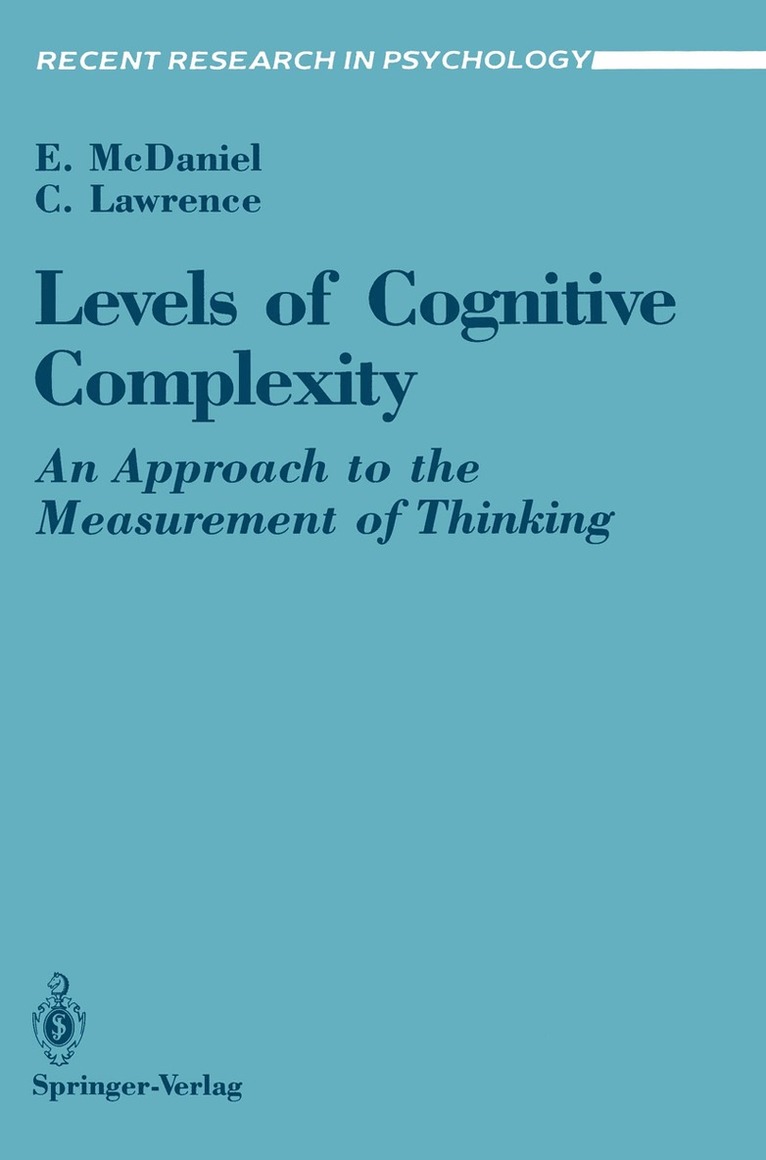
This research monograph describes a new approach to the measurement of thinking processes. The author begins with a discussion of the logic of thought versus the psychology of thinking. Traditionally, thinking has been defined in terms of the logical thought processes which lead to warranted conclusions. The psychological processes, on the other hand, involve the individual's perceptions, intentions and information-processing strategies. Traditional logical approaches appear to be most suitable for analysis of thinking in "formal" highly structured problem situations. Current tests of critical thinking reflect the "logical" approaches to measuring thinking; two tests of this type are evaluated by the author. The authors define the information-processing approach to measurement of thinking, which emphasizes the way situational information is perceived, selected, organized and interpreted. Using this approach, the authors have developed two interpretive exercises, The Holocaust and The Bomb Factories. The results of a number of studies conducted with these exercises are presented, and future work is projected.
Häftad, Engelska, 2008
264 kr
Skickas inom 5-8 vardagar
E-bok
PDF, Engelska, 20121 328 kr
Läs direkt efter köp
This research monograph describes a new approach to the measurement of thinking processes. The author begins with a discussion of the logic of thought versus the psychology of thinking. Traditionally, thinking has been defined in terms of the logical thought processes which lead to warranted conclusions. The psychological processes, on the other hand, involve the individual''s perceptions, intentions and information-processing strategies. Traditional logical approaches appear to be most suitable for analysis of thinking in "formal" highly structured problem situations. Current tests of critical thinking reflect the "logical" approaches to measuring thinking; two tests of this type are evaluated by the author. The authors define the information-processing approach to measurement of thinking, which emphasizes the way situational information is perceived, selected, organized and interpreted. Using this approach, the authors have developed two interpretive exercises, The Holocaust and The Bomb Factories. The results of a number of studies conducted with these exercises are presented, and future work is projected.