Ernst Kapp – författare
Visar alla böcker från författaren Ernst Kapp. Handla med fri frakt och snabb leverans.
18 produkter
18 produkter
Inbunden, Tyska, 2022
402 kr
Skickas inom 5-8 vardagar
Häftad, Tyska, 2022
291 kr
Skickas inom 5-8 vardagar
Inbunden, Tyska, 2022
400 kr
Skickas inom 5-8 vardagar
Häftad, Tyska, 2022
285 kr
Skickas inom 5-8 vardagar
Inbunden, Tyska, 2023
542 kr
Skickas inom 5-8 vardagar
Inbunden, Tyska, 2023
357 kr
Skickas inom 5-8 vardagar
Inbunden, Tyska, 2023
428 kr
Skickas inom 5-8 vardagar
Häftad, Tyska, 2023
414 kr
Skickas inom 5-8 vardagar
Häftad, Tyska, 2023
186 kr
Skickas inom 5-8 vardagar
Häftad, Tyska, 2023
333 kr
Skickas inom 5-8 vardagar
Häftad, Engelska, 2012
466 kr
Skickas inom 3-6 vardagar
Inbunden, Engelska, 2018
1 211 kr
Skickas inom 5-8 vardagar
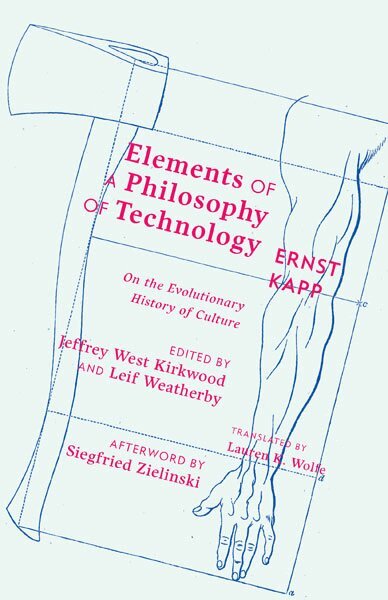
The first philosophy of technology, constructing humans as technological and technology as an underpinning of all cultureErnst Kapp was a foundational scholar in the fields of media theory and philosophy of technology. His 1877 Elements of a Philosophy of Technology is a visionary study of the human body and its relationship with the world that surrounds it. At the book’s core is the concept of “organ projection”: the notion that humans use technology in an effort to project their organs to the outside, to be understood as “the soul apparently stepping out of the body in the form of a sending-out of mental qualities” into the world of artifacts.Kapp applies this theory of organ projection to various areas of the material world-the axe externalizes the arm, the lens the eye, the telegraphic system the neural network. From the first tools to acoustic instruments, from architecture to the steam engine and the mechanic routes of the railway, Kapp’s analysis shifts from “simple” tools to more complex network technologies to examine the projection of relations. What emerges from Kapp’s prophetic work is nothing less than the emergence of early elements of a cybernetic paradigm.
Häftad, Engelska, 2018
294 kr
Skickas inom 5-8 vardagar
The first philosophy of technology, constructing humans as technological and technology as an underpinning of all cultureErnst Kapp was a foundational scholar in the fields of media theory and philosophy of technology. His 1877 Elements of a Philosophy of Technology is a visionary study of the human body and its relationship with the world that surrounds it. At the book’s core is the concept of “organ projection”: the notion that humans use technology in an effort to project their organs to the outside, to be understood as “the soul apparently stepping out of the body in the form of a sending-out of mental qualities” into the world of artifacts.Kapp applies this theory of organ projection to various areas of the material world-the axe externalizes the arm, the lens the eye, the telegraphic system the neural network. From the first tools to acoustic instruments, from architecture to the steam engine and the mechanic routes of the railway, Kapp’s analysis shifts from “simple” tools to more complex network technologies to examine the projection of relations. What emerges from Kapp’s prophetic work is nothing less than the emergence of early elements of a cybernetic paradigm.
Inbunden, Tyska, 1968
1 645 kr
Skickas inom 5-8 vardagar
E-bok
PDF, Tyska, 20131 505 kr
Läs direkt efter köp
Häftad, Tyska, 2015
290 kr
Skickas inom 3-6 vardagar
E-bok
PDF, Tyska, 2015215 kr
Läs direkt efter köp
In seinem umfassenden Hauptwerk Grundlinien einer Philosophie der Technik (1877) unternimmt der Pädagoge, Geograph und Philosoph Ernst Kapp den folgenreichen Versuch, alle technischen Artefakte als eine »Organprojektion« des menschlichen Körpers zu begreifen. Damit ist gemeint, dass der Mensch »unbewusst Form, Funktionsbeziehung und Normalverhältnis seiner leiblichen Gliederung auf die Werke seiner Hand überträgt und dass er dieser ihrer analogen Beziehungen zu ihm selbst erst hinterher sich bewusst wird«. Kapp leitet die Erfindung der technischen Dinge also aus dem Vorbild des menschlichen Organismus, vor allem aber aus der menschlichen Hand ab, die gleichsam als ein natürliches Werkzeug Form und Zweck aller mechanischen Werkzeuge bestimme. Die bis ins 19. Jahrhundert vorherrschende cartesianische Metaphorik des Organischen als eines bloß Mechanischen wird bei Kapp also geradezu umgedreht.Kapp wurde damit nicht nur zum Begründer der Technikphilosophie, sondern übte darüber hinaus großen Einfluss auf die Kultur- und Medientheorie aus, der weit ins 20. Jahrhundert hineinreicht. Das liegt nicht zuletzt daran, dass sich Kapps Anspruch keineswegs auf einen begrenzten Bereich des menschlichen Aktionsraums beschränkt, sondern neben techniktheoretischen auch geschichtsphilosophische und vor allem epistemologische Überlegungen einschließt, wie der programmatische Untertitel seines Werkes nahelegt.Trotz seiner Bedeutung als erstes genuin technikphilosophisches Werk der Moderne wurde Kapps Abhandlung bis dato nie wieder aufgelegt und erscheint erst jetzt in einer neuen Ausgabe. Die ausführliche Einleitung der Herausgeber zeichnet Kapps Argumentationsschritte nach und verortet den Text in der aktuellen technikphilosophischen und medientheoretischen Diskussion.
Häftad, Franska
619 kr
Tillfälligt slut