Ernst von Glasersfeld – författare
Visar alla böcker från författaren Ernst von Glasersfeld. Handla med fri frakt och snabb leverans.
9 produkter
9 produkter
Häftad, Engelska, 1996
661 kr
Skickas inom 10-15 vardagar
First Published in 1995. In the past decade or two, the most important theoretical perspective to emerge in mathematics education has been that of constructivism. This burst onto the international scene at the controversial Eleventh International Conference on the Psychology of Mathematics Education in Montreal in the summer of 1987. No one there will forget von Glasersfeld's authoritative plenary presentation on radical constructivism, and his replies to critics. Ironically, the conference, at which attacks on radical constructivism were perhaps intended to expose fatally its weaknesses, served as a platform from which the theory was launched to widespread international acceptance and approbation. Radical constructivism is a theory of knowing that provides a pragmatic approach to questions about reality, truth, language and human understanding. It breaks with the philosophical tradition and proposes a conception of knowledge that focuses on experiential fit rather than metaphysical truth. It claims to be a useful approach, not the revelation of a timeless world. The ten chapters of this book present different facets in an elegantly written and thoroughly argued account of this epistemological position, providing a profound analysis of its central concepts.
E-bok
Engelska, 2013757 kr
Läs direkt efter köp
First Published in 1995. In the past decade or two, the most important theoretical perspective to emerge in mathematics education has been that of constructivism. This burst onto the international scene at the controversial Eleventh International Conference on the Psychology of Mathematics Education in Montreal in the summer of 1987. No one there will forget von Glasersfeld''s authoritative plenary presentation on radical constructivism, and his replies to critics. Ironically, the conference, at which attacks on radical constructivism were perhaps intended to expose fatally its weaknesses, served as a platform from which the theory was launched to widespread international acceptance and approbation. Radical constructivism is a theory of knowing that provides a pragmatic approach to questions about reality, truth, language and human understanding. It breaks with the philosophical tradition and proposes a conception of knowledge that focuses on experiential fit rather than metaphysical truth. It claims to be a useful approach, not the revelation of a timeless world. The ten chapters of this book present different facets in an elegantly written and thoroughly argued account of this epistemological position, providing a profound analysis of its central concepts.
E-bok
PDF, Engelska, 2013757 kr
Läs direkt efter köp
First Published in 1995. In the past decade or two, the most important theoretical perspective to emerge in mathematics education has been that of constructivism. This burst onto the international scene at the controversial Eleventh International Conference on the Psychology of Mathematics Education in Montreal in the summer of 1987. No one there will forget von Glasersfeld''s authoritative plenary presentation on radical constructivism, and his replies to critics. Ironically, the conference, at which attacks on radical constructivism were perhaps intended to expose fatally its weaknesses, served as a platform from which the theory was launched to widespread international acceptance and approbation. Radical constructivism is a theory of knowing that provides a pragmatic approach to questions about reality, truth, language and human understanding. It breaks with the philosophical tradition and proposes a conception of knowledge that focuses on experiential fit rather than metaphysical truth. It claims to be a useful approach, not the revelation of a timeless world. The ten chapters of this book present different facets in an elegantly written and thoroughly argued account of this epistemological position, providing a profound analysis of its central concepts.
E-bok
PDF, Tyska, 2013678 kr
Läs direkt efter köp
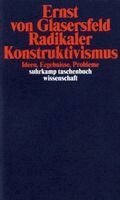
Del 1326 - suhrkamp taschenbücher wissenschaft
Radikaler Konstruktivismus
Häftad, Tyska, 1997
252 kr
Skickas inom 3-6 vardagar
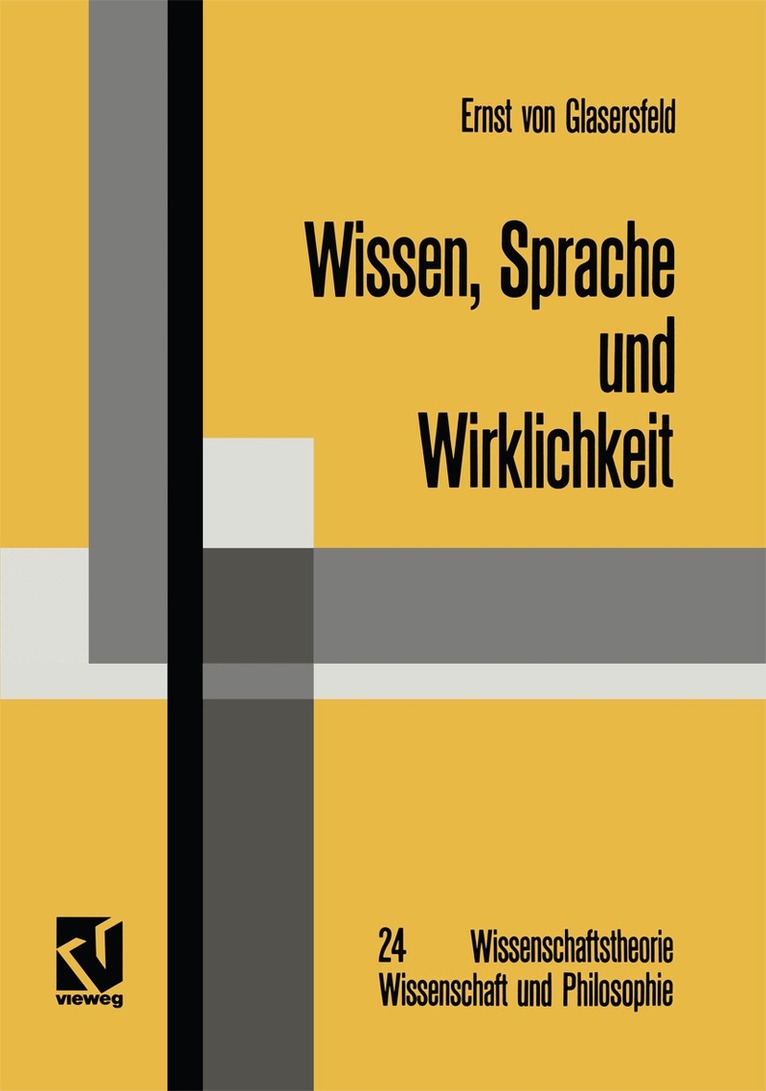
Del 24 - Wissenschaftstheorie, Wissenschaft und Philosophie
Wissen, Sprache und Wirklichkeit
Arbeiten zum radikalen Konstruktivismus
Häftad, Tyska, 1987
663 kr
Skickas inom 5-8 vardagar
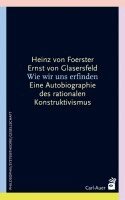
Häftad, Tyska
359 kr
Skickas inom 3-6 vardagar
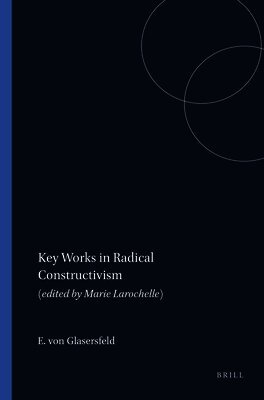
Del 18 - Bold Visions in Educational Research
Key Works in Radical Constructivism
(edited by Marie Larochelle)
Häftad, Engelska, 2007
677 kr
Skickas inom 5-8 vardagar
E-bok
PDF, Engelska, 20071 545 kr
Läs direkt efter köp
Key Works on Radical Constructivism brings together a number of essays by Ernst von Glasersfeld that illustrate the application of a radical constructivist way of thinking in the areas of education, language, theory of knowledge, and the analysis of a few concepts that are indispensable in almost everything we think and do. Ernst von Glasersfeld's work opens a window on how we know what we know. The present work grew out of a desire to make more accessible this line of thought, to highlight its originality and consistency, and to illustrate its fecundity in the domains of cognition and learning.The first three parts of this book contain texts by Glasersfeld that outline the constructivist approach and explicate the frequently drastic reconceptualizations he has suggested. Both the last part and the postscript consist of commentaries by Edith Ackermann, Jacques Desautels, Gerard Fourez, Leslie P. Steffe and Kenneth Tobin, scholars in the fields that Glasersfeld has been concerned with. They examine a number of critical aspects pertaining to (radical) constructivism's current and future development, often tracing out paths that warrant further exploration and reflection, in particular concerning the sociopolitical dimension of knowledge.Key Works on Radical Constructivism is intended as a reference book for researchers, educators, and students of education-and for anyone interested in grasping, or deepening their grasp of, radical constructivism's tenets, ambitions and concerns. Readers will discover in this collection of firsthand contributions the contours of a bold, contemporary debate about a most compelling current of thought.