Esparza Torres Miguel Angel Esparza Torres – författare
Visar alla böcker från författaren . Handla med fri frakt och snabb leverans.
5 produkter
5 produkter
E-bok
PDF, Spanska, 2023770 kr
Läs direkt efter köp
E-bok
Spanska, 2023770 kr
Läs direkt efter köp
E-bok
PDF, Engelska, 20151 499 kr
Läs direkt efter köp
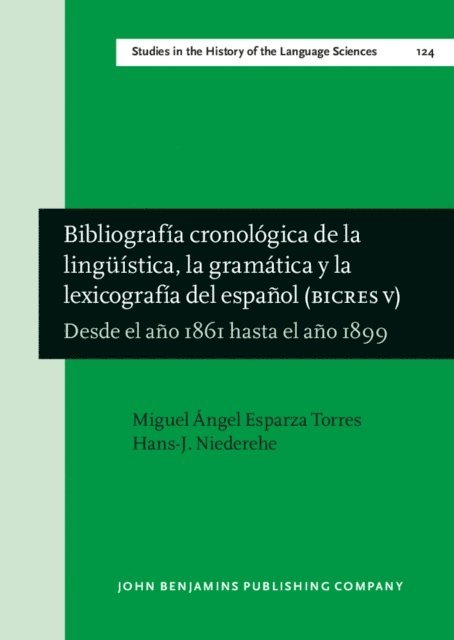
Since the publication of the still very valuable Biblioteca histórica de la filología by Cipriano Muñoz y Manzano, conde de la Viñaza (Madrid, 1893), our knowledge of the history of the study of the Spanish language has grown considerably, and most manuscript and secondary sources had never been tapped before Hans-Josef Niederehe of the University of Trier courageously undertook the task to bring together any available bibliographical information together with much more recent research findings, scattered in libraries, journals and other places. The resulting Bibliografía cronológica de la lingüística, la gramática y la lexicografía del español: Desde los principios hasta el año 1600 (BICRES) began appearing in 1994. BICRES I covered the period from the early beginnings to 1600, followed by BICRES II (1601–1700), BICRES III (1701–1800), and together with Miguel Ángel Esparza Torres of Madrid there followed BICRES IV (1801 to 1860). Now, the fifth volume, has become available, covering the years from 1861 to 1899. Access to the bibliographical information of altogether 5,272 titles is facilitated by several detailed indexes, such as a short title index, a listing of printers, publishers and places of production, and an author index.More than twenty years of research in the major libraries of Spain and other European countries have gone into this unique work — relative sources of the Americas have also been covered — making it exhaustive source for any serious scholar of any possible aspect of the Spanish language.
E-bok
PDF, Spanska, 20121 499 kr
Läs direkt efter köp
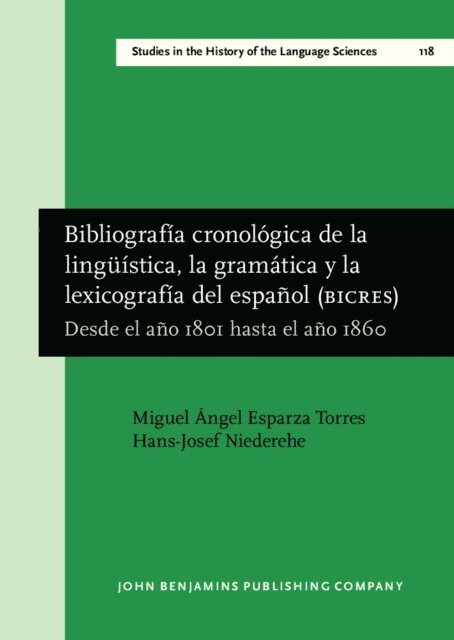
Since the publication of the still very valuable Biblioteca histórica de la filología by Cipriano Muñoz y Manzano, conde de la Viñaza (Madrid, 1893), our knowledge of the history of the study of the Spanish language has grown considerably. It has been the purpose of BICRES I (from the early beginnings to 1600), published in 1994, to bring together already available bibliographical information with the more recent research findings, scattered in many places, books and articles. BICRES II (covering the 1601–1700 period) followed in 1999 and BICRES III (including period 1701-1800) was published in 2005.Now, the fourth volume, arranged according to the same principles as those guiding the preceding volumes and covering the years from 1801 to 1860, has become available.Years of research in the major libraries of Spain and other European countries have gone into this new bibliography and relative sources of the Americas have also been covered, in order to offer — in an as exhaustive as possible fashion — a description of all Spanish grammars and dictionaries, histories of the Spanish language as well as studies devoted to particular facets of its evolution during the years 1801-1860.BICRES IV brings together in chronological order more than 3,279 titles. Access to the bibliographical information is facilitated by several detailed indexes, such as a short title index, a listing of printers, publishers and places of production, and an author index.
E-bok
PDF, Engelska, 19991 711 kr
Läs direkt efter köp
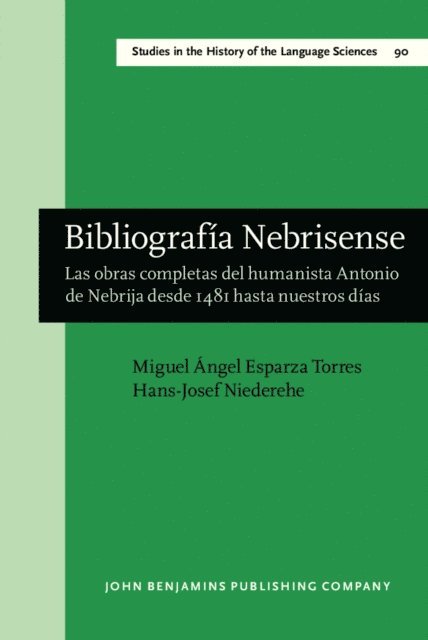
The Spanish humanist Antonio de Nebrija (1444-1522) is the author of an impressive body of scientific work which comprises a broad spectrum of humanistic knowledge. While the languages dealt with by Nebrija include not only Latin and Spanish, but the most prominent Romance languages, his grammatical work focuses on Latin, Castillian, Greek and even Hebrew. Moreover, his (bilingual) lexicographical studies combine Spanish, Latin, French, Catalan and Italian. In addition, there are medical dictionaries, dictionnaries of law, works on the Holy Bible, geographical research, treatises on rhethoric and history as well as on many other areas of contemporary knowledge. Most of these works have been published for allmost five centuries, thus inspiring European and missionary linguistics as well as Western philological traditions. They have served as models and sources for a great number and range of studies conducted and published not only in Spain, but nearly all over the world.Apart from the original version of Nebrija‘s works, numerous copies, also continuously produced during the past centuries, are accessible in international libraries. Many of these copies possess a great bibliographical value.The Bibliografía Nebrisense is a catalogue, listing the different editions of Nebrija‘s highly diversified œuvre. It provides information on the technical caracteristics of the individual editions and their respective locations. A complete bio-bibliographical study is added together with an exhaustive listing of secondary sources.El humanista español Antonio de Nebrija (1444-1522) fue autor de una ingente obra que abarcó los más variados campos de los saberes humanísticos y en la que, además, estaban implicadas no sólo latín y español, sino las principales lenguas románicas. Sus obras de tema gramatical, donde se encuentran latín, castellano, griego o hebreo; sus repertorios lexicográficos bilingües, donde se combinan español, latín, francés, catalán e italiano; sus diccionarios especializados de medicina, derecho, Sagrada Escritura o geografía, junto con sus trabajos sobre retórica, historia o tantos otros aspectos particulares que llamaron la atención del humanista han sobrevivido hasta nuestros días y durante más de cinco siglos han ejercido una influencia enorme en toda la lingüística y la tradición filológica occidental: sirvieron de modelo o de fuente para multitud de trabajos posteriores, no sólo en España.Las obras de Nebrija, en fin, fueron ininterrumpidamente editadas y ejemplares de todas ellas, a veces de valor incalculable desde el punto de vista bibliográfico, andan repartidos por bibliotecas de todo el mundo.La Bibliografía Nebrisense es un catálogo que reúne y describe estas ediciones, informando de sus características y paradero. Se añade, además, un completo estudio bio-bibliográfico y una relación exhaustiva de fuentes secundarias.