Niederehe Hans-Josef Niederehe – författare
Visar alla böcker från författaren . Handla med fri frakt och snabb leverans.
18 produkter
18 produkter
E-bok
PDF, Engelska, 20151 499 kr
Läs direkt efter köp
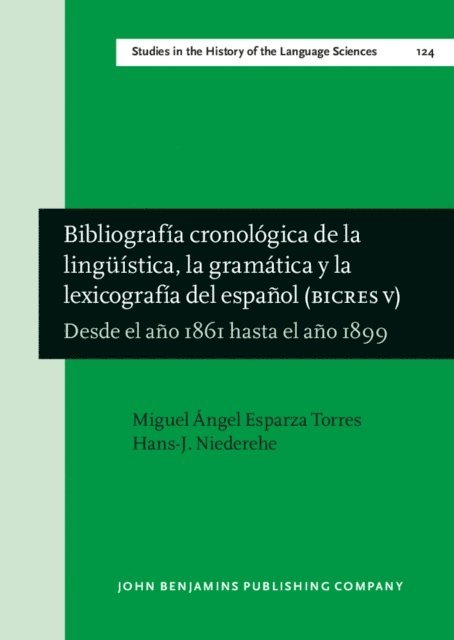
Since the publication of the still very valuable Biblioteca histórica de la filología by Cipriano Muñoz y Manzano, conde de la Viñaza (Madrid, 1893), our knowledge of the history of the study of the Spanish language has grown considerably, and most manuscript and secondary sources had never been tapped before Hans-Josef Niederehe of the University of Trier courageously undertook the task to bring together any available bibliographical information together with much more recent research findings, scattered in libraries, journals and other places. The resulting Bibliografía cronológica de la lingüística, la gramática y la lexicografía del español: Desde los principios hasta el año 1600 (BICRES) began appearing in 1994. BICRES I covered the period from the early beginnings to 1600, followed by BICRES II (1601–1700), BICRES III (1701–1800), and together with Miguel Ángel Esparza Torres of Madrid there followed BICRES IV (1801 to 1860). Now, the fifth volume, has become available, covering the years from 1861 to 1899. Access to the bibliographical information of altogether 5,272 titles is facilitated by several detailed indexes, such as a short title index, a listing of printers, publishers and places of production, and an author index.More than twenty years of research in the major libraries of Spain and other European countries have gone into this unique work — relative sources of the Americas have also been covered — making it exhaustive source for any serious scholar of any possible aspect of the Spanish language.
E-bok
PDF, Spanska, 20121 499 kr
Läs direkt efter köp
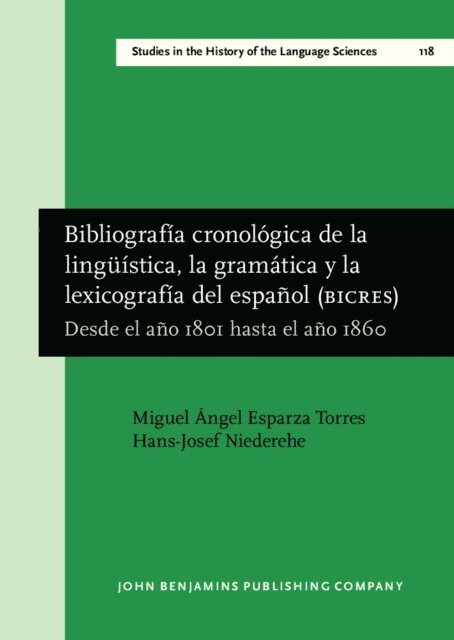
Since the publication of the still very valuable Biblioteca histórica de la filología by Cipriano Muñoz y Manzano, conde de la Viñaza (Madrid, 1893), our knowledge of the history of the study of the Spanish language has grown considerably. It has been the purpose of BICRES I (from the early beginnings to 1600), published in 1994, to bring together already available bibliographical information with the more recent research findings, scattered in many places, books and articles. BICRES II (covering the 1601–1700 period) followed in 1999 and BICRES III (including period 1701-1800) was published in 2005.Now, the fourth volume, arranged according to the same principles as those guiding the preceding volumes and covering the years from 1801 to 1860, has become available.Years of research in the major libraries of Spain and other European countries have gone into this new bibliography and relative sources of the Americas have also been covered, in order to offer — in an as exhaustive as possible fashion — a description of all Spanish grammars and dictionaries, histories of the Spanish language as well as studies devoted to particular facets of its evolution during the years 1801-1860.BICRES IV brings together in chronological order more than 3,279 titles. Access to the bibliographical information is facilitated by several detailed indexes, such as a short title index, a listing of printers, publishers and places of production, and an author index.
E-bok
PDF, Engelska, 19901 939 kr
Läs direkt efter köp
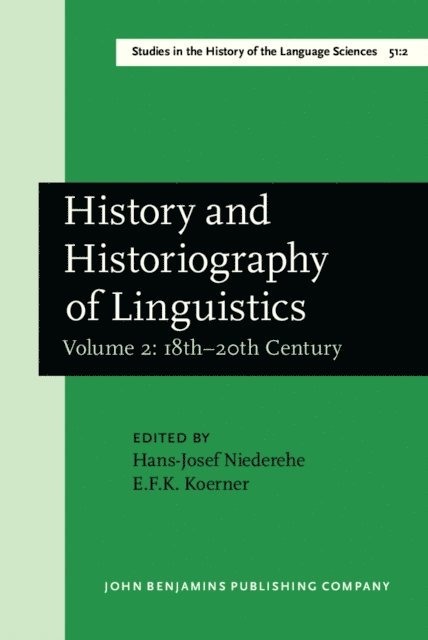
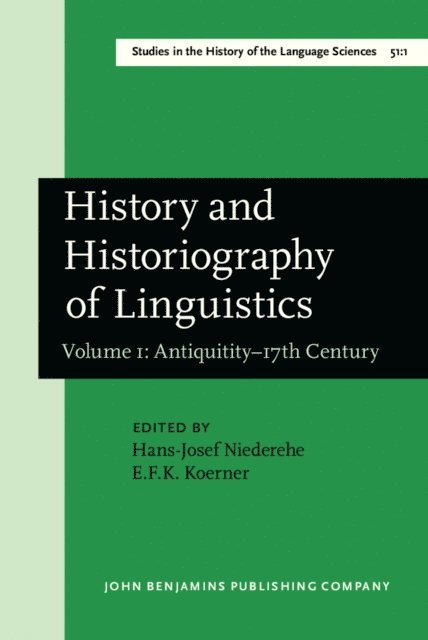
These two volume present papers from the Fourth International Conference on the History of the Language Sciences (ICHoLS IV), held at the University of Trier, Germany, in August 1987. Volume 1 contains the following sections: I. Generalia; II. Antiquity; III. Arabic Linguistics; IV. Middle Ages; V. Renaissance; VI. 17th Century. Volume 2 continues with: VII. 18th Century; VIII. 19th Century; IX. 20th Century; and provides Author and Subject Indexes.
E-bok
PDF, Engelska, 19901 923 kr
Läs direkt efter köp
These two volume present papers from the Fourth International Conference on the History of the Language Sciences (ICHoLS IV), held at the University of Trier, Germany, in August 1987. Volume 1 contains the following sections: I. Generalia; II. Antiquity; III. Arabic Linguistics; IV. Middle Ages; V. Renaissance; VI. 17th Century. Volume 2 continues with: VII. 18th Century; VIII. 19th Century; IX. 20th Century; and provides Author and Subject Indexes.
E-bok
PDF, Engelska, 19861 651 kr
Läs direkt efter köp
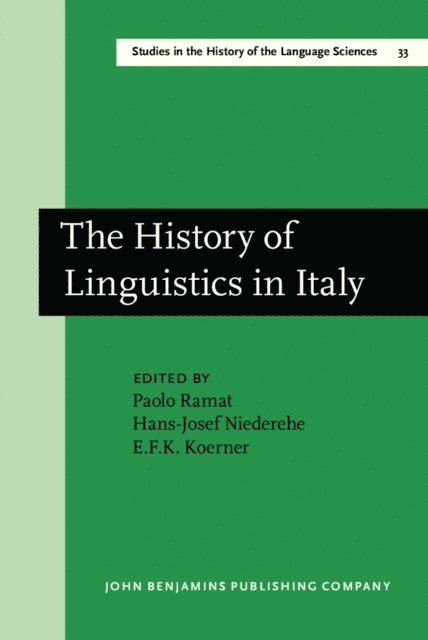
This volume brings together the papers published in Historiographia Linguistica 9:3 (1982), which was devoted to the history of linguistics in Italy, with Marazzini’s paper first published in Historiographia Linguistica 10:1/2 (1983), and an original article by Franco Lo Piparo expressly written for this volume. The present volume provides in addition an index of subjects, as well as an index of names, which supplies bio-bibliographical references to authors discussed.
E-bok
PDF, Engelska, 19821 499 kr
Läs direkt efter köp
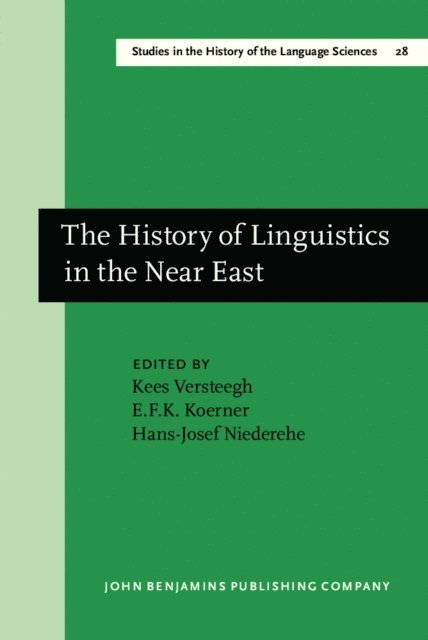
This collection of papers deals with aspects of the history of Arabic and Hebrew linguistics. These papers appeared simultaneously in Historiographia Linguistica 8:2/3 (1981).
E-bok
PDF, Engelska, 19801 646 kr
Läs direkt efter köp
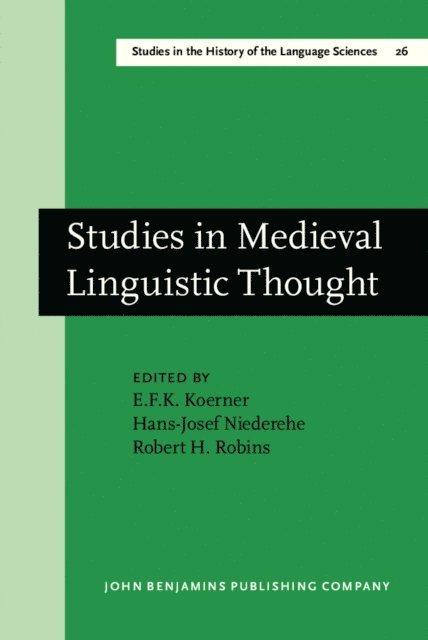
This volume presents a set of papers on linguistic thought in the Middle Ages. It is complemented by a comprehensive bibliography and indices. The papers in this volume appeared earlier in Historiographia Linguistica 7:1/2 (1980).
E-bok
PDF, Engelska, 19761 923 kr
Läs direkt efter köp
The first ''Kolloquium zur Wissenschaftsgeschichte der Romanistik'' (Trier 1975) was held to commemorate the hundredth anniversary of the death of Friedrich Diez, the founder of Romance philology. The colloquium offered Romanists and historians of linguistics the opportunity for intense discussion, which is continued in the papers in this volume.
E-bok
PDF, Engelska, 19991 711 kr
Läs direkt efter köp
The Spanish humanist Antonio de Nebrija (1444-1522) is the author of an impressive body of scientific work which comprises a broad spectrum of humanistic knowledge. While the languages dealt with by Nebrija include not only Latin and Spanish, but the most prominent Romance languages, his grammatical work focuses on Latin, Castillian, Greek and even Hebrew. Moreover, his (bilingual) lexicographical studies combine Spanish, Latin, French, Catalan and Italian. In addition, there are medical dictionaries, dictionnaries of law, works on the Holy Bible, geographical research, treatises on rhethoric and history as well as on many other areas of contemporary knowledge. Most of these works have been published for allmost five centuries, thus inspiring European and missionary linguistics as well as Western philological traditions. They have served as models and sources for a great number and range of studies conducted and published not only in Spain, but nearly all over the world.Apart from the original version of Nebrija‘s works, numerous copies, also continuously produced during the past centuries, are accessible in international libraries. Many of these copies possess a great bibliographical value.The Bibliografía Nebrisense is a catalogue, listing the different editions of Nebrija‘s highly diversified œuvre. It provides information on the technical caracteristics of the individual editions and their respective locations. A complete bio-bibliographical study is added together with an exhaustive listing of secondary sources.El humanista español Antonio de Nebrija (1444-1522) fue autor de una ingente obra que abarcó los más variados campos de los saberes humanísticos y en la que, además, estaban implicadas no sólo latín y español, sino las principales lenguas románicas. Sus obras de tema gramatical, donde se encuentran latín, castellano, griego o hebreo; sus repertorios lexicográficos bilingües, donde se combinan español, latín, francés, catalán e italiano; sus diccionarios especializados de medicina, derecho, Sagrada Escritura o geografía, junto con sus trabajos sobre retórica, historia o tantos otros aspectos particulares que llamaron la atención del humanista han sobrevivido hasta nuestros días y durante más de cinco siglos han ejercido una influencia enorme en toda la lingüística y la tradición filológica occidental: sirvieron de modelo o de fuente para multitud de trabajos posteriores, no sólo en España.Las obras de Nebrija, en fin, fueron ininterrumpidamente editadas y ejemplares de todas ellas, a veces de valor incalculable desde el punto de vista bibliográfico, andan repartidos por bibliotecas de todo el mundo.La Bibliografía Nebrisense es un catálogo que reúne y describe estas ediciones, informando de sus características y paradero. Se añade, además, un completo estudio bio-bibliográfico y una relación exhaustiva de fuentes secundarias.
E-bok
PDF, Engelska, 20011 776 kr
Läs direkt efter köp
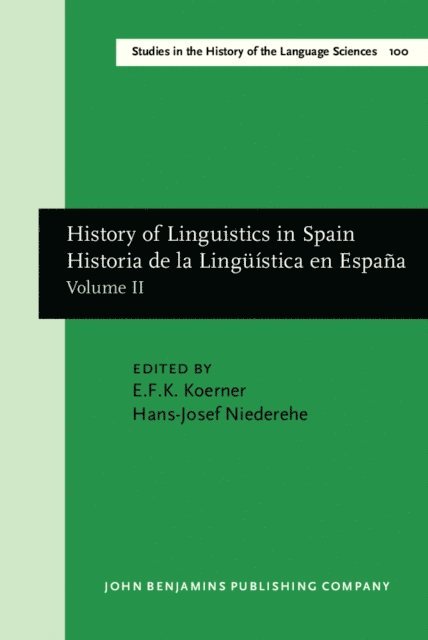
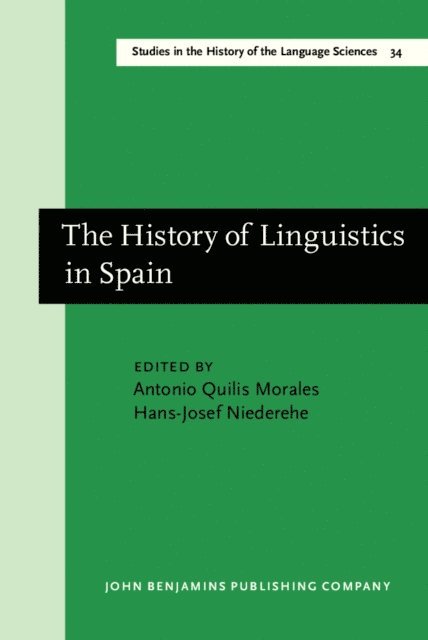
The contributions in this volume, a sequel to the volume published in 1986 (SiHoLS 34), treat many aspects of the history of the language sciences in Spain and in Hibero-America, from the Renaissance and ‘Siglo de Oro’ to the 20th century. Most papers were published in the journal Historiographia Linguistica; they were complemented with a few invited papers.
E-bok
PDF, Spanska, 19991 776 kr
Läs direkt efter köp
Since the publication of the still very valuable Biblioteca histórica de la filología by Cipriano Muñoz y Manzano, conde de la Viñaza, (Madrid, 1893), our knowledge of the history of the study of the Spanish language has grown considerably. It has been the purpose of BICRES I (from the beginnings to 1600), published in 1994 in the same series, to bring already available bibliographical information together with the more recent research findings, scattered in many places, books and articles and published during the past one hundred years. Now, the second volume, covering the years from 1601 to 1700, has been published, according to the same principles as the first one.Years of work in the major librairies of Spain and other European countries have gone into this new bibliography in order to offer as exhaustive as possible a description of all Spanish grammars and dictionaries, histories of the Spanish language as well studies devoted to particular facets of its evolution in the 17th century.BICRES II brings together in chronological order close to 1,300 titles. Access to the bibliographical information is facilitated by several detailed indexes, such as author index, short title index, index of places of production, index of printers and publishers, and a index of locations of the books described.Desde la publicación de la muy meritoria y aún hoy útil Biblioteca histórica de la filología castellana (Madrid, 1893) de Cipriano Muñoz y Manzano, conde de la Viñaza, nuestros cono-cimientos sobre la historia de la lingüística española se han ensanchado considerable-mente. Fue el propósito de BICRES I (“desde los comienzos hasta 1600”), que se publicó en 1994 en esta misma serie, sumar, a los datos bibliográficos conocidos, la información más reciente aparecida durante los últimos cien años en los más diversos lugares. BICRES II presenta la información correspondiente a los años 1601-1700 manteniendo los mismos principios metodológicos que fueron empleados en el primer volumen.Para terminar esta nueva bibliografía han sido necesarios años de trabajo en bibliotecas españolas y europeas. De esta manera se ha conseguido reunir la máxima cantidad disponible de datos sobre gramáticas y diccio-narios de la lengua española publicados en el siglo XVII, así como sobre historias de la lengua española y estudios dedicados a los más variados aspecto de su desarrollo.La Bibliografía cronológica de la lingüística, la gramática y la lexicografía del español (BICRES II) ofrece, en orden cronológico, apoximadamente 1.300 títulos. Una serie de índices detallados (autores, títulos abreviados, lugares de publicación, impresores y edito-riales y, finalmente, paraderos) facilita el acceso a la infomación bibliográfica.
E-bok
PDF, Spanska, 19941 776 kr
Läs direkt efter köp
Since the publication of the still very valuable Biblioteca histórica de la filología castellana by Cipriano Muñoz y Manzano, conde de la Viñaza, (Madrid, 1893), our knowledge of the history of the study of the Spanish language has grown considerably. It is the purpose of the present bibliography to bring already available bibliographical information together with the more recent research findings, scattered in many places, books and articles, published during the past one hundred years. More importantly still, many years of work in the major libraries of Spain and other European countries have gone into this new bibliography in order to offer an as exhaustive as possible description of all Spanish grammars and dictionaries, histories of the Spanish language as well studies devoted to particular facets of its evolution, from the early glosses in Latin and Arabic texts in the 10th century to the beginning of the more autonomous approach to vernacular studies in the Renaissance period — which is not only represented by the grammatical and lexicographical work of the great Spanish humanist Elio Antonio de Nebrija.Bibliografía cronológica de la lingüística, la gramática y la lexicografía del español (BICRES) brings together, in chronological order, close to 1,000 titles. Access to the bibliographical information is facilitated by several detailed indexes, such as author index, short title index, place of production index, index of printers and publishers, and a location index of the books described.
E-bok
PDF, Spanska, 20051 842 kr
Läs direkt efter köp
Since the publication of the still very valuable Biblioteca histórica de la filología by Cipriano Muñoz y Manzano, conde de la Viñaza (Madrid, 1893), our knowledge of the history of the study of the Spanish language has grown considerably. It has been the purpose of BICRES I (from the early beginnings to 1600), published in 1994, to bring together already available bibliographical information with the more recent research findings, scattered in many places, books and articles and published during the past one hundred years. BICRES II (covering the 1601–1700 period) followed in 1999. Now, the third volume, arranged according to the same principles as those guiding the preceding volumes and covering the years from 1701 to 1800, has become available.Years of research in the major libraries of Spain and other European countries have gone into this new bibliography in order to offer, in an as exhaustive as possible fashion, a description of all Spanish grammars and dictionaries, histories of the Spanish language as well studies devoted to particular facets of its evolution during the 18th century.Bibliografía cronológica de la lingüística, la gramática y la lexicografía del español, volume III (BICRES III) brings together in chronological order more than 1,500 titles. Access to the bibliographical information is facilitated by several detailed indexes, such as an author index, a short title index, and a listing of places of production, of printers and publishers, and also an index of the physical location of the books described.
E-bok
PDF, Engelska, 19872 917 kr
Läs direkt efter köp
This volume presents a selection of – slightly revised versions – of papers from the third International Conference on the History of the Language Sciences (ICHoLS III), Princeton, 1984. The papers are organized under the following headings: I Generalia; II Classical Period; III Medieval Period; IV Renaissance; V 17th Century; VI 18th Century; VII 19th Century, and VIII 20th Century.Contributors include W. Keith Percival, Aron Dotan, Michael G. Carter, Kees Versteegh, Brian Ó Cuív, Francis P. Dinneen, Manuel Breva-Claramonte, Douglas A. Kibbee, Joseph L. Subbiondo, Rüdiger Schreyer, Marc Wilmet, Robert H. Robins, Jean Rousseau, Ramón Sarmiento, Edward Stankiewicz, Irmengard Rauch, Talbot J. Taylor, Julie Andresen, and many others.
E-bok
PDF, Engelska, 19861 651 kr
Läs direkt efter köp
This selection of papers is concerned with the history of linguistics in Spain, dealing with the evolution of linguistic ideas from the Middle Ages and the European context of the linguistic debates in Spain to the 20th century, concluding with Malkiel''s appraisal of Ramón Menéndez Pidal (1869–1968). The volume includes papers on Antonio Nebrija and Sanctius, probably the best-known grammarians of the Iberian peninsula, but – as the other papers suggest – there is much more to be known about the Spanish linguistic traditions.The papers in this volume were previously published in Historiographia Linguistica XI:1/2 (1984).
E-bok
PDF, Tyska, 19761 499 kr
Läs direkt efter köp
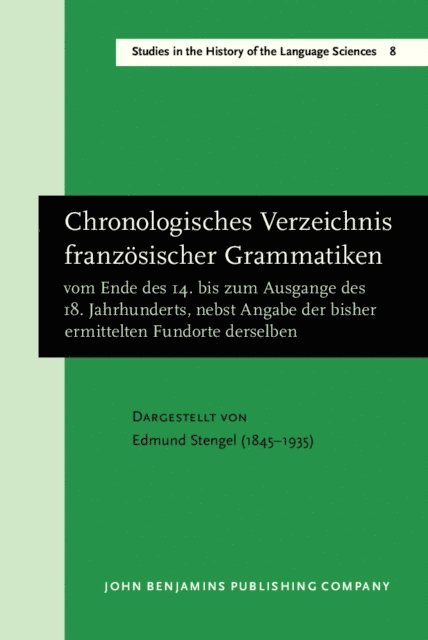
This volume (1976) contains a fac simile reprint of the original 1890 edition of Stengel’s Chronologisches Verzeichnis Französischer Grammatiken. In addition, it contains an appendix by Hans-Josef Niederehe which gives a short biography of E.M. Stengel and brings together the additions and corrections to the Verzeichnis which Stengel published in other sources in 1890 and 1896.
E-bok
PDF, Engelska, 19991 711 kr
Läs direkt efter köp
Alongside considerable continuity, 20th-century diachronic linguistics has seen substantial shifts in outlook and procedure from the 19th-century paradigm. Our understanding of what is really new and what is recycled owes a great debt to E. F. K. Koerner''s minutely researched interpretations of the work of the field''s founders and key transitional figures. At the cusp of the 21st century, some of the best known scholars in the field explore how these methodological shifts have been and continue to be played out in historical Romance, Germanic and Indo-European linguistics, as well as in work outside these traditional areas. These 22 studies, honouring the founder of Diachronica and other publication ventures that have helped revitalize historical enquiry in recent decades, include examinations of Indo-European methodology and the reconstructions carried out by Bloomfield and Sapir; the search for relatives of Indo-European; comparative, structural and sociolinguistic analyses of the history of the Romance languages; regular vs. morpholexical approaches to OHG umlaut; and the synchrony and diachrony of gender affixes in Tsez.
E-bok
PDF, Engelska, 19991 711 kr
Läs direkt efter köp
Although it is widely thought that structural linguistics began abruptly with the publication of Saussure''s ''revolutionary'' Course in General Linguistics, the work of E. F. K. Koerner has demonstrated that Saussure, for all his originality, remained true to the basic tenets of his 19th-century predecessors. In this volume, the development of modern linguistics before, during and after Saussure is traced in 20 studies honouring the scholar who has done more than anyone else to professionalize linguistic historiography during the last quarter century. Among the wide range of topics covered are: grammar and philosophy in the age of comparativism, the relation of Saussure''s anagram studies to his theory of the linguistic sign, nationalist overtones in German linguistics from 1914 to 1945, and the true story (with newly discovered documentation) of why Chomsky''s Logical Structure of Linguistic Theory didn''t get published during the 1950s or 60s. In addition to an introductory overview of Koerner''s career and a complete listing of his publications, the volume includes previously unpublished materials from Saussure''s notebooks.