Etienne van de Walle - Böcker
Visar alla böcker från författaren Etienne van de Walle. Handla med fri frakt och snabb leverans.
5 produkter
5 produkter
785 kr
Skickas inom 7-10 vardagar
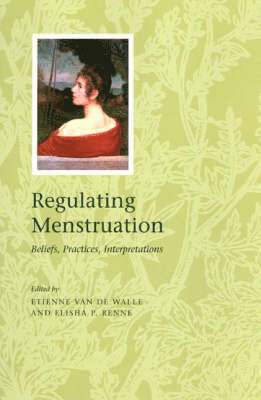
Menstruation, seen alternately as something negative—a "curse" or a failed conception—or as a positive part of the reproductive process to be celebrated as evidence of fertility, has long been a universal concern. How women interpret and react to menstruation and its absence reflects their individual needs both historically as well as in the contemporary cultural, social, economic, and political context in which they live. This unique volume considers what is known of women's options and practices used to regulate menstruation—practices used to control the periodicity, quantity, color, and even consistency of menses—in different places and times, while revealing the ambiguity that those practices present.Originating from an Internet conference held in February 1998, this volume contains fourteen papers that have been revised and updated to cover everything from the impact of the birth control pill to contemporary views on reproduction to the pharmacological properties of various herbal substances, reflecting the historical, contemporary, and anthropological perspectives of this timely and complex issue.
298 kr
Skickas inom 7-10 vardagar
Menstruation, seen alternately as something negative—a "curse" or a failed conception—or as a positive part of the reproductive process to be celebrated as evidence of fertility, has long been a universal concern. How women interpret and react to menstruation and its absence reflects their individual needs both historically as well as in the contemporary cultural, social, economic, and political context in which they live. This unique volume considers what is known of women's options and practices used to regulate menstruation—practices used to control the periodicity, quantity, color, and even consistency of menses—in different places and times, while revealing the ambiguity that those practices present.Originating from an Internet conference held in February 1998, this volume contains fourteen papers that have been revised and updated to cover everything from the impact of the birth control pill to contemporary views on reproduction to the pharmacological properties of various herbal substances, reflecting the historical, contemporary, and anthropological perspectives of this timely and complex issue.
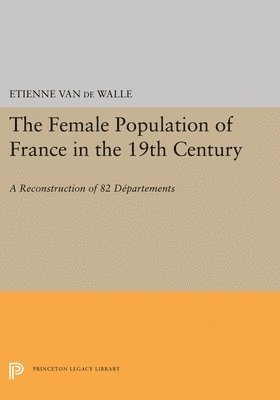
Female Population of France in the 19th Century
A Reconstruction of 82 Departments
Häftad, Engelska, 2015
738 kr
Skickas inom 7-10 vardagar
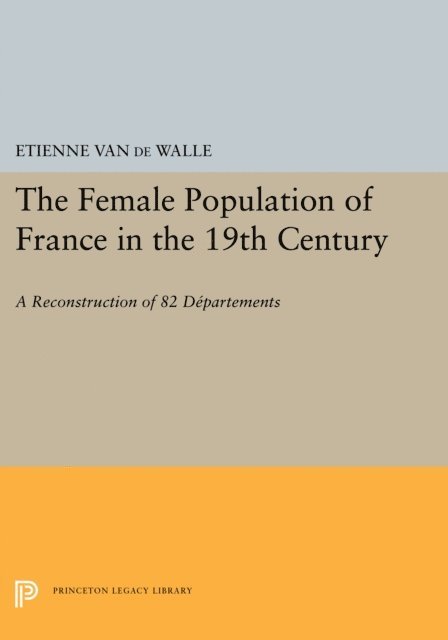
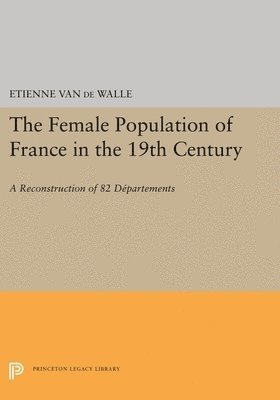
In analyzing the social and economic factors underlying the decline of fertility in nineteenth-century France. Etienne van de Walle found that official statistics for the period were incomplete and inaccurate. He thus undertook a full reconstruction. In this volume, he presents a detailed discussion of the methodology used to correct and to supplement these official statistics, along with the results of the reconstruction of 82 French departements, and French and English summaries of his findings. By computing standardized indices of fertility and nuptiality for each of the 82 departements, the author extends the period for which standardized demographic indices are available. His methodology, which evaluates and corrects the biases and defects of the official statistics, provides a model for similar background studies in the future. Originally published in 1974. The Princeton Legacy Library uses the latest print-on-demand technology to again make available previously out-of-print books from the distinguished backlist of Princeton University Press.These editions preserve the original texts of these important books while presenting them in durable paperback and hardcover editions. The goal of the Princeton Legacy Library is to vastly increase access to the rich scholarly heritage found in the thousands of books published by Princeton University Press since its founding in 1905.
Female Population of France in the 19th Century
A Reconstruction of 82 Departments
Inbunden, Engelska, 2016
3 442 kr
Skickas inom 3-6 vardagar
In analyzing the social and economic factors underlying the decline of fertility in nineteenth-century France. Etienne van de Walle found that official statistics for the period were incomplete and inaccurate. He thus undertook a full reconstruction. In this volume, he presents a detailed discussion of the methodology used to correct and to supplement these official statistics, along with the results of the reconstruction of 82 French departements, and French and English summaries of his findings. By computing standardized indices of fertility and nuptiality for each of the 82 departements, the author extends the period for which standardized demographic indices are available. His methodology, which evaluates and corrects the biases and defects of the official statistics, provides a model for similar background studies in the future. Originally published in 1974. The Princeton Legacy Library uses the latest print-on-demand technology to again make available previously out-of-print books from the distinguished backlist of Princeton University Press.These editions preserve the original texts of these important books while presenting them in durable paperback and hardcover editions. The goal of the Princeton Legacy Library is to vastly increase access to the rich scholarly heritage found in the thousands of books published by Princeton University Press since its founding in 1905.
1 292 kr
Skickas inom 10-15 vardagar
This volume in the ?General Demography of Africa? series encompasses many nations and focuses on a feature of the censuses ? household relationships. African households rank among the most complex in the world. This work makes it possible to investigate relationships among individuals within the household and relate them to household characteristics such as structure and headship. In addition to discussing household composition in comparative terms, the book pays special attention to the place of women in the household, and to the residence of children and the aged. The analyses use micro-data from a variety of countries including Botswana, Burkina Faso, Cameroon, Cote d?Ivoire, the Gambia, Senegal, Kenya and the Republic of South Africa.