Eugene F. Milone - Böcker
Visar alla böcker från författaren Eugene F. Milone. Handla med fri frakt och snabb leverans.
11 produkter
11 produkter
Del 352 - Astrophysics and Space Science Library
Short-Period Binary Stars: Observations, Analyses, and Results
Inbunden, Engelska, 2008
1 064 kr
Skickas inom 10-15 vardagar
Short-period binaries run the gamut from widely separated stars to black-hole pairs; in between are systems that include neutron stars and white dwarfs, and partially evolved systems such as tidally distorted and over-contact systems. These objects represent stages of evolution of binary stars, and their degrees of separation provide critical clues to how their evolutionary paths differ from that of single stars. The widest and least distorted systems provide astronomers with the essential precise data needed to study all stars: mass and radius. The interactions of binary star components, on the other hand, provide a natural laboratory to observe how the matter in these stars behaves under different and often varying physical conditions. Thus, cataclysmic variables with and without overpoweringly strong magnetic fields, and stars with densities from that found in the Sun to the degenerate matter of white dwarfs and the ultra-compact states of neutron stars and black holes are all discussed. The extensive index permits cross-referencing.
1 682 kr
Skickas inom 10-15 vardagar
Have you ever stopped at a construction project on the way to your of?ce and the day’s astrophysics? Remember the other onlookers – folks just enjoying the sp- tacle, as we all do in following developments away from our areas of active work? We are excited and thrilled when the Hubble Space Telescope discovers an Einstein Cross, when the marvelous pulsars enter our lives, and when computer scientists put a little box on our desk that outperforms yesterday’s giant machines. We are free to make use of such achievements and we respect the imagination and discipline needed to bring them about, just as onlookers respect the abilities and planning needed to create a building they may later use. After all, each of us contributes in our own areas as best as we can. In addition to the serious onlookers there will be passersby who take only a casual look at the site. They may use the building later, but have little or no interest in its construction and give no thought to the resources needed tobring it to completion. Upon arriving at work, those persons write astronomy and astrophysics books at various levels, in which they must say something about close binary stars. Usually a page or two will do, and the emphasis is on the MLR (mass, luminosity, radius) data obtained only from binaries.
1 578 kr
Skickas inom 10-15 vardagar
Exploring Ancient Skies brings together the methods of archaeology and the insights of modern astronomy to explore the science of astronomy as it was practiced in various cultures prior to the invention of the telescope.
Del 373 - Astrophysics and Space Science Library
Astronomical Photometry
Past, Present, and Future
Inbunden, Engelska, 2011
1 064 kr
Skickas inom 10-15 vardagar
This book will bring together experts in the field of astronomical photometry to discuss how their subfields provide the precision and accuracy in astronomical energy flux measurements that are needed to permit tests of astrophysical theories. Differential photometers and photometry, improvements in infrared precision, the improvements in precision and accuracy of CCD photometry, the absolute calibration of flux, the development of the Johnson UBVRI photometric system and other passband systems to measure and precisely classify specific types of stars and astrophysical quantities, and the current capabilities of spectrophotometry, and polarimetry to provide precise and accurate data, will all be discussed in this volume. The discussion of `differential’ or `two-star’ photometers will include those developed for planetary as well as stellar photometry and will range from the Princeton polarizing photometer through the pioneering work of Walraven to the differential photometers designed to measure the ashen light of Venus and to counter the effects of aurorae at high latitude sites; the last to be discussed will be the Rapid Alternate Detection System (RADS) developed at the University of Calgary in the 1980s.
Del 373 - Astrophysics and Space Science Library
Astronomical Photometry
Past, Present, and Future
Häftad, Engelska, 2013
1 064 kr
Skickas inom 10-15 vardagar
This book will bring together experts in the field of astronomical photometry to discuss how their subfields provide the precision and accuracy in astronomical energy flux measurements that are needed to permit tests of astrophysical theories. Differential photometers and photometry, improvements in infrared precision, the improvements in precision and accuracy of CCD photometry, the absolute calibration of flux, the development of the Johnson UBVRI photometric system and other passband systems to measure and precisely classify specific types of stars and astrophysical quantities, and the current capabilities of spectrophotometry, and polarimetry to provide precise and accurate data, will all be discussed in this volume. The discussion of `differential’ or `two-star’ photometers will include those developed for planetary as well as stellar photometry and will range from the Princeton polarizing photometer through the pioneering work of Walraven to the differential photometers designed to measure the ashen light of Venus and to counter the effects of aurorae at high latitude sites; the last to be discussed will be the Rapid Alternate Detection System (RADS) developed at the University of Calgary in the 1980s.
1 682 kr
Skickas inom 10-15 vardagar
Have you ever stopped at a construction project on the way to your of?ce and the day’s astrophysics? Remember the other onlookers – folks just enjoying the sp- tacle, as we all do in following developments away from our areas of active work? We are excited and thrilled when the Hubble Space Telescope discovers an Einstein Cross, when the marvelous pulsars enter our lives, and when computer scientists put a little box on our desk that outperforms yesterday’s giant machines. We are free to make use of such achievements and we respect the imagination and discipline needed to bring them about, just as onlookers respect the abilities and planning needed to create a building they may later use. After all, each of us contributes in our own areas as best as we can. In addition to the serious onlookers there will be passersby who take only a casual look at the site. They may use the building later, but have little or no interest in its construction and give no thought to the resources needed tobring it to completion. Upon arriving at work, those persons write astronomy and astrophysics books at various levels, in which they must say something about close binary stars. Usually a page or two will do, and the emphasis is on the MLR (mass, luminosity, radius) data obtained only from binaries.
536 kr
Skickas inom 10-15 vardagar
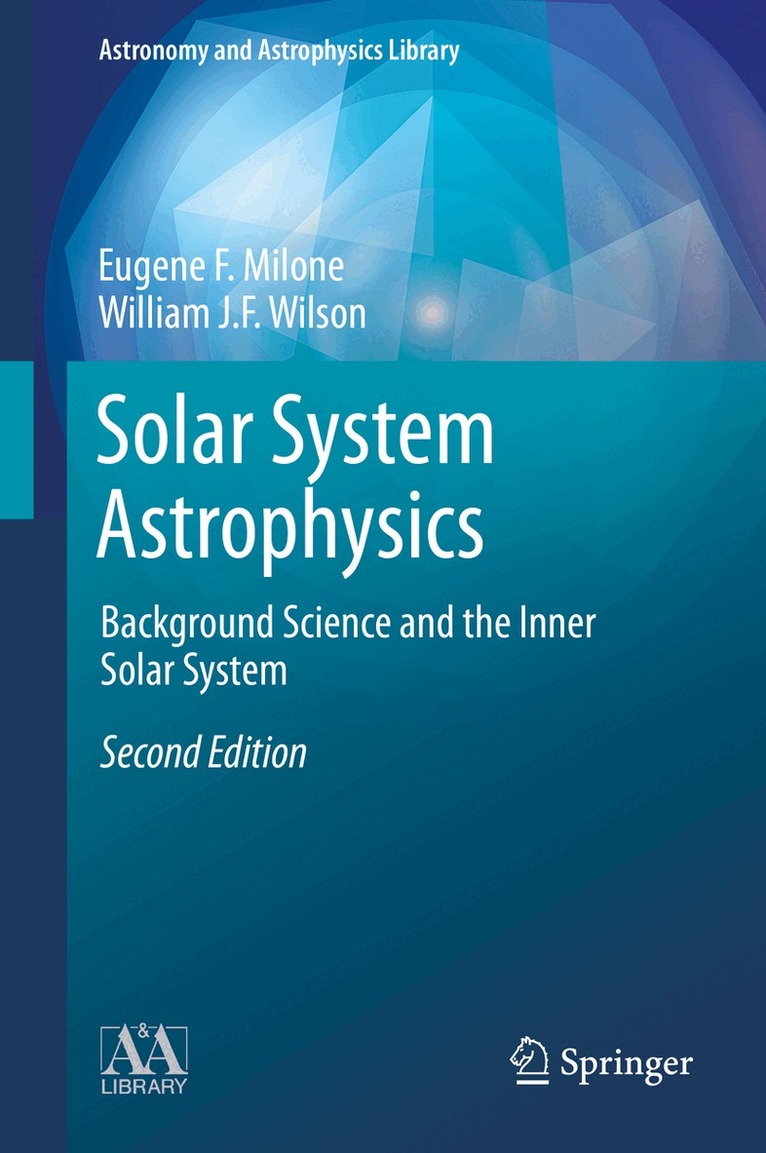
The second edition of Solar System Astrophysics: Background Science and the Inner Solar System provides new insights into the burgeoning field of planetary astronomy. As in the first edition, this volume begins with a rigorous treatment of coordinate frames, basic positional astronomy, and the celestial mechanics of two and restricted three body system problems. Perturbations are treated in the same way, with clear step-by-step derivations. Then the Earth's gravitational potential field and the Earth-Moon system are discussed, and the exposition turns to radiation properties with a chapter on the Sun. The exposition of the physical properties of the Moon and the terrestrial planets are greatly expanded, with much new information highlighted on the Moon, Mercury, Venus, and Mars.All of the material is presented within a framework of historical importance. This book and its sister volume, Solar System Astrophysics: Background Science and the Inner Solar system, are pedagogically well written, providing clearly illustrated explanations, for example, of such topics as the numerical integration of the Adams-Williamson equation, the equations of state in planetary interiors and atmospheres, Maxwell’s equations as applied to planetary ionospheres and magnetospheres, and the physics and chemistry of the Habitable Zone in planetary systems.Together, the volumes form a comprehensive text for any university course that aims to deal with all aspects of solar and extra-solar planetary systems. They will appeal separately to the intellectually curious who would like to know how just how far our knowledge of the solar system has progressed in recent years.
959 kr
Skickas inom 10-15 vardagar
The second edition of Solar System Astrophysics: Planetary Atmospheres and the Outer Solar System provides a timely update of our knowledge of planetary atmospheres and of the bodies of the outer solar system and their analogs in other planetary systems. This volume begins with an expanded treatment of the physics, chemistry, and meteorology of the atmospheres of the Earth, Venus, and Mars, moving on to their magnetospheres and then to a full discussion of the gas and ice giants and their properties. From here, attention switches to the small bodies of the solar system, beginning with the natural satellites. The comets, meteors, meteorites, and asteroids are discussed in order, and the volume concludes with the origin and evolution of our solar system. Finally, a fully revised section on extrasolar planetary systems puts the development of our system in a wider and increasingly well understood galactic context.All of the material is presented within a framework of historical importance. This book and its sister volume, Solar System Astrophysics: Background Science and the Inner Solar system, are pedagogically well written, providing clearly illustrated explanations, for example, of such topics as the numerical integration of the Adams-Williamson equation, the equations of state in planetary interiors and atmospheres, Maxwell’s equations as applied to planetary ionospheres and magnetospheres, and the physics and chemistry of the Habitable Zone in planetary systems. Together, the volumes form a comprehensive text for any university course that aims to deal with all aspects of solar and extra-solar planetary systems. They will appeal separately to the intellectually curious who would like to know how just how far our knowledge of the solar system has progressed in recent years.
536 kr
Skickas inom 10-15 vardagar
The second edition of Solar System Astrophysics: Background Science and the Inner Solar System provides new insights into the burgeoning field of planetary astronomy. As in the first edition, this volume begins with a rigorous treatment of coordinate frames, basic positional astronomy, and the celestial mechanics of two and restricted three body system problems. Perturbations are treated in the same way, with clear step-by-step derivations. Then the Earth's gravitational potential field and the Earth-Moon system are discussed, and the exposition turns to radiation properties with a chapter on the Sun. The exposition of the physical properties of the Moon and the terrestrial planets are greatly expanded, with much new information highlighted on the Moon, Mercury, Venus, and Mars.All of the material is presented within a framework of historical importance. This book and its sister volume, Solar System Astrophysics: Background Science and the Inner Solar system, are pedagogically well written, providing clearly illustrated explanations, for example, of such topics as the numerical integration of the Adams-Williamson equation, the equations of state in planetary interiors and atmospheres, Maxwell’s equations as applied to planetary ionospheres and magnetospheres, and the physics and chemistry of the Habitable Zone in planetary systems.Together, the volumes form a comprehensive text for any university course that aims to deal with all aspects of solar and extra-solar planetary systems. They will appeal separately to the intellectually curious who would like to know how just how far our knowledge of the solar system has progressed in recent years.
959 kr
Skickas inom 10-15 vardagar
The second edition of Solar System Astrophysics: Planetary Atmospheres and the Outer Solar System provides a timely update of our knowledge of planetary atmospheres and of the bodies of the outer solar system and their analogs in other planetary systems. This volume begins with an expanded treatment of the physics, chemistry, and meteorology of the atmospheres of the Earth, Venus, and Mars, moving on to their magnetospheres and then to a full discussion of the gas and ice giants and their properties. From here, attention switches to the small bodies of the solar system, beginning with the natural satellites. The comets, meteors, meteorites, and asteroids are discussed in order, and the volume concludes with the origin and evolution of our solar system. Finally, a fully revised section on extrasolar planetary systems puts the development of our system in a wider and increasingly well understood galactic context.All of the material is presented within a framework of historical importance. This book and its sister volume, Solar System Astrophysics: Background Science and the Inner Solar system, are pedagogically well written, providing clearly illustrated explanations, for example, of such topics as the numerical integration of the Adams-Williamson equation, the equations of state in planetary interiors and atmospheres, Maxwell’s equations as applied to planetary ionospheres and magnetospheres, and the physics and chemistry of the Habitable Zone in planetary systems. Together, the volumes form a comprehensive text for any university course that aims to deal with all aspects of solar and extra-solar planetary systems. They will appeal separately to the intellectually curious who would like to know how just how far our knowledge of the solar system has progressed in recent years.
Del 352 - Astrophysics and Space Science Library
Short-Period Binary Stars: Observations, Analyses, and Results
Häftad, Engelska, 2010
1 064 kr
Skickas inom 10-15 vardagar
Short-period binaries run the gamut from widely separated stars to black-hole pairs; in between are systems that include neutron stars and white dwarfs, and partially evolved systems such as tidally distorted and over-contact systems. These objects represent stages of evolution of binary stars, and their degrees of separation provide critical clues to how their evolutionary paths differ from that of single stars. The widest and least distorted systems provide astronomers with the essential precise data needed to study all stars: mass and radius. The interactions of binary star components, on the other hand, provide a natural laboratory to observe how the matter in these stars behaves under different and often varying physical conditions. Thus, cataclysmic variables with and without overpoweringly strong magnetic fields, and stars with densities from that found in the Sun to the degenerate matter of white dwarfs and the ultra-compact states of neutron stars and black holes are all discussed. The extensive index permits cross-referencing.