Eugenio Biagini - Böcker
Visar alla böcker från författaren Eugenio Biagini. Handla med fri frakt och snabb leverans.
5 produkter
5 produkter
504 kr
Skickas inom 10-15 vardagar
Gladstone focuses on the public side of the statesman's life and on those aspects of his private life - such as his religious beliefs and family life - which most affected his career. Besides reflecting the current state of the debate, this study draws on the author's own work in progress on various aspects of Victorian liberalism, including political charisma and nationalism. With its thematic approach, Dr Biagini's short, clear analysis offers an exciting introduction and a flexible teaching aid, with a guide to further reading.Gladstone focuses on the public side of the statesman's life and on those aspects of his private life - such as his religious beliefs and family life - which most affected his career. Besides reflecting the current state of the debate, this study draws on the author's own work in progress on various aspects of Victorian liberalism, including political charisma and nationalism. With its thematic approach, Dr Biagini's short, clear analysis offers an exciting introduction and a flexible teaching aid, with a guide to further reading.A new biographical study of the quintessential Victorian statesmanThe book has an unusual thematic approach making it easy to look up specific questionsUses a wide range of source material to shed light on Gladstone's life and work
1 096 kr
Kommande
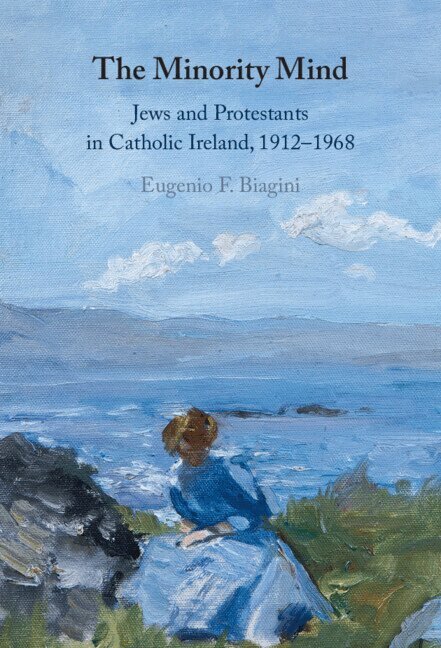
Partition was about minorities and their oppression - real or imagined, anticipated or remembered - which inspired a wide debate, still relevant today for the future of Northern Ireland. The partitionist assumptions - that a new nation-state required religious homogeneity and that minorities would be victimised - were rooted in historical experience and reflected contemporary political practice. This book illuminates the historical significance of religious minorities in southern Ireland at a time when the twenty-six Counties formed 'a Catholic state for a Catholic people'. Dragged into a process of nation building about which Jews and Protestants had serious reservations, they often felt like guests of an unappeasable host. Many emigrated, but those who stayed offered a critical contribution to civil society. Based on a wide range of primary sources, including recently discovered personal diaries, Eugenio F. Biagini's holistic account of the minority experience explains the role of entrenched diversity in shaping attitudes to civil rights and national identity.
373 kr
Skickas inom 7-10 vardagar
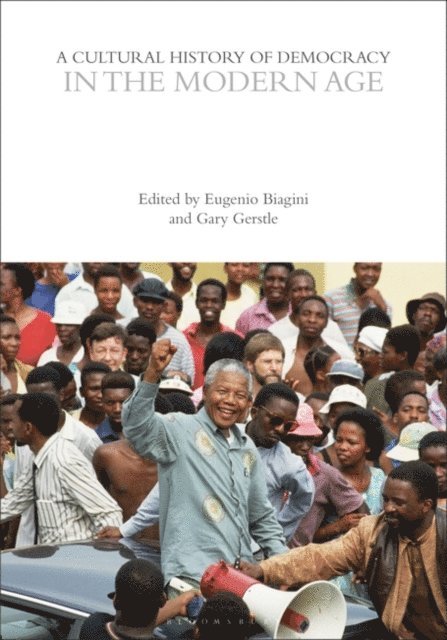
This volume explores democracy in the 20th century, examining the triumph, crises, recovery, and resilience of democracy and its associated cultures in this period.From 1920 democracy became the hegemonic discourse in political cultures, to the extent that even its enemies claimed its legacy. The end of empires ushered in an unprecedented globalization of democratic aspirations. Barriers of gender and race were gradually removed, and greater equality gave new meaning to citizenship. Yet, already in 1922 democracy was on its back foot with the rise of fascism. Even after the latter’s defeat in 1945, liberal democracy died wherever communist democracy triumphed. The situation changed again from 1989, but democratic hubris was then checked by the rise of a new enemy—populism. The paradox is that the century of democracy’s triumph was also that of its near final defeat, while the peace and stability that everybody desired and many expected as the outcome of the extension of democracy were, at best, intermittent and geographically limited.Each chapter takes a different theme as its focus: sovereignty; liberty and the rule of law; the “common good”; economic and social democracy; religion and the principles of political obligation; citizenship and gender; ethnicity, race, and nationalism; democratic crises, revolutions, and civil resistance; international relations; and democratic politics beyond the polis. These ten different approaches to democracy since 1920 offer a global, synoptic, and probing exploration of the subject.
2 223 kr
Skickas inom 7-10 vardagar
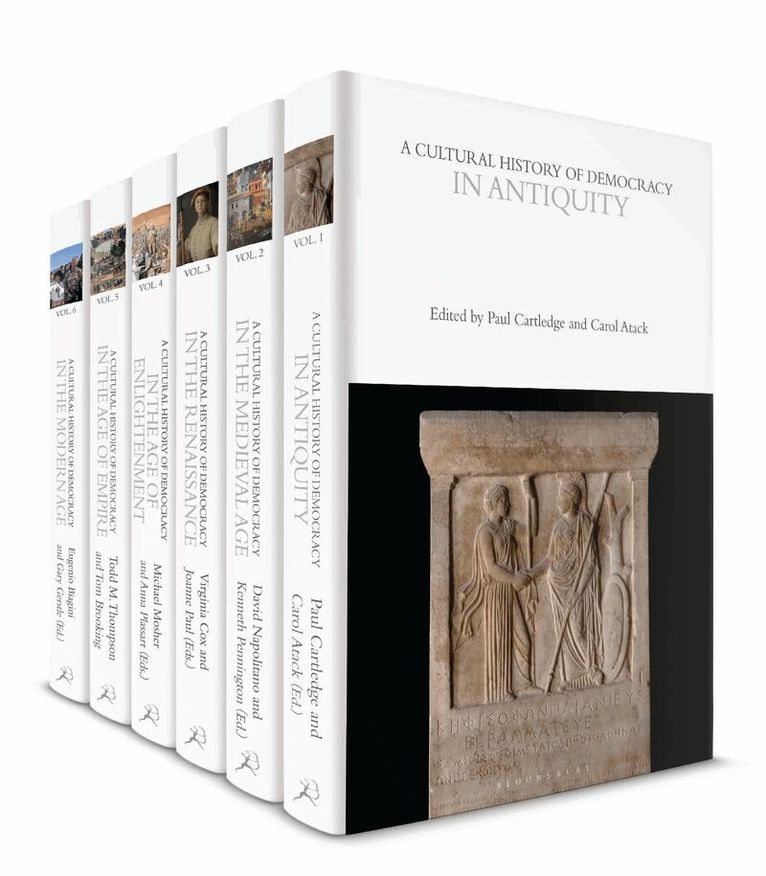
How has the concept of democracy been understood, manifested, reimagined and represented through the ages? In a work that spans 2,500 years these fundamental questions are addressed by 66 experts, each contributing their overview of a theme applied to a period in history. With the help of a broad range of case material they illustrate the physical, social and cultural contexts of democracy in Western culture from antiquity to the present.Individual volume editors ensure the cohesion of the whole, and to make it as easy as possible to use, chapter themes are identical across each of the volumes. Superbly illustrated, this paperback edition of the full six-volume set combines to present the most comprehensive and authoritative survey available on democracy throughout history.The six volumes cover: 1. Antiquity (500 BCE–565 CE); 2. Medieval Age (565–1450); 3. Renaissance (1450–1650); 4. Age of Enlightenment (1650–1800); 5. Age of Empire (1800–1920); 6. Modern Age (1920–present)Each volume discusses the same themes in its ten chapters: sovereignty; liberty; the ‘common good’; economic and social democracy; religion and the principles of political obligation; gender and citizenship; ethnicity, race and nationalism; democratic processes, revolutions and civil resistance; international relations; and expanding the polis, transforming sovereignty.The page extent for the pack is approximately 2016pp. The Cultural Histories SeriesA Cultural History of Democracy is part of The Cultural Histories Series. Titles are available as hardcover sets for libraries needing just one subject or preferring a tangible reference for their shelves or as part of a fully-searchable digital library. The digital product is available to institutions by annual subscription or on perpetual access via www.bloomsburyculturalhistory.com. Individual volumes for academics and researchers interested in specific historical periods are also available in print or digitally via www.bloomsburycollections.com.
Alfred Marshall’s Lectures to Women
Some Economic Questions Directly Connected to the Welfare of the Laborer
Inbunden, Engelska, 1995
1 962 kr
Skickas inom 7-10 vardagar
The Lectures to Women given by Alfred Marshall at Cambridge in 1873, which focus on the effects of working conditions on man's character and prospects, are unique in their content and purpose. They offer insight into a radical period in Marshall's life of which relatively little is known.This new critical edition makes the Lectures, which have sometimes been referred to by Marshallian scholars, available to a wider body of historians of economic thought. Based on Mary Paley Marshall's original notes, corrected by Marshall himself, the Lectures are supplemented by Marshall's lecture outlines. Some contemporary and related texts are also published here including a paper on the future of the working classes from the same year and Marshall's exchange of articles with the trade unionist John Holmes in 1874 known as the Bee-Hive debate. A contextualised commentary on the lectures is provided by Rita McWilliams Tullberg, Ernesto Biagini and Tiziano Raffaelli who adopt three lines of enquiry respectively: the lectures as part of the movement for higher education for women in the Victorian era, the lectures as indicative of Marshall's stand vis-a-vis the political-ideological framework of the time and the lectures as an indicator of Marshall's methodological tendencies concerning the study of social phenomena.