Evrim Tan – författare
Visar alla böcker från författaren Evrim Tan. Handla med fri frakt och snabb leverans.
5 produkter
5 produkter
Inbunden, Engelska, 2026
3 628 kr
Skickas inom 5-8 vardagar
This Handbook connects blockchain innovation with the discipline and practice of public governance. Drawing on the expertise and perspectives of diverse academic communities and practitioners, it provides insights on managing, utilizing, regulating, and governing blockchain in this context.Bridging the gap between theory and practice, chapters explore whether blockchain can truly transform public governance and under what conditions its adoption can be successful. It examines blockchain’s potential to enhance transparency, accountability, and efficiency in areas such as public finance, healthcare, education, identity management, and regulatory compliance. Contributors analyze both the opportunities and challenges of integrating blockchain into governance structures, addressing key managerial, regulatory, and technical considerations. Through real-world case studies, chapters investigate the specific institutional, technological, and organizational conditions required for meaningful impact. They detail a roadmap for leveraging blockchain effectively in public governance, ultimately helping decision-makers to navigate its complexities and maximize its potential.Multidisciplinary in scope, this Handbook is a crucial resource for scholars and students of public policy, innovation and technology, and governance. It is also a beneficial read for policymakers and practitioners in public administration and management for its discussion of the pressing policy challenges associated with the use of blockchain in the public sector.
E-bok
PDF, Engelska, 2026855 kr
Läs direkt efter köp
This Handbook connects blockchain innovation with the discipline and practice of public governance. Drawing on the expertise and perspectives of diverse academic communities and practitioners, it provides insights on managing, utilizing, regulating, and governing blockchain in this context.Bridging the gap between theory and practice, chapters explore whether blockchain can truly transform public governance and under what conditions its adoption can be successful. It examines blockchain's potential to enhance transparency, accountability, and efficiency in areas such as public finance, healthcare, education, identity management, and regulatory compliance. Contributors analyze both the opportunities and challenges of integrating blockchain into governance structures, addressing key managerial, regulatory, and technical considerations. Through real-world case studies, chapters investigate the specific institutional, technological, and organizational conditions required for meaningful impact. They detail a roadmap for leveraging blockchain effectively in public governance, ultimately helping decision-makers to navigate its complexities and maximize its potential.Multidisciplinary in scope, this Handbook is a crucial resource for scholars and students of public policy, innovation and technology, and governance. It is also a beneficial read for policymakers and practitioners in public administration and management for its discussion of the pressing policy challenges associated with the use of blockchain in the public sector.
E-bok
Engelska, 2026855 kr
Läs direkt efter köp
This Handbook connects blockchain innovation with the discipline and practice of public governance. Drawing on the expertise and perspectives of diverse academic communities and practitioners, it provides insights on managing, utilizing, regulating, and governing blockchain in this context.Bridging the gap between theory and practice, chapters explore whether blockchain can truly transform public governance and under what conditions its adoption can be successful. It examines blockchain's potential to enhance transparency, accountability, and efficiency in areas such as public finance, healthcare, education, identity management, and regulatory compliance. Contributors analyze both the opportunities and challenges of integrating blockchain into governance structures, addressing key managerial, regulatory, and technical considerations. Through real-world case studies, chapters investigate the specific institutional, technological, and organizational conditions required for meaningful impact. They detail a roadmap for leveraging blockchain effectively in public governance, ultimately helping decision-makers to navigate its complexities and maximize its potential.Multidisciplinary in scope, this Handbook is a crucial resource for scholars and students of public policy, innovation and technology, and governance. It is also a beneficial read for policymakers and practitioners in public administration and management for its discussion of the pressing policy challenges associated with the use of blockchain in the public sector.
Inbunden, Engelska, 2018
814 kr
Skickas inom 10-15 vardagar
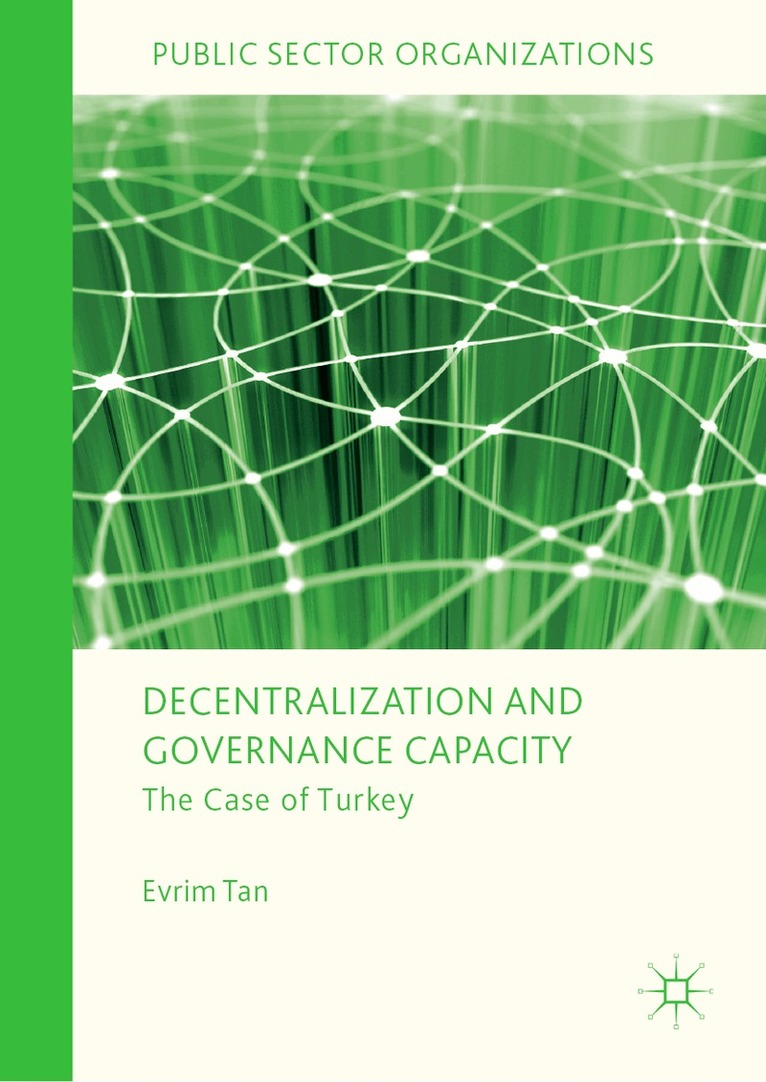
It is widely assumed that the relationship between governance capacity and decentralization determines the success in governance, but how does this relationship function is largely contested. Does decentralization lead to an improvement in governance capacities, or are certain capacities preconditioned in order for decentralization to lead better governance? Relying on an empirical study of Turkish provincial municipalities, the book argues success in decentralization is strongly influenced by the socioeconomic conditions in the province and to a lesser extent by the local government’s capacity. The book provides a novel approach to capacity building practices and decentralization reforms by suggesting that the relationship between decentralization and governance capacity should be addressed not only on the organizational but also on the developmental level. In this way, the book proposes asymmetrical decentralization according to socio-economic development at subnational level for better governance outcomes.
E-bok
Engelska, 20181 029 kr
Läs direkt efter köp
It is widely assumed that the relationship between governance capacity and decentralization determines the success in governance, but how does this relationship function is largely contested. Does decentralization lead to an improvement in governance capacities, or are certain capacities preconditioned in order for decentralization to lead better governance? Relying on an empirical study of Turkish provincial municipalities, the book argues success in decentralization is strongly influenced by the socioeconomic conditions in the province and to a lesser extent by the local government’s capacity. The book provides a novel approach to capacity building practices and decentralization reforms by suggesting that the relationship between decentralization and governance capacity should be addressed not only on the organizational but also on the developmental level. In this way, the book proposes asymmetrical decentralization according to socio-economic development at subnational level for better governance outcomes.