Ezra N. Suleiman - Böcker
Visar alla böcker från författaren Ezra N. Suleiman. Handla med fri frakt och snabb leverans.
9 produkter
9 produkter
2 155 kr
Skickas inom 10-15 vardagar
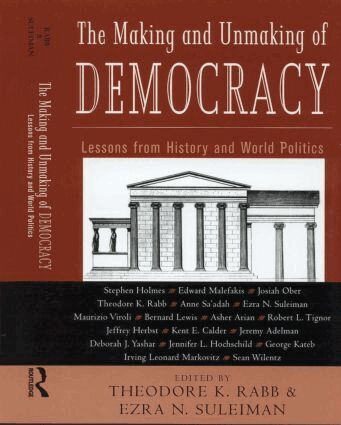
For every citizen of the world, there is no more urgent issue than the spread of democracy. Democracy is what the WTO-protestors are calling for; it's the main concern of human rights advocates; and it's only long-term way to end terrorism. But how does democracy spread? What can be done to encourage and support. This remarkable new collection brings together some of the best minds in variety of fields to discuss the conditions that promote and sustain, or undermine and extinguish democratic institutions and ideas. Spanning political thought from ancient Athens to contemporary sub-Saharan Africa, the contributors develop an outline of how democracy develops. Several key factors emerge: Democratic transitions are always heavily shaped by the ideas and practices of past regimes (like tribal traditions in Africa), international political and economic pressure to liberalize (as in Asia) and current economic conditions. The quality of democracy is almost always improved by the elimination of religion as the center of the state, by the move from democracy as protection of the individual from the state to democracy as enhancer of rights, and by the progression from a focus on the individual to a focus on the community. Expansive in its coverage and fundamental in its significance, The Making and Unmaking of Democracy is a volume to learn from, argue against, and expand upon.
820 kr
Skickas inom 10-15 vardagar
For every citizen of the world, there is no more urgent issue than the spread of democracy. Democracy is what the WTO-protestors are calling for; it's the main concern of human rights advocates; and it's only long-term way to end terrorism. But how does democracy spread? What can be done to encourage and support. This remarkable new collection brings together some of the best minds in variety of fields to discuss the conditions that promote and sustain, or undermine and extinguish democratic institutions and ideas. Spanning political thought from ancient Athens to contemporary sub-Saharan Africa, the contributors develop an outline of how democracy develops. Several key factors emerge: Democratic transitions are always heavily shaped by the ideas and practices of past regimes (like tribal traditions in Africa), international political and economic pressure to liberalize (as in Asia) and current economic conditions. The quality of democracy is almost always improved by the elimination of religion as the center of the state, by the move from democracy as protection of the individual from the state to democracy as enhancer of rights, and by the progression from a focus on the individual to a focus on the community. Expansive in its coverage and fundamental in its significance, The Making and Unmaking of Democracy is a volume to learn from, argue against, and expand upon.
377 kr
Skickas inom 7-10 vardagar
Bureaucracy is a much-maligned feature of contemporary government. And yet the aftermath of September 11 has opened the door to a reassessment of the role of a skilled civil service in the survival and viability of democratic society. Here, Ezra Suleiman offers a timely and powerful corrective to the widespread view that bureaucracy is the source of democracy's ills. This is a book as much about good governance as it is about bureaucratic organizations. Suleiman asks: Is democratic governance hindered without an effective instrument in the hands of the legitimately elected political leadership? Is a professional bureaucracy required for developing but not for maintaining a democratic state? Why has a reform movement arisen in recent years championing the gradual dismantling of bureaucracy, and what are the consequences? Suleiman undertakes a comparative analysis of the drive toward a civil service grounded in the New Public Management. He argues that "government reinvention" has limited bureaucracy's capacity to adequately serve the public good.All bureaucracies have been under political pressure in recent years to reduce not only their size but also their effectiveness, and all have experienced growing deprofessionalism and politicization. He compares the impact of this evolution in both democratic societies and societies struggling to consolidate democratic institutions. Dismantling Democratic States cautions that our failure to acknowledge the role of an effective bureaucracy in building and preserving democratic political systems threatens the survival of democracy itself.
1 041 kr
Skickas inom 3-6 vardagar
By examining the relationship between the notaires, members of a significant French legal profession with deep roots in French history, and the state, Ezra Suleiman demonstrates that clientelism exists and may be more dangerous in a centralized state than in a decentralized one. Originally published in 1988. The Princeton Legacy Library uses the latest print-on-demand technology to again make available previously out-of-print books from the distinguished backlist of Princeton University Press. These editions preserve the original texts of these important books while presenting them in durable paperback and hardcover editions. The goal of the Princeton Legacy Library is to vastly increase access to the rich scholarly heritage found in the thousands of books published by Princeton University Press since its founding in 1905.
477 kr
Skickas inom 7-10 vardagar
Why do some elites survive while others do not? How do certain institutions manage to preserve their importance in the face of crises, instability, and change? How does a democratic society legitimize elitist institutions? Combining the use of important social theories--particularly those of Mosca, Schumpeter, Tocqueville, and Pareto--with empirical analysis, Ezra Suleiman tries to answer these questions in his examination of the dominance and stability of France's governing elites. The author draws on original survey data, historical evidence, and specialized documentary sources. His three part discussion deals, first, with the state institutions that nurture the French elite; second, with the organization, legitimization, and adaptation of the elite and its institutions; and third, with some of the policy and political implications of France's elitist system. In the final section of his book, he closely examines the relationship between elites in the public and private sectors.In his investigation of France's "state-created" elites, Professor Suleiman shows the great importance of the grandes ecoles in training and promoting the elites, and the grand corps in providing a base from which the elites launch themselves into extra-governmental careers. He also finds that the elites' capacity to adapt to an evolving social, political, and economic environment is a major factor in their ability to survive. Originally published in 1979. The Princeton Legacy Library uses the latest print-on-demand technology to again make available previously out-of-print books from the distinguished backlist of Princeton University Press. These editions preserve the original texts of these important books while presenting them in durable paperback and hardcover editions. The goal of the Princeton Legacy Library is to vastly increase access to the rich scholarly heritage found in the thousands of books published by Princeton University Press since its founding in 1905.
1 261 kr
Skickas inom 3-6 vardagar
The interaction between politics and administration has generally been ignored by students of bureaucracy. Ezra N. Suleiman, however, views the French bureaucracy as a dynamic and integral part of the French political system. Using survey data as well as historical and contemporary sources, he concentrates on the highest officials and examines their relationships with both the political sector and the society. After identifying the place of the state in French society the author deals with the recruitment of higher civil servants, using comparative data to explain why the high social origins of French civil servants have remained constant. His investigation of the important institutional mechanisms of the central administration stresses that even a centralized and powerful bureaucracy must be seen as a complex of institutions rather than as a monolithic organization. Finally the author deals with the relations of the higher civil servants with other groups in society and with the regime of the Fifth Republic. Originally published in 1974.The Princeton Legacy Library uses the latest print-on-demand technology to again make available previously out-of-print books from the distinguished backlist of Princeton University Press. These editions preserve the original texts of these important books while presenting them in durable paperback and hardcover editions. The goal of the Princeton Legacy Library is to vastly increase access to the rich scholarly heritage found in the thousands of books published by Princeton University Press since its founding in 1905.
2 643 kr
Skickas inom 3-6 vardagar
By examining the relationship between the notaires, members of a significant French legal profession with deep roots in French history, and the state, Ezra Suleiman demonstrates that clientelism exists and may be more dangerous in a centralized state than in a decentralized one. Originally published in 1988. The Princeton Legacy Library uses the latest print-on-demand technology to again make available previously out-of-print books from the distinguished backlist of Princeton University Press. These editions preserve the original texts of these important books while presenting them in durable paperback and hardcover editions. The goal of the Princeton Legacy Library is to vastly increase access to the rich scholarly heritage found in the thousands of books published by Princeton University Press since its founding in 1905.
2 271 kr
Skickas inom 3-6 vardagar
Why do some elites survive while others do not? How do certain institutions manage to preserve their importance in the face of crises, instability, and change? How does a democratic society legitimize elitist institutions? Combining the use of important social theories--particularly those of Mosca, Schumpeter, Tocqueville, and Pareto--with empirical analysis, Ezra Suleiman tries to answer these questions in his examination of the dominance and stability of France's governing elites. The author draws on original survey data, historical evidence, and specialized documentary sources. His three part discussion deals, first, with the state institutions that nurture the French elite; second, with the organization, legitimization, and adaptation of the elite and its institutions; and third, with some of the policy and political implications of France's elitist system. In the final section of his book, he closely examines the relationship between elites in the public and private sectors.In his investigation of France's "state-created" elites, Professor Suleiman shows the great importance of the grandes ecoles in training and promoting the elites, and the grand corps in providing a base from which the elites launch themselves into extra-governmental careers. He also finds that the elites' capacity to adapt to an evolving social, political, and economic environment is a major factor in their ability to survive. Originally published in 1979. The Princeton Legacy Library uses the latest print-on-demand technology to again make available previously out-of-print books from the distinguished backlist of Princeton University Press. These editions preserve the original texts of these important books while presenting them in durable paperback and hardcover editions. The goal of the Princeton Legacy Library is to vastly increase access to the rich scholarly heritage found in the thousands of books published by Princeton University Press since its founding in 1905.
2 997 kr
Skickas inom 3-6 vardagar
The interaction between politics and administration has generally been ignored by students of bureaucracy. Ezra N. Suleiman, however, views the French bureaucracy as a dynamic and integral part of the French political system. Using survey data as well as historical and contemporary sources, he concentrates on the highest officials and examines their relationships with both the political sector and the society. After identifying the place of the state in French society the author deals with the recruitment of higher civil servants, using comparative data to explain why the high social origins of French civil servants have remained constant. His investigation of the important institutional mechanisms of the central administration stresses that even a centralized and powerful bureaucracy must be seen as a complex of institutions rather than as a monolithic organization. Finally the author deals with the relations of the higher civil servants with other groups in society and with the regime of the Fifth Republic. Originally published in 1974.The Princeton Legacy Library uses the latest print-on-demand technology to again make available previously out-of-print books from the distinguished backlist of Princeton University Press. These editions preserve the original texts of these important books while presenting them in durable paperback and hardcover editions. The goal of the Princeton Legacy Library is to vastly increase access to the rich scholarly heritage found in the thousands of books published by Princeton University Press since its founding in 1905.