F Flagg Taylor – författare
Visar alla böcker från författaren . Handla med fri frakt och snabb leverans.
3 produkter
3 produkter
Inbunden, Engelska, 2014
507 kr
Skickas inom 3-6 vardagar
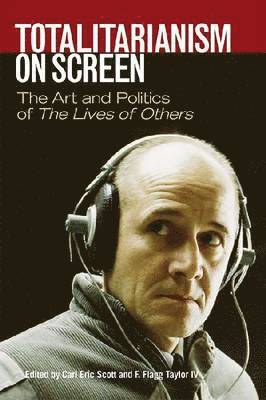
From its creation in 1950, to the fall of the Berlin Wall in 1989, the German Democratic Republic's Ministry for State Security closely monitored its nation's citizens. Known as the Staatssicherheit or Stasi, this organization was regarded as one of the most repressive intelligence agencies in the world. Florian Henckel von Donnersmarck's 2006 film The Lives of Others ( Das Leben der Anderen) has received international acclaim -- including an Academy Award, an Independent Spirit Award, and multiple German Film Awards -- for its moving portrayal of East German life under the pervasive surveillance of the Stasi.In Totalitarianism on Screen, political theorists Carl Eric Scott and F. Flagg Taylor IV assemble top scholars to analyze the film from philosophical and political perspectives. Their essays confront the nature and legacy of East Germany's totalitarian government and outline the reasons why such regimes endure.Other than magazine and newspaper reviews, little has been written about The Lives of Others. This volume brings German scholarship on the topic to an English-speaking audience for the first time and explores the issue of government surveillance at a time when the subject is often front-page news. Featuring contributions from German president Joachim Gauck, prominent singer-songwriter Wolf Biermann, journalists Paul Hockenos and Lauren Weiner, and noted scholars Paul Cantor and James Pontuso, Totalitarianism on Screen contributes to the growing scholarship on totalitarianism and will interest historians, political theorists, philosophers, and fans of the film.
Inbunden, Engelska, 2018
294 kr
Skickas inom 5-8 vardagar
E-bok
Engelska, 2023195 kr
Läs direkt efter köp
The Most Insightful and Profound Reflections on Tyranny.Totalitarianism was the dominant phenomenon of the twentieth century. Deeply troubling questions endure regarding the nature of such tyrannical regimes: What enabled human beings to carry out such horrific crimes against their fellow man? What does the endurance of Communism reveal about human liberty? Why did human beings suffer rule by ideological lies for so long, and what kept them open to the truth? What are we to make of the relationship between totalitarianism and the foundational principles of democratic modernity?Some of the greatest minds of the twentieth century sought answers to these haunting questions. Now, for the first time ever, their incisive and profound reflections on totalitarianism have been brought together in one book. The Great Lie showcases the insights of such giants as Aleksandr Solzhenitsyn, Vaclav Havel, Hannah Arendt, Eric Voegelin, Czeslaw Milosz, Leo Strauss, and Raymond Aron, along with neglected but important thinkers such as Waldemar Gurian, Aurel Kolnai, Leszek Kolakowski, Pierre Manent, Claude Lefort, and Chantal Delsol.The brilliant essays in this volume illuminate the very nature of totalitarian regimes, and the monstrous ideology that is their defining feature. The Great Lie allows readers to make sense of political evil and how it can attract so many people into its ideological fold. This is not a matter of mere academic interest in an age when we confront totalitarianism in such regimes as North Korea and Cuba—and, arguably, in radical Islamist movements.